In Vietnam, You Can Live Without a Partner but Not Without a Motorbike
Vietnam has nearly 80 million motorcycles for 100 million people. The motorbike is not just transport -- it is a way of life.
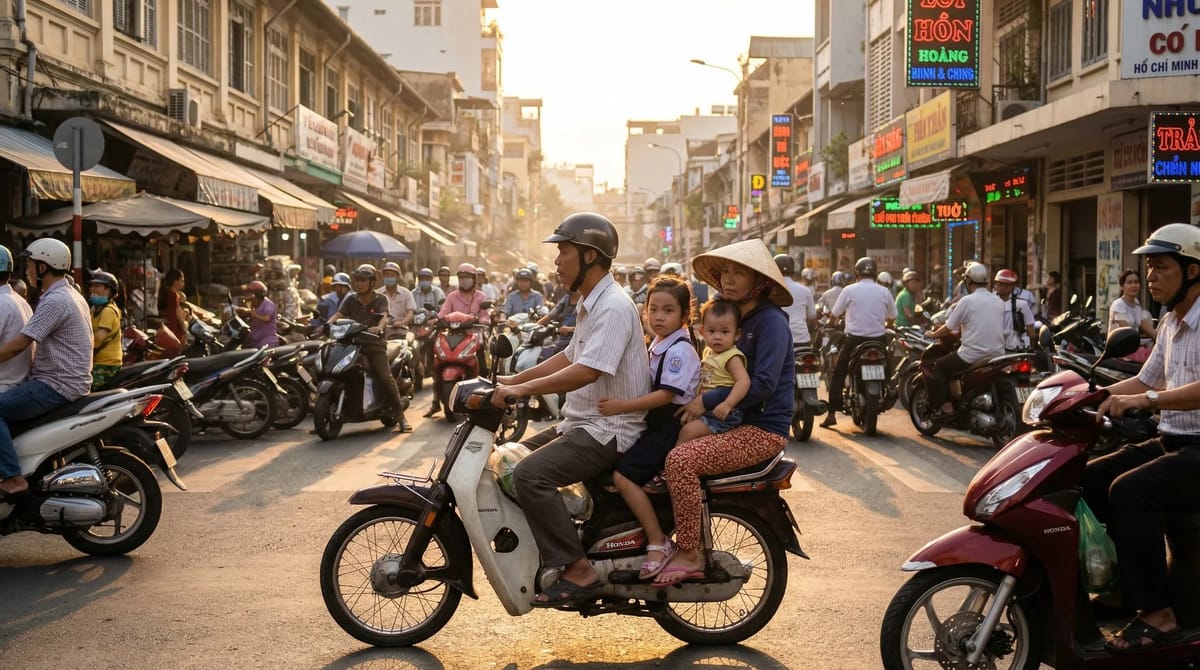
There is a saying in Vietnam: you can live without a partner, but you cannot live without a motorbike.
This is not a joke. The country has nearly 100 million people and almost 80 million registered motorcycles. That works out to roughly one bike for every two people. More than 80% of households own at least one. Many own three or four.
Here, the motorcycle is not just transportation. It is life itself.
One Bike, One Family
If you have ever visited Vietnam, you have seen this: a father, a mother, two children -- all on a single motorcycle. Sometimes a dog is squeezed in. Sometimes it is bags of groceries. Foreigners stare. For Vietnamese, it is just another Tuesday.
The motorbike is the family workhorse. School runs, grocery trips, the long ride home for Tet -- everything happens on two wheels. On weekend evenings, young couples cruise through the city on casual dates. During Lunar New Year, entire families ride for hours to reach relatives in the countryside.
The Mobile Storefront
Walk any street in Vietnam and you will see loads that defy physics: three-tier egg crates, a small forest of potted plants, cargo stacked taller than the rider, live animals. All balanced on a single motorcycle.
For millions of Vietnamese, the motorbike is a mobile truck. Street vendors load up their entire inventory, ride to where the customers are, and set up shop on the sidewalk. No rent. No lease. Just a bike and some goods, and you are in business.
Grab delivery riders have become one of the most common sights in recent years. Full-time GrabBike drivers earn roughly VND 5 to 8 million a month after costs -- about USD 200 to 320. The entry barrier is low: a bike and a phone. For many, it is a lifeline.
What You Ride Says Something
In Vietnam, your motorcycle can signal your style and your wallet.
The Honda SH and Vespa sit at the premium end, priced well above the average. Some owners keep different bikes for different occasions -- a basic scooter for the daily commute, a flashier model when appearances matter.
Auspicious Days and New Year Washes
Buying a new motorcycle is a serious occasion. Many families consult the calendar for a lucky day to bring the bike home, then hold a small ceremony to thank the spirits and pray for safe travels.
Before Lunar New Year, every motorcycle gets a thorough wash. Lines at wash shops stretch around the block. Prices double or triple. Nobody complains. The belief is firm: washing your vehicle during the first three days of the New Year washes away your luck. So it must be done beforehand.
These rituals reveal the motorcycle's true status in Vietnamese life. It is not just a consumer product. It is a family asset, deserving of respect.
Sixty-Fold Growth in Three Decades
Vietnam had 1.2 million motorcycles in 1990. Today the number is close to 80 million -- a more than sixty-fold increase in just over thirty years.
The Vietnam Association of Motorcycle Manufacturers (VAMM) reported over 2.6 million units sold in 2024. That is five bikes sold every minute. Honda commands 80% of the market, but electric models are gaining ground fast. VinFast's motorcycle sales more than tripled, pushing the company into third place.
The motorcycle's cultural meaning has shifted too. Thirty years ago, owning one was a status symbol. Today, it is the default. Not having one is the oddity.
A Life on Two Wheels
Carried home from the hospital as a newborn. Dropped off at school every morning. Riding to work as an adult. Picking up grandchildren decades later. A Vietnamese person's life unfolds on the back of a motorcycle.
The bike mirrors the national character: nimble, practical, endlessly adaptable. No matter how narrow the alley or dense the traffic, there is always a way forward.
No wonder the Vietnamese say: you can live without a partner, but you truly cannot live without a motorbike.
Sources: VAMM, VnExpress, VietnamNet, Vietcetera, CNA, Tuoi Tre