From Street Vendors to Billion-Dong Jackpots: Inside Vietnam's Lottery Industry
Vietnam's USD 6.5 billion lottery industry runs on two parallel systems -- computerized Vietlott and street-corner vé số tickets sold by half a million vendors.
Last night, Vietnam's Vietlott computerized lottery drew a jackpot worth VND 257 billion -- roughly USD 10 million. It was the second-largest prize in Vietnamese lottery history, behind only the VND 345 billion jackpot from last July.
But these overnight-fortune stories are just the surface. Beneath them lies an industry with a far more complicated face.
Bigger Than the Public Security Budget
In 2024, Vietnamese spent a combined USD 6.5 billion on lottery tickets. For context, that is roughly equal to the entire annual budget of Vietnam's Ministry of Public Security.
The industry has grown about 10% per year over the past five years, contributing more than VND 206 trillion to government coffers -- about 2.5% of national revenue.
In some southern provinces, lottery income is the backbone of local finances. In Soc Trang Province, the local lottery company accounts for 40% of all provincial revenue. In Bac Lieu Province, lottery income exceeds the province's total tax collection.
Two Systems, Two Worlds
Vietnam runs two completely different lottery systems.
The first is the "construction lottery" -- the kind you see on every street corner. Operated by the 63 provincial governments, each ticket costs VND 10,000 (about USD 0.40). Numbers are pre-printed; you pick from what is available. Drawings happen daily at 4 p.m., with a fixed top prize of VND 2 billion.
The second is Vietlott, a computerized lottery introduced in 2011. It works like a Western-style lotto: pick your own numbers, buy via a mobile app, and the jackpot rolls over until someone wins. The VND 257 billion prize came from this system.
Half a Million People Sell Tickets for a Living
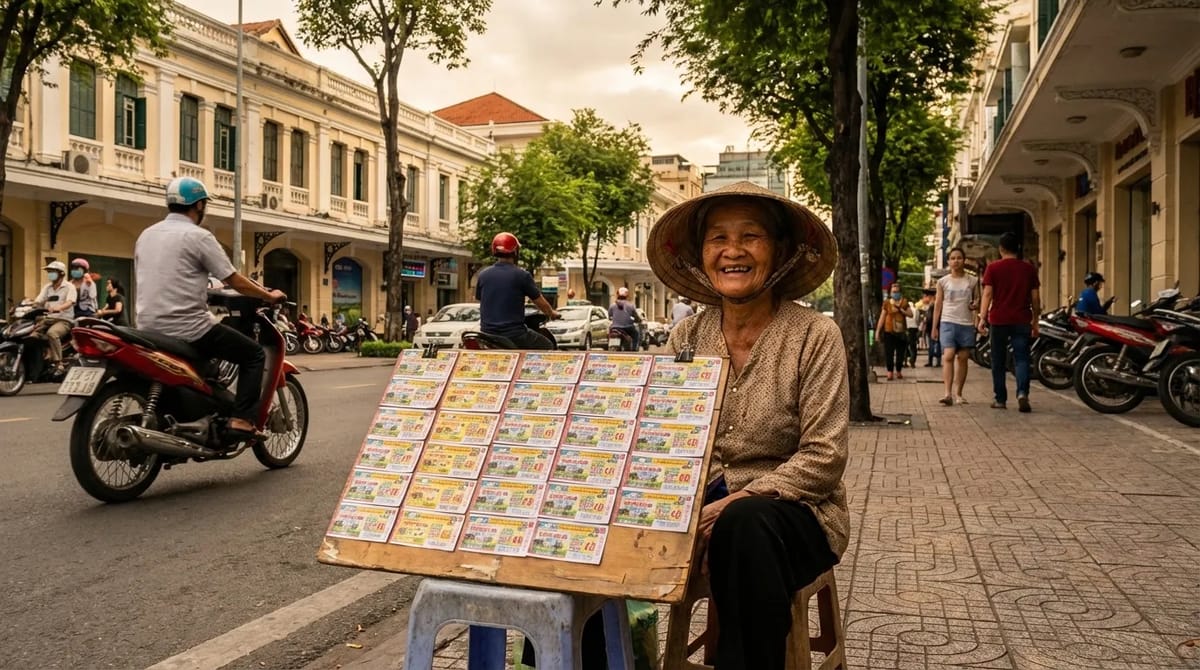
Walk any street in Vietnam and you will spot them: men and women in conical hats, clutching a fistful of lottery tickets, weaving between restaurant tables and cafe chairs.
There are roughly 500,000 of them. Most are elderly or disabled. They have no labor contracts, no health insurance, no safety net of any kind.
Each ticket sells for VND 10,000. The vendor's cut is 10% to 12% -- about VND 1,000 to 1,200 per ticket. Selling 200 tickets in a day brings in around VND 240,000, less than USD 10.
If tickets go unsold, the vendor absorbs the loss. "Since they increased the supply, I still only get 200 tickets a day," one vendor told local media. "Whatever I don't sell, I eat the cost."
The contrast is stark. Staff at lottery companies earn comfortable salaries. Employees at the Hau Giang Province lottery company average VND 43 million a month (about USD 1,700). In Binh Phuoc Province, the figure is VND 33 million (about USD 1,300).
Same industry. Two entirely different realities.
A History Stretching Back to French Colonial Rule
Vietnam's lottery traces its roots to the late 19th century. In 1883, St. Joseph's Cathedral in Hanoi held a lottery to raise funds for renovations.
In 1935, the French colonial government established the "Indochina Lottery," covering Vietnam, Cambodia, and Laos. The tickets were printed in French, Vietnamese, Chinese, and Khmer.
After reunification in 1975, the government took over and rebranded the system as the "construction lottery," with revenues directed toward local infrastructure. When Vietlott launched in 2011, the two systems began running in parallel -- and still do today.
A Ladder Out of Poverty, or a Trap?
The official name -- "construction lottery" -- implies the money funds public projects. And it does. But the people buying and selling lottery tickets are overwhelmingly from lower-income groups.
Research shows that residents of less-developed areas like the Mekong Delta spend a disproportionate share of their income on lottery tickets. The poorer the region, the higher the sales.
Lottery company employees earn VND 33 to 43 million a month. Street vendors earn under VND 240,000 a day. One industry, two worlds.
Jackpot Skeptics
Vietlott has not been without controversy.
Every time a major jackpot is claimed, a wave of amateur detective work erupts online. Winners collect their prizes wearing masks -- legally required to protect their identity. Some netizens have noticed that different winners appear to wear identical masks. Others have compared shoes, claiming they match those of lottery shop owners. Conspiracy theories follow: Vietlott controls the software and the printers, so what stops them from printing a winning ticket after the draw and backdating it?
In 2016, a real incident fueled the suspicion. Someone screenshotted the Vietlott website showing a winning announcement posted at noon -- but the draw did not take place until 6 p.m. The company blamed a software glitch. The public was not convinced.
Vietlott's official position: the masks comply with privacy law, all winners' information is verified by police, and award ceremonies are witnessed by the Ministry of Finance and accredited journalists.
Sources: Vietlott, VnExpress, Tuoi Tre, Thanh Nien, Vietnam Ministry of Finance