Vietnam Just Made Southeast Asia's Biggest Oil Discovery in Two Decades
An offshore field called Hải Sư Vàng holds over 400 million barrels of recoverable oil — the third-largest Southeast Asian discovery this century. It arrives just as Vietnam's output has been in freefall.
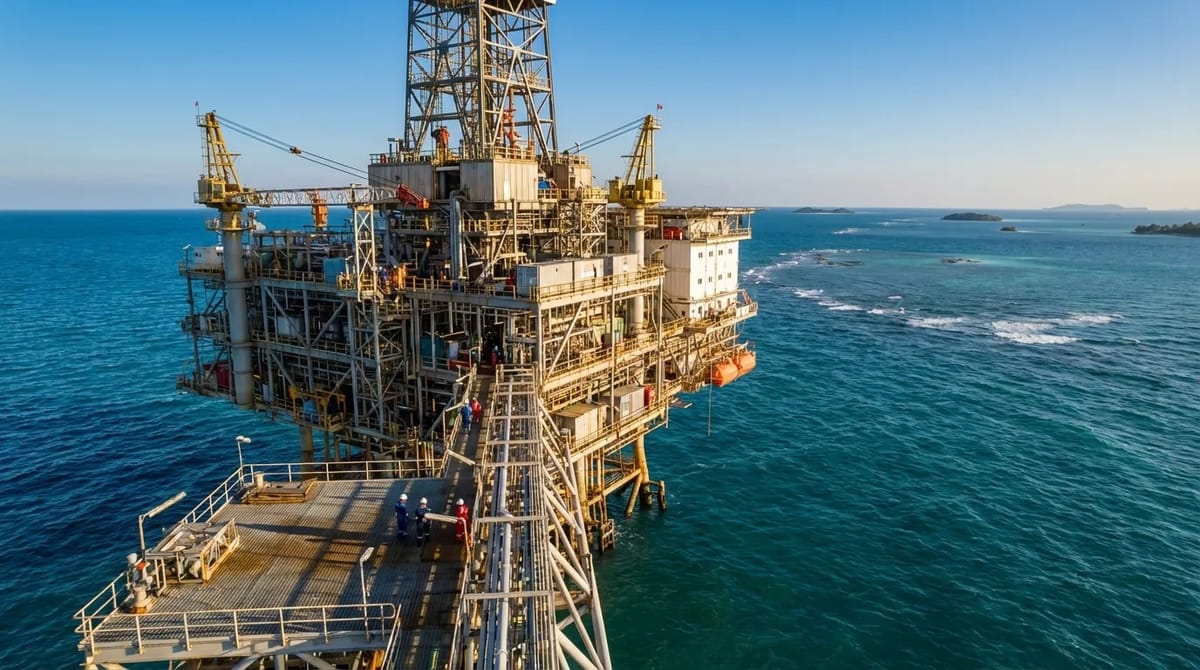
In late January 2026, Vietnam's Ministry of Industry and Trade confirmed what the energy industry had been watching closely: an offshore oil field in the Cửu Long Basin, explored over the past year, holds major commercial potential.
The field is Hải Sư Vàng — Golden Sea Lion — sitting in Block 15-2/17, about 64 kilometers off the coast. Energy consultancy Wood Mackenzie ranks it the third-largest oil discovery in Southeast Asia since 2000, behind only Indonesia's Banyu Urip and Malaysia's Gumusut.
Two Wells, One Big Answer
U.S.-based Murphy Oil drilled the first exploration well, HSV-1X, in January 2025. It went down about 4,000 meters and hit roughly 113 meters of net oil pay across two reservoir zones. The market noticed. But the second well told the real story.
HSV-2X, drilled in October 2025, came back even stronger: 131 meters of net oil pay — 101 meters in the deep main reservoir, 30 in a shallower zone. Flow tests delivered 6,000 barrels per day of light crude at 37 degrees API. Good oil, good volume.
Murphy updated its estimates. Mid-case recoverable resources for the main reservoir now sit near the top of the earlier 170-to-430-million-barrel range. Add the shallow reservoir — not yet formally booked — and total resources likely exceed 430 million barrels. The oil column stretches about 488 meters.
Arriving at Exactly the Right Moment
Vietnam needed this. Crude output has been sliding for twenty years — from around 365,000 barrels per day in 2005 to under 120,000 in 2025. Old fields drying up, new exploration stalled. Between 2016 and 2020, the country signed just three new oil and gas contracts, down about sevenfold from the prior five years.
Hải Sư Vàng is the first credible shot at reversing the decline. Vietnam's 2024 crude production hit 9.87 million tons, beating the annual target by about 20%. That year also saw three new discoveries — the most in a decade. But a meaningful rebound in national output won't come until 2027 or later, once this field and others start producing.
The Partners
Murphy Oil holds 40% and operates the field. PVEP, a subsidiary of state-owned PetroVietnam, has 35%. South Korea's SK Earthon takes the remaining 25%.
Deputy Minister Nguyễn Sinh Nhật Tân called the discovery "very positive" at a January press briefing and said the government would support a full evaluation. Under Vietnamese rules, developers need to drill more appraisal wells and submit a detailed resource report before they can move to production.
Murphy has wells HSV-3X and HSV-4X scheduled for 2026, with a full-year capital budget of USD 1.1 to 1.3 billion.
When Will Oil Flow?
Not immediately. In the same Cửu Long Basin, Murphy's smaller project Lạc Đà Vàng (Golden Camel) should start producing in Q4 2026 — the company's first producing asset in Vietnam. Hải Sư Vàng is bigger and more complex. Full production isn't expected until around 2029.
Whether this field gets developed smoothly will shape Vietnam's energy map for the next decade.