Vietnam's Stock Market Is About to Graduate — and Billions in Capital Will Follow
Seven years on the watch list. 28 stocks. Billions in passive capital. Vietnam's stock market upgrade from frontier to emerging status is down to the final checkpoint.

On February 5, 2026, the Vietnam Stock Exchange sat down with FTSE Russell to go over the upgrade roadmap. The March interim review — now less than two months away — will determine whether Vietnam stays on track to move from frontier to emerging market status in September.
Billions of dollars in international capital hang on the outcome.
Seven Years of "Not Yet"
FTSE Russell put Vietnam on its upgrade watch list in September 2018. The signal was clear: potential to move up, but not ready.
For seven years after that, every semi-annual review brought the same question and the same answer. Not yet.
The sticking point was a rule that made institutional investors cringe. To buy Vietnamese stocks, foreigners had to park 100% of the transaction value upfront — a requirement almost no other major market imposes. Capital locked up, zero flexibility. FTSE Russell called it the key barrier.
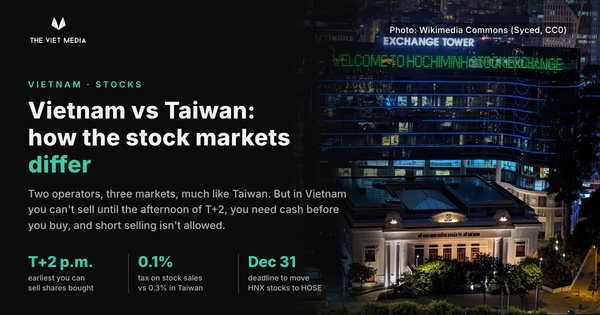
Vietnam spent years on a fix. In 2024, it launched a non-pre-funding mechanism: foreign investors only need funds in place on settlement day (T+2). The system has run smoothly since, with no settlement failures.
Vietnam also adopted the KRX trading system from Korea Exchange around the same time, upgrading matching speed and reliability.
On October 7, 2025, FTSE Russell finally said yes. Vietnam would be promoted to Secondary Emerging Market, effective September 21, 2026.
Passive Money Doesn't Have a Choice
The upgrade's most direct consequence is mechanical. Enormous pools of capital sit in ETFs and index funds tracking FTSE benchmarks worldwide. When Vietnam enters the emerging market index, those funds have to buy Vietnamese stocks at whatever weight the index assigns. No discretion involved.
FTSE Russell's estimate: about USD 6 billion in passive inflows. The World Bank goes further — roughly USD 5 billion short-term, potentially USD 25 billion cumulatively by 2030.
Vietnam's market isn't starting from zero. The VN-Index closed 2025 at 1,784 points, up about 40% for the year. Total market cap reached around USD 387 billion, north of 80% of GDP. Investment accounts crossed 11 million, up nearly a quarter in a single year. But foreign ownership still trails comparable emerging markets. The upgrade should help close that gap.
The 28 Stocks in Line
FTSE Russell published a preliminary list of 28 Vietnamese stocks expected to enter its global indices.
Large-caps: Hòa Phát Group (HPG), Vietcombank (VCB), Vingroup (VIC), Vinhomes (VHM). Mid-caps: Masan Group (MSN), Sabeco (SAB), Vinamilk (VNM). The other 21 are small-caps — VietJet Air (VJC), SSI Securities, Sacombank (STB), and more.
Vietnam's weight in the FTSE Emerging Markets Index will be about 0.22%, and roughly 0.04% globally. Those numbers sound tiny. But for a country leaving the frontier tier, what matters is getting through the door. Vietnam will be classified alongside China, India, Indonesia, and the Philippines.
One More Hurdle: Broker Access
One issue isn't fully resolved. Foreign investors currently must route trades through local Vietnamese brokerages — global firms can't place orders directly. FTSE Russell says it's not a hard upgrade requirement, but it dampens institutional appetite. It's a focus item for the March review.
A poor showing in March could delay the September timeline. Most analysts, though, think that's unlikely. Vietnam has made enough progress.
The bigger milestone is further out. MSCI, the other index giant, still puts Vietnam in the frontier bucket. The consensus is that an MSCI emerging market upgrade won't come before 2027 at the earliest. That would open an even larger gate.