Eight Temples Every Visitor to Vietnam Should Know About
The first thing many Vietnamese do during Tết is visit a temple. These eight — from a 1,500-year-old pagoda to a site drawing 5 million visitors a year — are the country's most iconic.
One of the most important Tết traditions in Vietnam is called lễ chùa đầu năm — visiting a temple at the start of the new year.
During the first three days of Lunar New Year, most Vietnamese will find time to burn incense, pray for peace, and ask for good fortune at a temple.
After praying, there's another tradition called hái lộc, or "picking fortune."
Visitors snap a small green branch from a tree on the temple grounds and bring it home to place on the family altar — a way of carrying the year's blessings back with them.
Vietnam has tens of thousands of temples from north to south.
Here are eight of the most famous, ranging from a 1,500-year-old pagoda to a pilgrimage site that draws five million visitors a year.
Trấn Quốc Pagoda: Hanoi's Oldest Temple
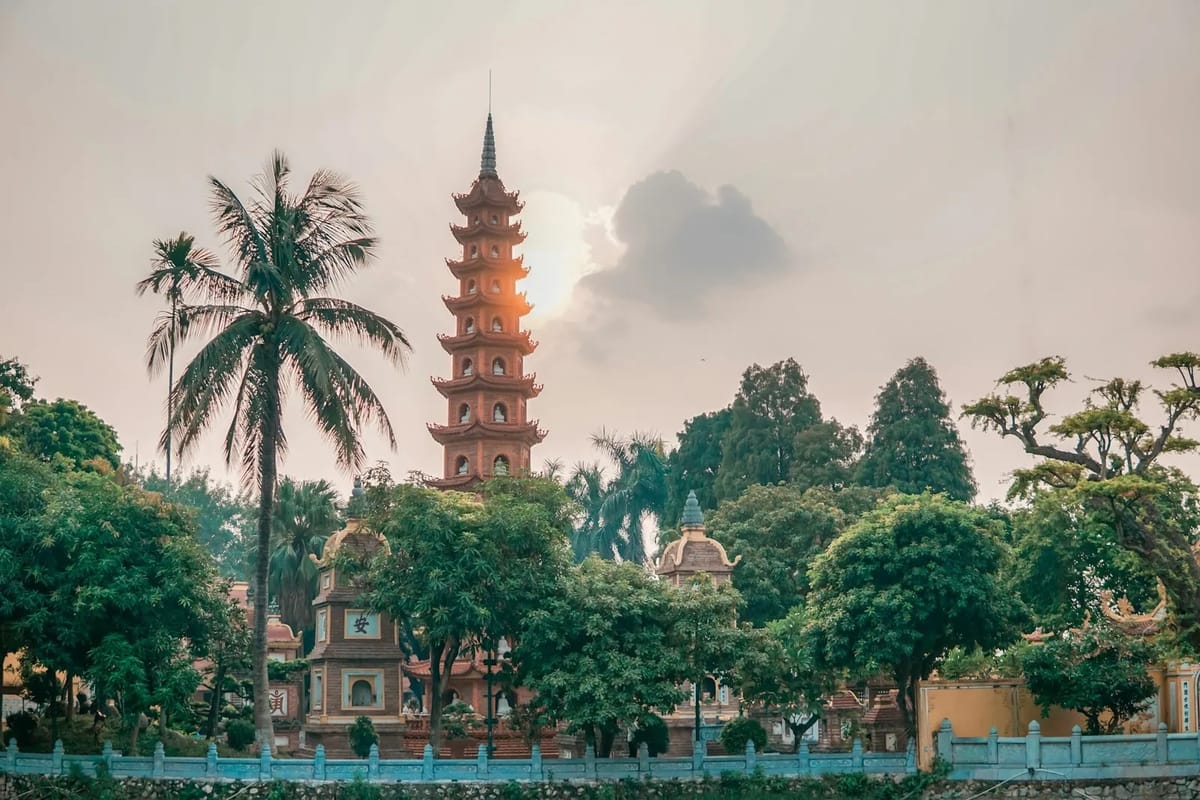
Trấn Quốc Pagoda sits on Gold Fish Island in Hanoi's West Lake.
Built in the sixth century, it's over 1,500 years old — the oldest surviving Buddhist temple in Hanoi.
The pagoda was originally built on the banks of the Red River and called Khai Quốc ("National Founding").
In 1615, as the river eroded its banks, the entire temple was relocated to its current island in the middle of West Lake and renamed Trấn Quốc ("National Protection").
Inside the grounds stands a bodhi tree said to have been grown from a cutting of the original tree in Bodh Gaya, India — the tree under which the Buddha achieved enlightenment.
International travel media have repeatedly named Trấn Quốc one of the world's most beautiful temples.
At sunset, its red brick stupa reflected on the lake's surface makes a compelling case.
One Pillar Pagoda (Chùa Một Cột): The Temple on Vietnam's Money
The One Pillar Pagoda stands next to Ba Đình Square in Hanoi, right beside the Ho Chi Minh Mausoleum.
It's probably the most recognizable temple in Vietnam — its image has appeared on both banknotes and coins.
The entire prayer hall sits atop a single stone pillar rising from a lotus pond.
The pillar is 1.25 meters in diameter.
The wooden hall on top, seen from a distance, looks like a lotus flower floating on water.
The legend behind it: in 1049, Emperor Lý Thái Tông, who had no heir, dreamed that the bodhisattva Avalokiteśvara sat on a lotus blossom and handed him a baby.
A monk advised the emperor to build a temple matching the dream — a single pillar in a lotus pond with a prayer hall on top.
French forces destroyed the pagoda when they withdrew from Hanoi in 1954.
The current structure is a 1955 reconstruction.
In 2012, the Asia Record Organisation certified it as "the most uniquely structured Buddhist temple in Asia."
Thiên Mụ Pagoda: That Car Has Been Parked for Sixty Years
Thiên Mụ Pagoda sits on the north bank of the Perfume River in Huế.
Built in 1601 on the orders of Lord Nguyễn Hoàng, it's Huế's most iconic temple.
The most visible structure is Phước Duyên Tower — an octagonal brick pagoda standing 21 meters tall with seven stories, each housing a Buddha statue.
The tower has become Huế's unofficial city symbol.
But what makes the deepest impression is a pale blue car parked inside the temple grounds.
In 1963, the monk Thích Quảng Đức rode this Austin Westminster sedan from Saigon to a downtown intersection, sat in the lotus position, and set himself on fire to protest the South Vietnamese government's persecution of Buddhists.
The photograph shocked the world.
In 1964, the car's owner donated it to Thiên Mụ Pagoda and had it shipped from Saigon to Huế.
It has been parked there for over sixty years.
Bái Đính Pagoda: Vietnam's Biggest — Record After Record
Bái Đính Pagoda is in Ninh Bình province, about two hours from Hanoi by car.
The entire complex covers 1,700 hectares, with the new temple area alone spanning 80 hectares — the largest Buddhist temple complex in Vietnam and Southeast Asia.
Everything here is built to superlative scale.
The seated Shakyamuni Buddha in the Three Worlds Hall stands 10 meters tall and weighs 100 tons — Asia's largest gilded bronze Buddha statue.
Southeast Asia's largest bronze Maitreya Buddha is also here.
The temple flanks are lined with Asia's longest arhat corridor.
The main bell weighs 36 tons.
The older section of the complex dates to the early twelfth century, but the part most visitors see is the new temple area, built between 2003 and 2010.
During Tết, millions of visitors pour in.
Bái Đính is also a primary venue for Vietnam's Vesak (Buddha's birthday) celebrations.
Perfume Pagoda (Chùa Hương): A Temple You Reach by Boat
The Perfume Pagoda isn't a single temple.
It's a sprawling complex of shrines scattered across limestone mountains about 60 kilometers southwest of Hanoi.
The heart of the complex is the "Inner Temple," built inside a natural cave called Hương Tích ("Fragrant Traces").
Above the cave entrance, Chinese characters carved in 1770 read "The Finest Cavern Under the Southern Sky."
Inside are Buddha and Avalokiteśvara statues carved from green stone.
Getting there is part of the experience.
Visitors take a rowboat along a stream for about an hour, then hike roughly four kilometers up the mountain to reach the cave.
The journey passes through rice paddies and dramatic limestone karst scenery.
The Perfume Pagoda festival is Vietnam's longest religious celebration, running from the sixth day of the first lunar month through the end of the third — a full three months.
In peak years, over 1.5 million visitors make the pilgrimage.
Linh Ứng Pagoda (Đà Nẵng): A Thirty-Story Avalokiteśvara
Linh Ứng Pagoda on the Sơn Trà Peninsula in Đà Nẵng is the youngest entry on this list — it opened in 2010.
But it hosts a 67-meter white Avalokiteśvara statue, equivalent to a thirty-story building and the tallest Buddha statue in Vietnam.
The statue has 17 interior levels, each containing 21 Buddha figures in different poses.
The lotus base has a diameter of 35 meters.
The Avalokiteśvara faces the city, and local fishermen regard her as their guardian at sea.
Đà Nẵng actually has three temples named Linh Ứng — on the Marble Mountains (south), Bà Nà Hills (west), and Sơn Trà Peninsula (east).
Locals believe the three form a Buddhist triangle that protects Đà Nẵng from typhoons.
Long Sơn Pagoda: Nha Trang's White Buddha
Long Sơn Pagoda in Nha Trang was founded in 1886 and is the largest Buddhist temple in Khánh Hòa province.
Originally built on a hilltop, it was destroyed by a typhoon in 1900 and relocated to its current site at the base of the hill.
Climb 193 steps from the temple and you reach a 24-meter white Shakyamuni Buddha seated at the summit, completed in 1965.
Around the lotus base are carved portraits of seven monks who self-immolated in 1963 to protest the South Vietnamese government's persecution of Buddhists.
Nha Trang is one of Vietnam's main beach resort cities, and many visitors make a side trip to Long Sơn for the Buddha.
From the statue's vantage point, you get a panoramic view of the entire city and bay.
Bà Đen Mountain (Núi Bà Đen): Five Million Visitors a Year by Cable Car
Bà Đen Mountain in Tây Ninh province rises 986 meters — the highest peak in southern Vietnam.
It's about 100 kilometers from Ho Chi Minh City, roughly a two-hour drive.
Near the summit sits Bà Đen Temple, over 300 years old.
It's dedicated to Lý Thị Thiên Hương, a woman from local legend who threw herself off the cliff to preserve her honor.
She was later deified.
Because she had dark skin, the mountain was named Bà Đen — "Black Lady Mountain."
In 2020, Sun World built a cable car system here.
The ride from base to summit takes eight minutes; walking takes two hours.
The cable car station holds a Guinness World Record as the world's largest.
At the summit stands a 72-meter bronze Avalokiteśvara statue cast from over 170 tons of copper, certified by the Asia Record Organisation as the tallest mountaintop bronze Buddha statue in Asia.
In early 2026, a 7.2-meter 24K gold-plated Buddha was also installed at the peak.
Since the cable car opened, visitor numbers have surged.
In 2024, the mountain surpassed five million visitors in under ten months — the most popular religious tourism site in southern Vietnam.