Soviet Legacy and the 2026 Education Overhaul: Why Vietnamese Universities Look the Way They Do
Vietnam has 243 universities, most single-discipline, a direct Soviet legacy. After Doi Moi, private universities and international schools flooded in. Now 2026 brings five reforms at once, but a 120,000-teacher shortage looms.
Soviet Legacy and the 2026 Education Overhaul: Why Vietnamese Universities Look the Way They Do
The previous article covered daily life in Vietnamese schools: the 5-4-3 system, choosing your path right after junior high, no winter break, and tutoring that costs families 4 million VND a month.
This article picks up at the university level. Why do Vietnamese universities look so different from those in Taiwan or the West? Why are there so many single-discipline institutions? The answer lies in the Cold War. Then we'll look at the private university and international school boom that followed Doi Moi, and the five reforms being rolled out in 2026.
30,000 Soviet-Trained Students Shaped Today's University Landscape
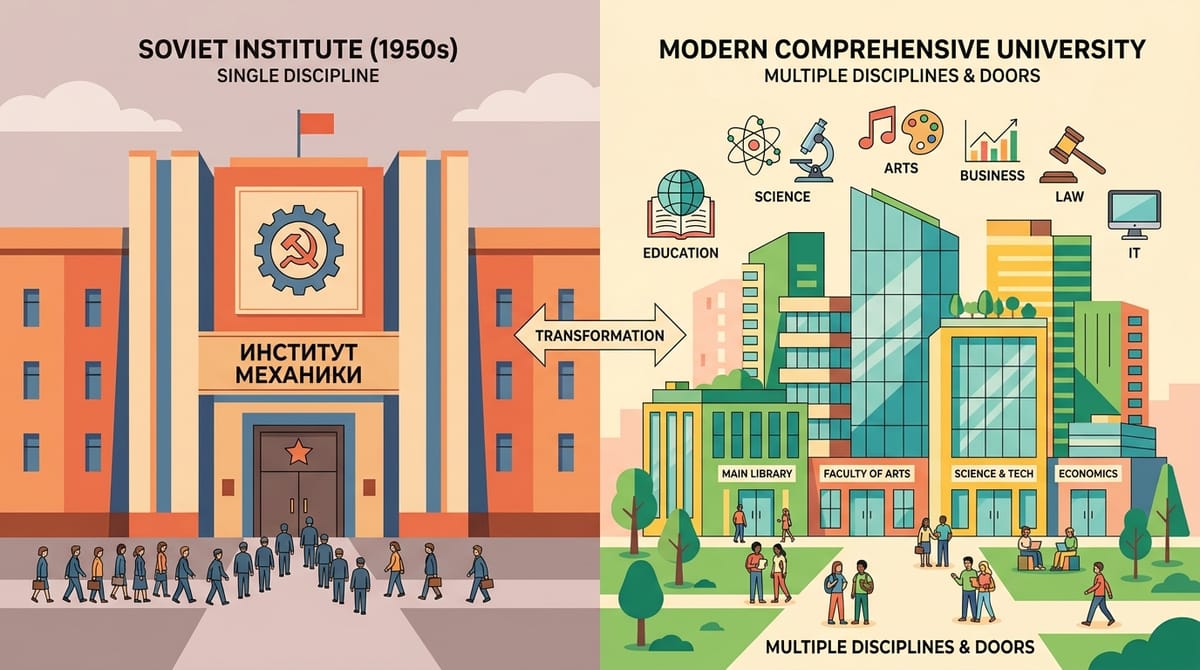
In Taiwan, a typical university houses many colleges, each containing multiple departments. National Taiwan University, National Cheng Kung University, and National Sun Yat-sen University all follow this comprehensive model.
In Vietnam, such large comprehensive universities are actually the minority.
Vietnamese higher education institutions fall into roughly four categories:
Colleges (truong cao dang): awarding associate degrees, the vocational college-level institutions described in the previous article.
Single-discipline universities (dai hoc don nganh): focused on one field, such as the Hanoi University of Architecture or the Ho Chi Minh City University of Medicine and Pharmacy.
Multi-discipline universities (dai hoc da nganh): similar to Taiwanese universities with multiple colleges, but relatively few in number.
Research academies (hoc vien): focused on research and advanced training, such as the Diplomatic Academy or the Academy of Finance.
Why so many single-discipline schools? The answer is the Cold War.
After the 1954 Geneva Accords, North Vietnam aligned fully with the socialist bloc. The Soviet Union exported not just economic aid but its entire education model: build many small, single-specialty institutions, each training talent for a specific sector, with teaching separated from research.
Under this system, North Vietnam sent students to the USSR and other socialist countries, training over 30,000 undergraduates and 13,500 postgraduates. Between 1939 and 1964, the number of university students in Vietnam grew nearly 50-fold to 27,000, powered by the rapid expansion of Soviet-style specialized institutions.
Undergraduate programs in Vietnam typically take 4 years, engineering programs 5 years, and medicine or dentistry 6 years, similar to Taiwan.
From Zero to 62 Private Universities After Doi Moi
After the 1986 Doi Moi (Renovation) reforms, Vietnam began gradually restructuring its higher education system. The 1998 Education Law opened the door for private universities, credit-based systems replaced Soviet-era fixed-class cohorts, and Vietnam started building a national qualifications framework aligned with ASEAN standards. But the Soviet-era institutional landscape remains the foundation of Vietnamese higher education today.
As of 2025, Vietnam has 243 universities: 173 public, 62 private, and 5 foreign-invested. Private universities account for about a quarter of the total, but their enrollment and societal influence are growing rapidly.
Two private institutions deserve special attention.
The first is VinUni (VinUniversity), founded by Vingroup, Vietnam's largest conglomerate. It enrolled its first class in 2020. In just five years, VinUni earned a QS 5-Star rating, making it the youngest university in the world to achieve this certification. In March 2025, it became the first Vietnamese university to meet 100% of FIBAA institutional accreditation criteria. Its acceptance rate is below 10%. Tuition ranges from 350 million to 820 million VND (roughly USD 13,500 to 31,500) per year, though all students from 2025 to 2030 receive a 35% tuition subsidy.
The second is FPT University, founded by Vietnam's tech giant FPT Corporation, with campuses in Hanoi, Ho Chi Minh City, Da Nang, Can Tho, and Quy Nhon. It currently enrolls about 30,000 students and generated over 4,300 billion VND in revenue in 2024, the highest of any private university in Vietnam. A new campus expansion is underway for 2026.
Both institutions share a key characteristic: backing from major corporate conglomerates pursuing a "build a world-class university with corporate resources" strategy, fundamentally different from the tuition-and-government-subsidy model that sustains most private universities in Taiwan.
International Schools Approaching USD 38,000 a Year
Beyond private universities, international schools (truong quoc te) represent a rapidly expanding market in Vietnam.
As of late 2021, Vietnam's education sector had 605 foreign investment projects totaling over USD 4.57 billion, with Hanoi and Ho Chi Minh City accounting for more than 90% of the investment.
The highest tuition belongs to UNIS Hanoi (United Nations International School), charging up to USD 38,210 per year for high school. ISHCMC (International School Ho Chi Minh City) charges 680 million to 960 million VND annually (roughly USD 26,000 to 37,000). BVIS (British Vietnamese International School) is relatively more affordable at 250 million to 670 million VND.
The market breaks into three tiers:
Entry-level: USD 9,000 to 14,000 per year.
Mid-range: USD 15,000 to 23,000 per year.
Top-tier (British, American, IB curriculum): USD 25,000 to 38,500 per year.
For the 2025-2026 school year, most international schools raised fees 3% to 5%, with some increases reaching 8.2%. International schools in Da Nang cost 40-60% less than those in Ho Chi Minh City, making them an alternative for some expat families.
For Vietnamese middle-class families, a year of international school tuition can consume the majority of household income. Yet demand continues to grow, driven by parents seeking English proficiency, international credentials, and a springboard for studying abroad.
A 120,000-Teacher Shortage: Urban and Rural Kids Attend Different Schools
The biggest challenge facing Vietnamese education is not system design but execution.
As of May 2025, primary schools, secondary schools, and kindergartens collectively lack nearly 120,000 teachers. The Ministry of Education estimates an additional 358,000 will be needed by 2030. The reasons are straightforward: salaries aren't competitive enough, many education graduates leave for the private sector, and remote areas struggle to recruit anyone.
The urban-rural gap is another structural problem. In 2022, the net upper-secondary attendance rate was 82.4% in urban areas versus 74.1% in rural regions, an 8-percentage-point gap. For secondary education overall, enrollment stood at 90% in cities versus 76% in rural areas, a gap of nearly 15 points.
Infrastructure lags as well. A 2021-2022 survey found that nearly 47% of rural students lacked personal devices for online learning, and 60% of teachers in remote areas lacked digital teaching skills.
Higher education employment is also a concern. About 40% of university graduates work in fields unrelated to their degrees or in positions that don't require university-level qualifications. Youth unemployment (ages 15-24) stood at 8.38% in the first nine months of 2025, and the unemployment rate for college-educated workers (4.49%) actually exceeded that of workers with basic education (1.71%).
There is oversupply in law, teacher training, and finance-banking, while tech engineers, mechatronics technicians, programmers, and digital supply chain specialists remain in severe shortage. This structural mismatch is one of the core problems the 2026 reforms aim to address.
Can a Vietnamese Degree Be Used Across ASEAN?
Vietnam is working toward alignment with the ASEAN Qualifications Reference Framework (AQRF).
The AQRF is a cross-border qualifications recognition mechanism launched by the ten ASEAN member states in 2007. It defines 8 qualification levels covering knowledge, skills, and competencies. In practice, it allows a degree earned in Vietnam to be compared and benchmarked against qualifications from Malaysia, Thailand, or Singapore.
Countries that have completed their referencing reports include Malaysia, the Philippines, Indonesia, and Thailand. Vietnam's referencing report was officially published in Q4 2025, meaning Vietnam's qualifications system is now benchmarked against the ASEAN common framework.
This matters for Vietnamese graduates. The ASEAN Economic Community (AEC) aims to enable free movement of skilled professionals across the region, and qualifications recognition is the first step. Vietnam's AQRF completion means that Vietnamese university degrees will gradually gain greater recognition in other ASEAN countries.
Five Reforms at Once: The 2026 Education Overhaul
On December 10, 2025, Vietnam's National Assembly passed amendments to three laws simultaneously: the Law on Education, the Law on Vocational Education, and the Law on Higher Education, all effective January 1, 2026.
Combined with the earlier Teacher Law and free education policy, five major reforms are now advancing in parallel.
First, the elimination of junior high diplomas. From January 1, 2026, Vietnam no longer issues junior high school graduation certificates. Instead, school principals confirm "completion of junior high curriculum" directly in student records.
Second, nationwide unified textbooks. Starting the 2026-2027 school year, all schools will use the "Ket noi tri thuc voi cuoc song" (Connecting Knowledge to Life) series published by the Vietnam Education Publishing House, ending the era of three concurrent textbook sets. Free textbooks are planned for nationwide rollout by 2029-2030, at a cost exceeding 403.6 billion VND annually, using a library-style lending model.
Third, 15 years of free education. Effective September 2025, tuition is waived at all public schools from kindergarten through high school. Private school students receive tuition subsidies.
Fourth, the establishment of vocational high schools. As mentioned earlier, this creates a fourth pathway after junior high, with diplomas equivalent to general high school.
Fifth, teacher salaries raised to the highest tier in the public sector. Under the 2025 Teacher Law (Luat Nha giao), teachers' base monthly salaries increase by 2 million to 7 million VND (roughly USD 77 to 270). Kindergarten and general education teachers receive professional allowances of at least 70%, rising to 100% for those in remote and disadvantaged areas.
Additional changes include legal recognition of digital diplomas as equivalent to paper versions, and a 36% reduction in administrative procedures under the vocational education law.
All five reforms point in the same direction: lower barriers, close gaps, and retain teachers. Whether they deliver depends on local governments' implementation capacity and whether the finances hold up.
If you found this article helpful, feel free to share it with others interested in Vietnam.
Want regular updates on Vietnam? Visit our website to subscribe to our free newsletter.
Find our content valuable? Consider becoming a paid supporter to help us continue producing in-depth coverage. Paid subscribers get priority consideration for story suggestions.
Sources: Wikipedia, WENR, Vietnam Ministry of Education and Training, Vietnam Government Gazette, VietnamNet, Vietnam Briefing, Tuoi Tre, VnExpress, OECD, ASEAN Secretariat, Taipei Forum Foundation
The Viet Media Monthly
A curated monthly digest of the most important political, economic, tech, and industry developments in Vietnam.
Designed for reading on desktop or tablet — no algorithm, no noise. Just the stories that matter.
Delivered before the 10th of each month. Cancel anytime.