How Vietnamese Students Go to School: The 5-4-3 System, No Winter Break, and One Exam to Rule Them All
Vietnam runs a 5-4-3 school system where students choose their path right after junior high. One exam decides both graduation and university admission. Tutoring costs 4 million VND a month. Adjusted for income, Vietnamese students score just behind Hong Kong, Taiwan, and Korea.
How Vietnamese Students Go to School: The 5-4-3 System, No Winter Break, and One Exam to Rule Them All
Most people outside Vietnam know the country for its food, factories, and tourism. Ask them how the school system works, and you'll get a blank stare.
Vietnam's education system is a product of three historical layers: French colonialism, Soviet influence, and post-reform modernization. And it's currently going through the most intensive round of reforms in two decades.
This is the first of two articles. Here we cover the structure and daily life: how Vietnamese students attend school, take exams, and cram for tests.
Same 12 Years, but the Split Comes Earlier
Vietnam's basic education follows a 5-4-3 system: 5 years of primary school (tieu hoc), 4 years of junior high (trung hoc co so), and 3 years of senior high (trung hoc pho thong). That's 12 years total, starting at age 6.
Taiwan uses a 6-3-3 system. Same 12 years, different split: Vietnam has one fewer year of primary school and one extra year of junior high.
That extra year makes junior high graduation a far more significant turning point in Vietnam than in Taiwan, where virtually all students proceed to senior high.
Since September 2025, all public schools from kindergarten through high school are tuition-free, covering roughly 23.2 million students. The government spends about 30 trillion VND (roughly USD 1.2 billion) annually on this policy. Education accounts for at least 20% of the national budget, one of the highest ratios globally.
Four Paths After Junior High
In Taiwan, nearly everyone goes to senior high school after 9th grade. In Vietnam, junior high graduation is a real fork in the road. Before 2026 there were three options; a fourth was added this year.
The first is the traditional academic route: pass the high school entrance exam, attend general senior high for three years, then sit the national graduation exam.
The second is intermediate vocational school (trung cap), a 2-to-3-year program for junior high graduates that trains hands-on technical workers.
The third is college-level vocational school (cao dang), roughly equivalent to an associate degree, with practical training comprising up to 30% of the curriculum.
The fourth, new in 2026, is vocational high school (trung hoc nghe). For the first time, vocational high school diplomas carry the same legal weight as general high school diplomas, and graduates can apply directly to university.
These paths aren't one-way streets. Vietnam's lien thong system lets vocational graduates ladder up: intermediate to college, college to university, with the latter typically requiring about 1.5 years.
One Exam Decides Everything, and 2025 Changed the Rules
Vietnamese high school students face a single national exam (ky thi tot nghiep THPT) that simultaneously determines whether they graduate and whether they get into university.
Starting in 2025, the format shifted from "3+1" to "2+2": two required subjects plus two electives.
The required subjects are Vietnamese Literature (essay format, 120 minutes) and Mathematics (multiple choice with new true/false and short-answer components, 90 minutes). Students choose two more from nine options: Foreign Language, History, Physics, Chemistry, Biology, Geography, Economics and Law, Informatics, and Technology. Each elective is 50 minutes of multiple choice.
The entire exam takes just a day and a half, the shortest in a decade.
Over 1.16 million students sat the exam in 2025. The graduation threshold is a 5.0 average across all subjects on a 10-point scale, with no subject below 1.0. University admission combines exam scores (50%) with three years of high school grades (50%), plus bonus points.
School From 7 AM to 4:30 PM
Vietnamese students spend longer hours at school than their Taiwanese counterparts.
From the 2025-2026 academic year, all primary and secondary schools are required to operate on a full-day, two-session schedule (hoc 2 buoi/ngay).
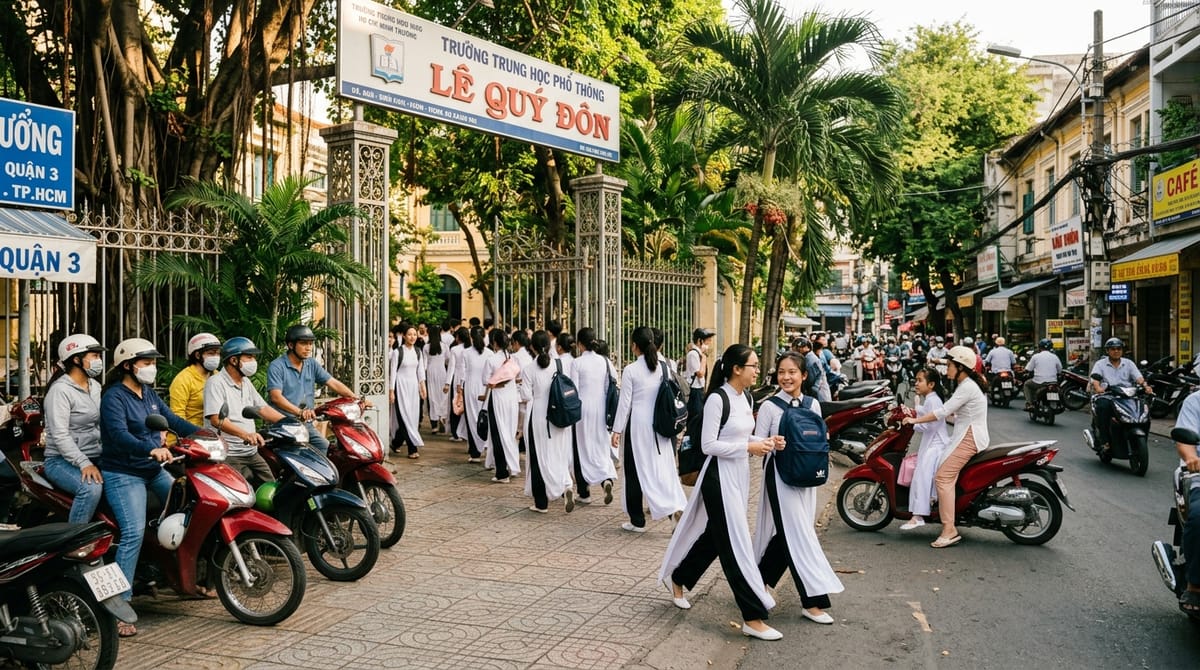
In Ho Chi Minh City, the first class begins between 7:00 and 8:00 AM, with no dismissal before 10:30 AM. Afternoon classes start between 1:00 and 1:30 PM and end no earlier than 4:00 PM, no later than 5:00 PM. Students spend roughly 9 to 10 hours at school.
Previously, many schools ran morning and afternoon shifts (buoi sang / buoi chieu), with different groups of students rotating through the same classrooms due to space constraints. The transition to full-day schooling is still causing scheduling headaches at many institutions.
No Winter Break, One Week Off for Tet
The school year runs in two semesters. The first starts on September 5 (a nationwide uniform start date) and ends in mid-January. The second runs from mid-January to late May, totaling 35 teaching weeks.
Summer break runs from late May to early September, about three months. But there is no winter break. The only break between semesters is the Tet (Lunar New Year) holiday, roughly one week. In 2026, Tet falls on February 14-22.
Unlike Taiwan's nationwide uniform academic calendar, Vietnam's education ministry sets a framework that provinces can adjust based on local conditions.
Tutoring Is a National Sport That No Regulation Can Stop
Vietnam's private tutoring culture (hoc them / day them) is as deeply rooted as Taiwan's, arguably more so.
In February 2025, the education ministry issued Circular 29, mandating that in-school tutoring be free of charge, limited to 2 periods per subject per week, and voluntary.
The result? Schools stopped offering after-school classes, and demand flooded into the private market.
Private tutoring rates vary, but a typical online session costs about 150,000 VND (roughly USD 6). A student taking two sessions per week in three subjects racks up nearly 4 million VND (about USD 155) per month. With Vietnam's per capita GDP around USD 4,700, that's 20-30% of many families' monthly income.
In May 2026, Circular 19 added new requirements: private tutoring centers must register as businesses and publicly disclose their teachers and fees. But in a society driven by competitive exams, tutoring has never disappeared because of regulation.
PISA Scores: A Poor Country Getting Rich-Country Results
Vietnam has long been a puzzle for education researchers in the OECD's PISA assessments.
In the 2022 PISA test, Vietnam ranked 34th out of 81 countries, second in Southeast Asia behind only Singapore. The scores: Math 469 (31st), Reading 462 (34th), Science 472 (35th), roughly around the OECD average.
Taiwan scored significantly higher the same year: Math 547 (3rd), Reading 515 (5th), Science 537 (4th).
But adjust for socioeconomic status, and the picture flips. After OECD's socioeconomic adjustment, Vietnamese students' math performance trails only Hong Kong, Taiwan, and South Korea. Vietnam achieves near-Taiwan-level foundational skills with far less educational investment.
The 2022 scores did decline from 2018: Math dropped 27 points, Reading 43, and Science 71. Possible causes include pandemic-related school closures, expanded sampling, and the growing pains of curriculum reform.
In the Southeast Asian rankings, Singapore leads by a wide margin, Vietnam holds a solid second, followed by Brunei (42nd), Malaysia (47th), Thailand (63rd), Indonesia (69th), the Philippines (77th), and Cambodia (81st).
Next up: why Vietnamese universities look the way they do, and the five education reforms being rolled out in 2026.
If you found this article helpful, feel free to share it with others interested in Vietnam.
Want regular updates on Vietnam? Visit our website to subscribe to our free newsletter.
Find our content valuable? Consider becoming a paid supporter to help us continue producing in-depth coverage. Paid subscribers get priority consideration for story suggestions.
Sources: Wikipedia, WENR, OECD PISA, Vietnam Ministry of Education and Training, Vietnam Government Gazette, VietnamNet, VnExpress, Tuoi Tre, Vietnam Briefing, Taipei Forum Foundation
The Viet Media Monthly
A curated monthly digest of the most important political, economic, tech, and industry developments in Vietnam.
Designed for reading on desktop or tablet — no algorithm, no noise. Just the stories that matter.
Delivered before the 10th of each month. Cancel anytime.