As Mixue Retreats, Vietnam's Coffee and Tea Chain Market Splits in Two
Mixue closed more than 400 international stores in its latest fiscal year, with Vietnam and Indonesia bearing the brunt. But local brands like Highlands, Phúc Long and Katinat keep expanding. Vietnam's $1.3 billion beverage chain market is not shrinking — it is splitting along consumer preference.
[As Mixue Retreats, Vietnam's Coffee and Tea Chain Market Splits in Two]
Vietnam's coffee and tea chain market is going through a structural sort.
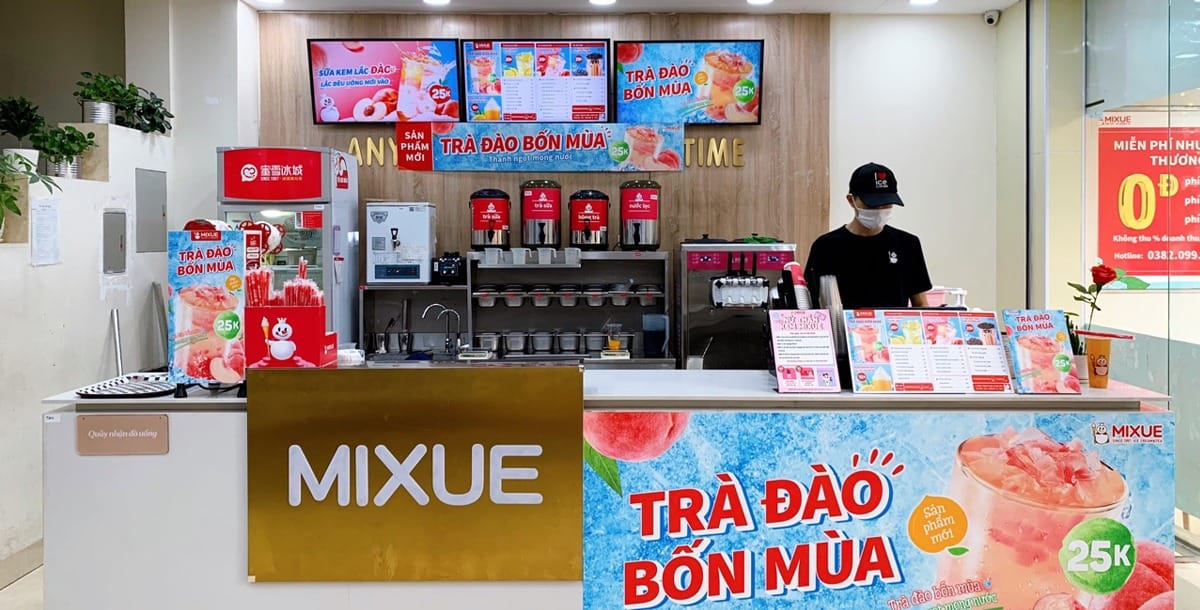
Mixue, the Chinese low-price chain that pushed its way across Vietnamese streets in recent years, said in its latest annual report that it had closed more than 400 international outlets — with Vietnam and Indonesia accounting for the bulk of the retreat.
At the same time, Vietnam's home-grown chains Highlands Coffee, Phúc Long and Katinat keep adding stores. Foreign premium player Starbucks Vietnam is also growing.
Vietnamese newspaper Tuoi Tre summed it up in an April 26 headline: "Beverage chains downsize to protect profits."
Market-size data backs this reading. According to figures cited by VnExpress, Vietnam's coffee chain segment hit USD 725 million in 2025, up 27% from 2023. The tea chain segment reached USD 617 million over the same period, up 28%.
The closures are concentrated at the low-price end of the market.
▍ Two Diverging Trajectories
Mixue entered Vietnam in 2018, priced its drinks at 25,000 to 30,000 VND a cup, and crossed 1,000 stores nationwide by 2023.
The picture changed in late 2025.
Citing Mixue's 2025 financial report, Taiwan's CNA news agency reported the group's international footprint shrank by 162 stores in just six months. Mixue listed in Hong Kong in March 2025; since June, its share price has fallen by roughly half.
Highlands Coffee, by contrast, is closing in on a milestone. By the end of 2025, the local chain ran 985 stores — just 15 short of 1,000. Annual revenue grew nearly 16%, EBITDA reached around 1.1 trillion VND, and same-store sales — excluding new openings — climbed more than 8%.
Other local brands tell a similar story. Tea chain Phúc Long added 79 stores in a year to reach 237. Newer entrant Katinat went from 93 outlets at the start of 2025 to 114 by September. Starbucks Vietnam expanded to 150 locations.
Vietnam's combined coffee and tea chain market now exceeds USD 1.3 billion — the third largest in Southeast Asia, after Indonesia and Thailand. Both segments grew nearly 30% from 2023 to 2025.
Through 2025, the overall market kept growing. What is splitting is the consumer base.
▍ Why "Lowest Price" Stops Working
Mixue's everywhere-cheap formula is hitting several walls in Vietnam at once.
The first is internal saturation. The aggressive 2021-to-2023 store rollout pushed density too high in major cities, and outlets of the same brand started cannibalizing each other. Under the franchise model, this hit franchisees especially hard — they were now competing against each other.
Costs are also tightening. Local Vietnamese media reports that 50% to 60% of beverage operators have seen raw material costs rise over the past year, alongside higher rents and labor. Mixue, locked into the bottom of the price ladder, has no room to raise prices. Its in-Vietnam promotions have pushed cups down to 8,000 VND, and new low-price tea entrants are advertising 7,000 VND. Margins at this end of the market are getting squeezed.
Consumer preferences are moving too. Younger Vietnamese drinkers no longer pick on price alone — they care about quality, store experience, low-sugar options, and natural ingredients. Tuoi Tre singled out Chagee as a template for the new wave: QR-coded cups, automated drink-mixing machines, and an integrated package of efficiency, consistency, and brand feel.
▍ iPOS's Three-Tier Framework: The Squeezed Middle
Vietnamese beverage data firm iPOS reads the restructuring through three layers:
➤ Strong brands — well capitalized, differentiated products, marketing budgets to match. Still expanding.
➤ Low-cost players — accept thin margins to chase volume.
➤ Mid-tier operators — "not cheap enough to compete with mass chains, and not strong enough to convince customers to pay a premium."
The middle is where the pain concentrates. Chains stuck around the 30,000-to-40,000 VND price band, without the brand pull of a Highlands or Starbucks, find no firm ground on either side.
▍ What to Watch in the Second Half of 2026
iPOS and other industry observers expect summer 2026 to be when the restructuring really accelerates.
The frame industry insiders are using: competition will shift from store-count growth to per-store efficiency, customer experience, and financial resilience.
After the holiday week, which signs come down on Vietnamese streets — and which stay lit — will be the most direct read on the market's direction.