From Recovery to Expansion: Why Vietnam's Airlines Are All Accelerating at Once
In a single week, Vietnam Airlines opened its first Amsterdam route, private carriers doubled down on fleets, and three new airlines lined up to enter. The demand is real — but it is almost all international, and the supply side has three chokepoints.
[From Recovery to Expansion: Why Vietnam's Airlines Are All Accelerating at Once]
For about ten days in mid-June, Vietnam's airlines moved as if they had compared calendars. New routes came one after another.
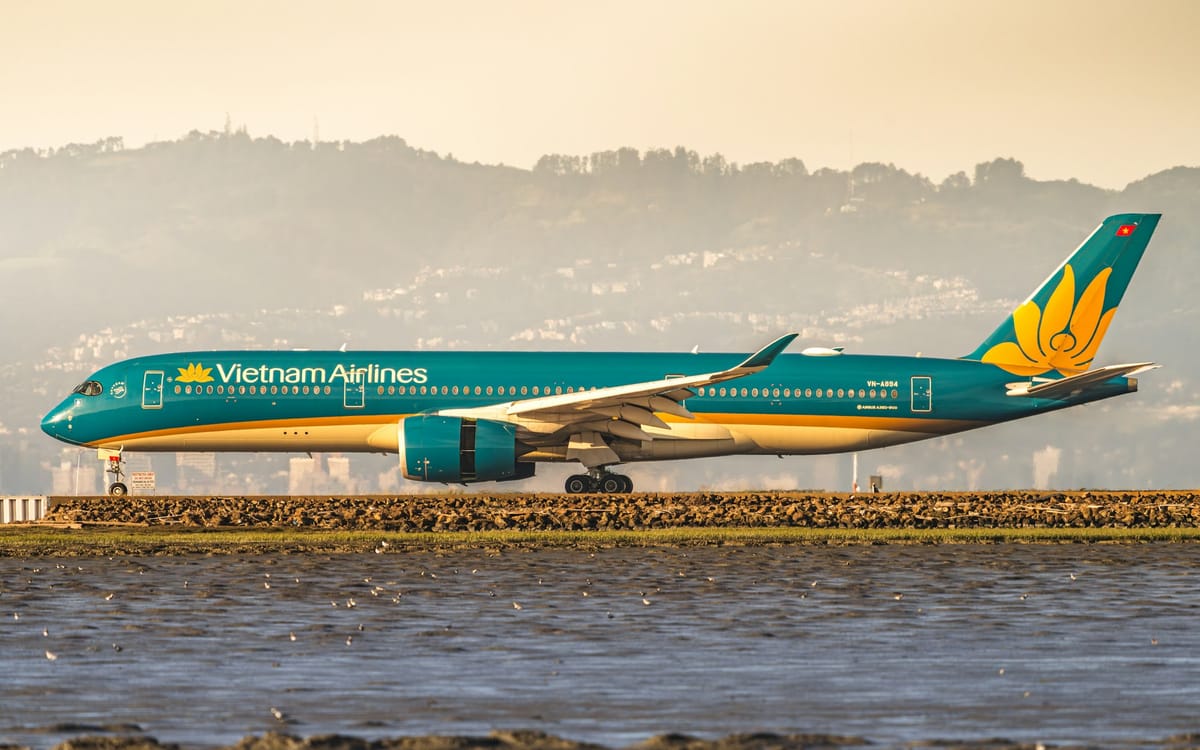
In the early hours of June 16, a Vietnam Airlines flight left Hanoi for Amsterdam — the country's first nonstop link to the Netherlands, bringing the flag carrier's Europe network to 12 nonstop routes. From July, it also added frequency between Hanoi and Moscow.
Private carriers kept pace. Vietjet announced a Hanoi–Prague route starting in October. Vietravel Airlines launched Hanoi–Buon Ma Thuot, brought back Hanoi–Cam Ranh (the gateway to Nha Trang), and added flights on its Hanoi–Ho Chi Minh City trunk route; internationally, it put HCMC–Shenzhen tickets on sale and began charter flights from Hanoi to Lanzhou in China.
The most watched player is Sun PhuQuoc Airways. Its first HCMC–Van Don flight in mid-June took off more than 90% full, and three more domestic routes — Hanoi–Cam Ranh, HCMC–Hai Phong and Hai Phong–Phu Quoc — follow by late July.
Start with the regulator's numbers. Last year, Vietnam's air traffic grew by more than a tenth, with international routes outpacing domestic ones, and foreign visitor arrivals topped 20 million for the first time. For 2026, the Civil Aviation Authority (CAA) is openly targeting "double-digit growth." When the regulator and the airlines lean the same way at the same time, the question shifts from whether the market can recover to how far the next expansion can run.
The most aggressive moves are on the capital side, among the private airlines.
Sun PhuQuoc Airways is barely a year old and has already raised capital twice, most recently to a scale of about USD 510 million, doubling its shareholder count. The fleet plan is tighter still: 11 aircraft today, 26 by the end of August. Its international network covers Taipei, Seoul and Hong Kong, with Phu Quoc–Singapore due in late July.
Vietravel Airlines, backed by Vietnamese conglomerate T&T Group, is working on a longer clock: a 50-strong fleet by 2030.
The queue to enter keeps growing. Beyond the incumbents, Masterise, LOTHA Airlines and Crystal Bay Airlines have all filed plans. Maintenance is being built out too: in mid-June, Hong Kong-based HAECO, Japan Airlines, Toyota Tsusho and Sun Group signed a joint venture for a USD 360 million aircraft maintenance complex at Van Don International Airport.
The demand behind all this is overwhelmingly international. In the first half of the year, foreign arrivals grew nearly 15% year on year, with more than 80% coming by air. The fastest-growing source market is Russia, which sent nearly three times as many visitors in the first five months as a year earlier.
Domestic flying is a different story: passenger numbers were essentially flat in the first half. The domestic routes Vietravel and Sun PhuQuoc are opening at speed are slices of a pie that is not visibly growing.
The supply side has three structural gates. The first is aircraft: about one in ten commercial planes in Vietnam sat grounded last year because of engine problems and global supply chain breakdowns, and delays rose with them — the whole industry is short of engines and parts, and Vietnam is not exempt. The second is the ground: at peak hours, major airports are close to their limits, and relief waits on the opening of Long Thanh airport outside HCMC and construction at Gia Binh near Hanoi and Phu Quoc. The third is cost: aviation is capital-heavy and slow to pay back, squeezed between fuel prices and exchange rates.
The airlines and the regulator are both betting on expansion, and international traffic gives them real cover. Whether the bet holds depends on getting through those three supply gates.
The Viet Media Monthly
A curated monthly digest of the most important political, economic, tech, and industry developments in Vietnam.
Designed for reading on desktop or tablet — no algorithm, no noise. Just the stories that matter.
Delivered before the 10th of each month. Cancel anytime.