Sixty Years of the Cafe Apartment: Why Saigon's Most Photographed Building Is Still Standing
It sits on the most expensive land in Ho Chi Minh City, its cafes are technically illegal, and eviction notices went out back in 2016. Nearly a decade later, the shops are still open. What protects the building may simply be the tourists climbing its stairs every day.
[Sixty Years of the Cafe Apartment: Why Saigon's Most Photographed Building Is Still Standing]
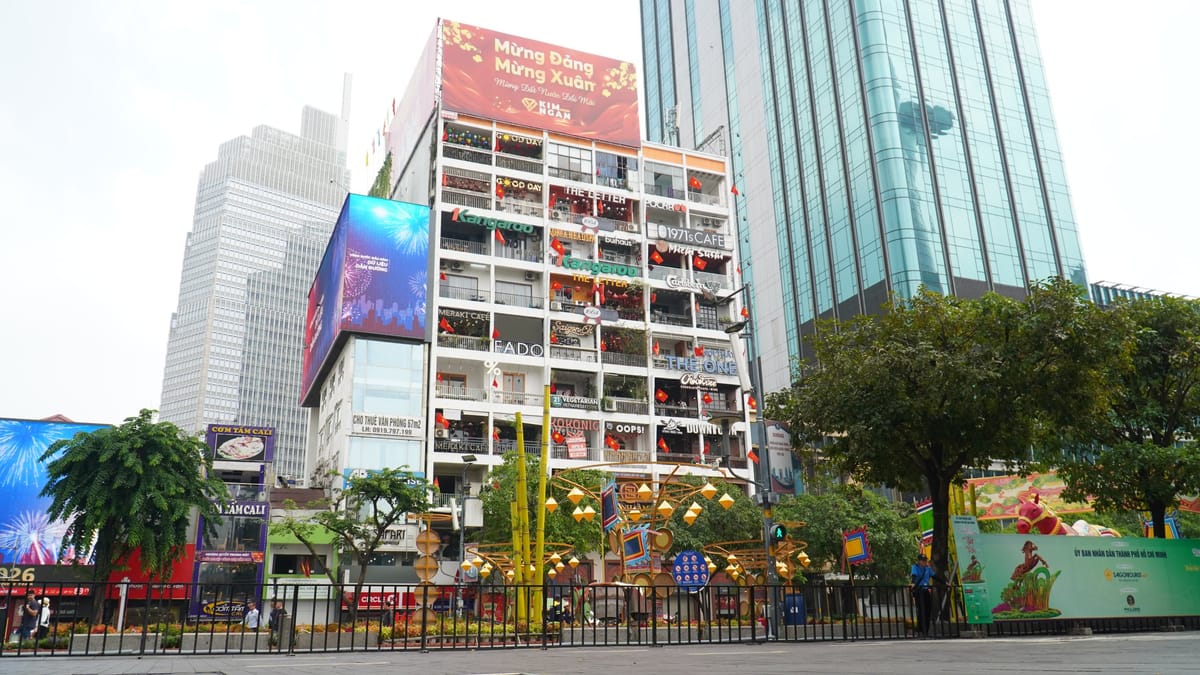
There is an old apartment block in Saigon so famous that even National Geographic's official Facebook page has featured it: a nine-storey building transformed into a hive of cafes, restaurants and studios. It stands at 42 Nguyen Hue in Ho Chi Minh City — the "Cafe Apartment," as tourists know it.
Its address could hardly be better. Nguyen Hue Boulevard runs from the City Hall down to the Saigon River, lined with five-star hotels and financial towers; locals call the area "diamond land." Squeezed between the new high-rises, number 42 is the smallest building on the street.
The block went up in 1960, and it was never an ordinary apartment building. Block A, facing the boulevard, housed companies and offices during the French and American eras; Block B, at the rear, was home to government officials; Block C, on the side, held the kitchens. The French-Vietnamese illustrator Marcelino Truong lived here as a boy — from 1961 to 1963, when his father, Truong Buu Khanh, served as an adviser to the Ngo Dinh Diem government. Half a century later he turned that childhood into a graphic memoir, "Such a Lovely Little War" — the title is ironic. In a family photo from those years, the children stand on the balcony of number 42.
After Saigon changed hands in 1975, so did the building. The apartments were transferred to city departments, and new residents gradually partitioned the old office spaces into homes. Years later, Vietnam's Tuoi Tre newspaper interviewed two long-time residents. Ngo Thi Thanh Tan, deputy head of the building's management board, moved in back in 1980, when she worked as a cashier at the Ba Son shipyard; she has since acquired property elsewhere but chooses to stay. The life of Nguyen Thi De ran the other way: before 1975 she lived in a villa of over a thousand square metres. After her husband disappeared fleeing the country by boat, she and her children — five of them in all — ended up in a former storage room tucked into the stairwell between the seventh and eighth floors, less than five square metres and without so much as a unit number. She has lived there for more than thirty years.
For the next four decades the building simply grew old. The turning point came in 2015, when the Nguyen Hue pedestrian street opened. The boulevard became a public plaza, foot traffic poured past the front door, and cafes, boutiques and studios rented their way up the floors. By 2017, Blocks A and B had been almost entirely leased to businesses, with the remaining residents confined to Block C; a street-facing unit could fetch up to 35 million VND a month, about USD 1,500 — and that was 2017 pricing.
The residents, meanwhile, kept dwindling. By 2021, fewer than a third of the building's 100 households were original residents; the rest had become shops and offices. By the residents' own reckoning, land here is now worth over 1 billion VND per square metre, about USD 40,000 — a word-of-mouth estimate, not an official figure.
Here is the twist: the business that made the building famous has been illegal from the start. Vietnam's housing law bars the use of residential units as business premises. In 2016, Hanoi began clearing shops out of its apartment blocks and Ho Chi Minh City followed, serving the merchants of 42 Nguyen Hue with relocation notices and a 15-day deadline, on the grounds that old buildings like this were poorly maintained and never designed for commerce. The deadline passed and nothing happened. The following year, Saigoneer reported that the authorities were "in no rush" to enforce the order. It eventually fizzled out.
The eviction order never drove anyone out. What thinned the shops was the pandemic: the building held over forty businesses before COVID, and by 2023 only about half were still open. Moss and water stains had spread across the walls, and the decay was plain to see. According to ZNews, only about one in ten local visitors actually buys anything; the rest come for photos.
Early this year brought a new twist. Ahead of Tet, the city included number 42 in a downtown beautification campaign: the entire facade was repainted white while keeping the original architectural lines. Photos of the refreshed building spread on social media — some people assumed they were AI-generated.
The longer-term pressure comes from the city's redevelopment agenda. Ho Chi Minh City has more than 470 apartment blocks built before 1975, of which 16 have been condemned as dangerous and slated for evacuation and demolition. More than half have been cleared, and in May this year the city set building-by-building deadlines for the rest. Number 42 is not on that list, so there is no immediate threat. But none of the old problems have gone away: the housing law still forbids shops in residential units, the building keeps getting older, and the land keeps getting more valuable. Vietnam Coracle, a long-running travel writer covering Vietnam, puts it bluntly: the building sits on prime real estate and demolition threats have never been far away; if it is still standing today, that is probably because the Cafe Apartment is simply too popular.
If you want to visit: the Cafe Apartment is at 42 Nguyen Hue, in the middle section of the pedestrian street (formerly District 1, now Sai Gon Ward). The lift charges a few thousand VND, which most cafes refund with a purchase. It is slow — take the stairs on the way down.
The Viet Media Monthly
A curated monthly digest of the most important political, economic, tech, and industry developments in Vietnam.
Designed for reading on desktop or tablet — no algorithm, no noise. Just the stories that matter.
Delivered before the 10th of each month. Cancel anytime.