Vietnam Airlines Signs USD 8.1 Billion Boeing Deal — The Biggest in Vietnamese Aviation History
USD 8.1 billion. 50 Boeing 737-8s. Signed in Washington with the General Secretary watching. Vietnam Airlines just placed the largest aircraft order in Vietnamese history — and three years ago, this airline was on the brink of bankruptcy.
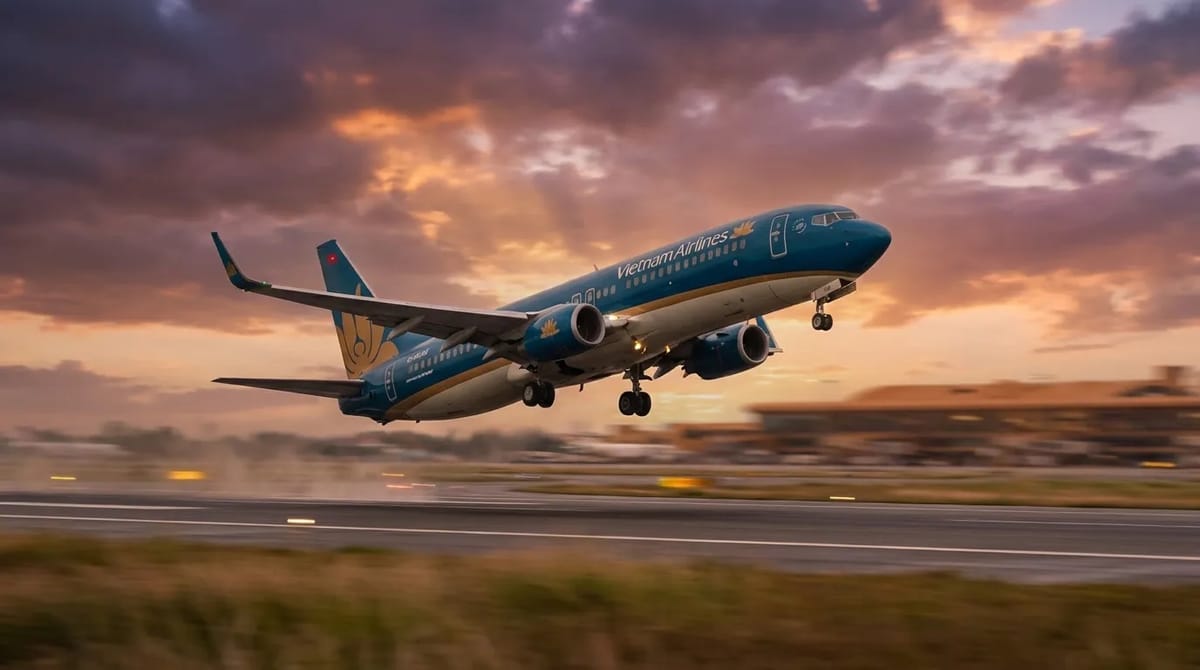
On February 19, Vietnam Airlines signed a contract for 50 Boeing 737-8 aircraft in Washington, D.C.
The deal is worth USD 8.1 billion — the largest single aircraft purchase in Vietnamese aviation history.
General Secretary Tô Lâm was there to witness the signing.
He was in Washington at the invitation of Donald Trump, attending the inaugural session of the "Gaza Peace Commission" as a founding member.
Placing a blockbuster procurement deal in that diplomatic setting was no accident.
What They Bought
The 737-8 is the workhorse of Boeing's 737 MAX family — a single-aisle narrowbody with 162 to 178 seats.
Compared to the previous generation, it burns about 20 percent less fuel.
It's designed for domestic routes and regional Asian flights.
Deliveries are scheduled for 2030 to 2032.
That means Vietnam Airlines' fleet won't change much in the next four years because of this order.
The real impact won't arrive until 2030 and beyond.
Where the Money Comes From
USD 8.1 billion is the list price.
Actual transaction prices typically include discounts — but even discounted, this is an enormous sum.
Vietnam Airlines lined up financing from three sources: the U.S. Export-Import Bank (EXIM Bank), Citibank, and a consortium of Vietnamese domestic banks.
EXIM Bank's willingness to back the deal carries a policy signal of its own.
The U.S. government has long used EXIM to support Boeing's overseas sales.
This transaction is, in part, a concrete product of the warming relationship between Washington and Hanoi.
Vietnam Airlines' Comeback
To understand the weight of this order, you need to know where Vietnam Airlines was just a few years ago.
During the pandemic, the airline came close to bankruptcy and survived only through a government capital injection.
But 2025 was a completely different story.
Full-year consolidated revenue exceeded VND 121 trillion — an all-time company record.
Consolidated pre-tax profit topped VND 8.45 trillion, and the parent company's after-tax profit reached VND 5.51 trillion, doubling from the previous year.
From the edge of collapse to its most profitable year ever, in three years.
That's the confidence behind an USD 8.1 billion order.
The Fleet Expansion Blueprint
Vietnam Airlines currently operates about 102 aircraft.
With the new 737-8s, the fleet is projected to reach roughly 151 by 2030.
The heavy investment in narrowbodies reflects a strategic shift: more frequencies and higher density on domestic and Asian regional routes, rather than relying solely on widebody aircraft for long-haul.
In 2025 alone, Vietnam Airlines launched 14 new international routes.
The pace of expansion is clearly accelerating.
The airline's target is five-star status from Skytrax by 2030.
Its current rating is four stars.
Fleet modernization is one of the prerequisites for the upgrade.
This Is Just the First Order
According to senior Vietnam Airlines executives at the signing ceremony, a follow-up order for 30 widebody aircraft is in the pipeline, with an estimated value exceeding USD 12 billion.
If that widebody order also goes through, Vietnam Airlines' total aircraft procurement over the next few years will surpass USD 20 billion.
For an airline that was begging the government for a lifeline five years ago, the number feels almost surreal.
But Vietnam's aviation market is growing fast enough to justify the ambition.
Vietnam Airlines' target for 2026 is 29.07 million passengers, a 13 percent increase over the previous year.
The country's overall aviation market has already surpassed pre-pandemic levels — and it's still accelerating.
What It Means for Travelers
Vietnam Airlines operates some of the most frequent flights between Taiwan and Vietnam.
A larger fleet could mean more flights from Taipei and Kaohsiung to Vietnamese cities, giving frequent travelers more options and potentially more competitive fares.