Tô Lâm — From a Police Family to Vietnam's Most Powerful Leader
In January 2026, Tô Lâm won a unanimous 180-vote re-election as General Secretary. A profile of the former security chief who became Vietnam's most powerful leader since Hồ Chí Minh.
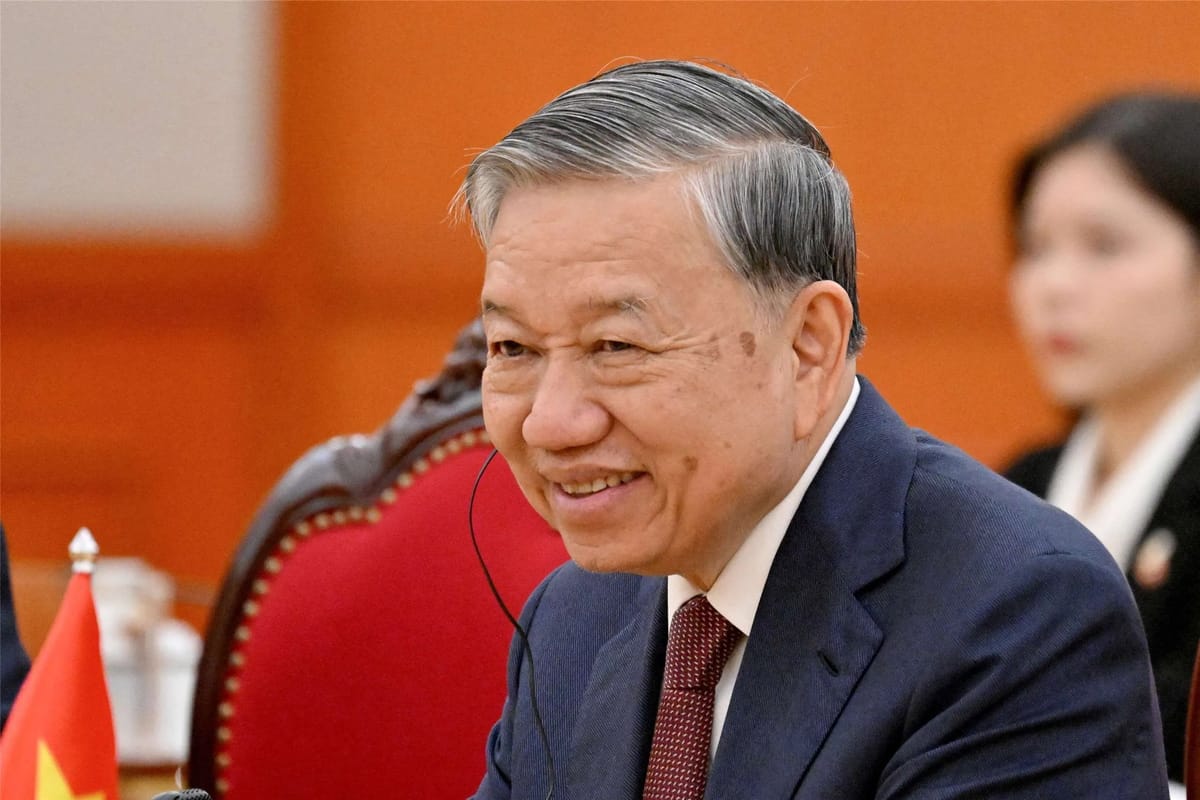
In January, Vietnam's Communist Party wrapped up its 14th National Congress. Tô Lâm, 68, was re-elected General Secretary with a unanimous 180 votes.
It is the most powerful position in Vietnamese politics.
Born Into the Security Apparatus
Tô Lâm was born in 1957 in Hưng Yên province, northern Vietnam. His father, Tô Quyền, was provincial police chief of Hải Hưng, holding the rank of senior colonel. Growing up inside the public security system, his career path seemed almost predetermined.
He entered the People's Security University at 17. Five years later he graduated and joined the Ministry of Public Security. He never left. Over four decades he earned a law doctorate and a professorship — rare credentials within the security establishment.
The rise was steady: deputy division chief in 1988, division chief in 1990, deputy director in 1993, director in 1997. Deputy minister in 2010. Minister of Public Security in 2016 — entering the top leadership tier. In 2019, he received the rank of General, the highest in the public security system.
The Upheaval of 2024
2024 was arguably the most dramatic political year in Vietnam since independence.
In March, President Võ Văn Thưởng resigned over corruption links after just one year. In April, National Assembly Chairman Vương Đình Huệ stepped down for similar reasons — 11 days after his case surfaced. In May, Permanent Secretary Trương Thị Mai also resigned. Three of Vietnam's "four pillars" of leadership, replaced in three months.
All the departures traced back to the "Blazing Furnace" anti-corruption campaign launched by General Secretary Nguyễn Phú Trọng. The man running the campaign on the ground was Tô Lâm, as public security minister.
In May, Tô Lâm was appointed President. In July, Nguyễn Phú Trọng died after leading the party for 13 years. In August, Tô Lâm was elected General Secretary while keeping the presidency — making him the most powerful Vietnamese leader since Hồ Chí Minh.
The Anti-Corruption Enforcer
Much of Tô Lâm's political capital comes from anti-corruption work.
When Nguyễn Phú Trọng launched the "Blazing Furnace" in 2016, Tô Lâm served as deputy head of the Anti-Corruption Steering Committee, handling day-to-day enforcement. The scale was staggering: by 2024, over 2,700 party organizations and 168,000 party members had been disciplined. Among them, 33 current or former Central Committee members and more than 50 senior military officers.
The casualties reached the very top — two presidents (Nguyễn Xuân Phúc and Võ Văn Thưởng) and one National Assembly chairman (Vương Đình Huệ). Since 2021, a third of the Politburo's members have resigned over political issues.
As others fell, Tô Lâm not only survived but climbed higher. The campaign cemented his image as an iron-fisted enforcer.
A Sweeping Government Overhaul
After taking power, Tô Lâm pushed through Vietnam's biggest administrative restructuring ever.
Launched in November 2024, the central ministry reorganization finished by March 2025. In July, a new "two-tier local government" system went nationwide. Provincial-level units shrank from 63 to 34. The district level was eliminated entirely. Over 6,700 commune-level units were cut.
Moving this fast carries risks. The long-term effects are still unclear.
Economic Ambitions
Tô Lâm has also set aggressive economic targets. The 14th Congress resolution calls for average annual GDP growth above 10% from 2026 to 2030 and per capita GDP of USD 8,500 by 2030. The long-term goal: high-income developed country status by 2045.
Bold numbers. Hitting them would mean shifting from cheap labor and exports to technology, innovation, and domestic demand.
"We must achieve double-digit growth to meet our targets," Tô Lâm said in his closing speech.
Diplomatic Balancing Act
On foreign policy, Vietnam sticks to "bamboo diplomacy" — flexible, non-aligned, bending without breaking.
Tô Lâm's first overseas trip was to China. In August 2024, he met Xi Jinping in Beijing. Chinese state media covered it heavily, calling it proof that Vietnam places "high importance" on the relationship. Both sides declared 2025 a "China-Vietnam Cultural Exchange Year" and agreed to align the Belt and Road Initiative with Vietnam's "Two Corridors, One Circle" framework.
But Vietnam doesn't put all its eggs in one basket. It maintained its Comprehensive Strategic Partnership with the U.S. In 2025 it upgraded diplomatic ties with 17 countries and signed 350 cooperation agreements.
Vietnam now has 10 Comprehensive Strategic Partners — China, the U.S., Japan, South Korea, Russia, Australia, and others. This multi-hedging approach gives Vietnam room to maneuver as U.S.-China rivalry sharpens.
The Next Five Years
Re-elected, Tô Lâm's term runs through 2031.
The challenges ahead are real: balancing between Washington and Beijing, delivering on double-digit growth, managing the human fallout from restructuring. But his grip on the party looks firm.
For the next five years, this leader who spent his entire career in the security apparatus will shape where Vietnam goes.