To Lam's First State Visit as Vietnam's President: Four Days in China, Three Cross-Border Railways, and a USD 256 Billion Trade Relationship
To Lam landed in Beijing on April 14 for his first foreign trip as state president. The real story isn't the optics. It's the three railways and the USD 256 billion trade list.
[To Lam's First State Visit as Vietnam's President: Four Days in China, Three Cross-Border Railways, and a USD 256 Billion Trade Relationship]
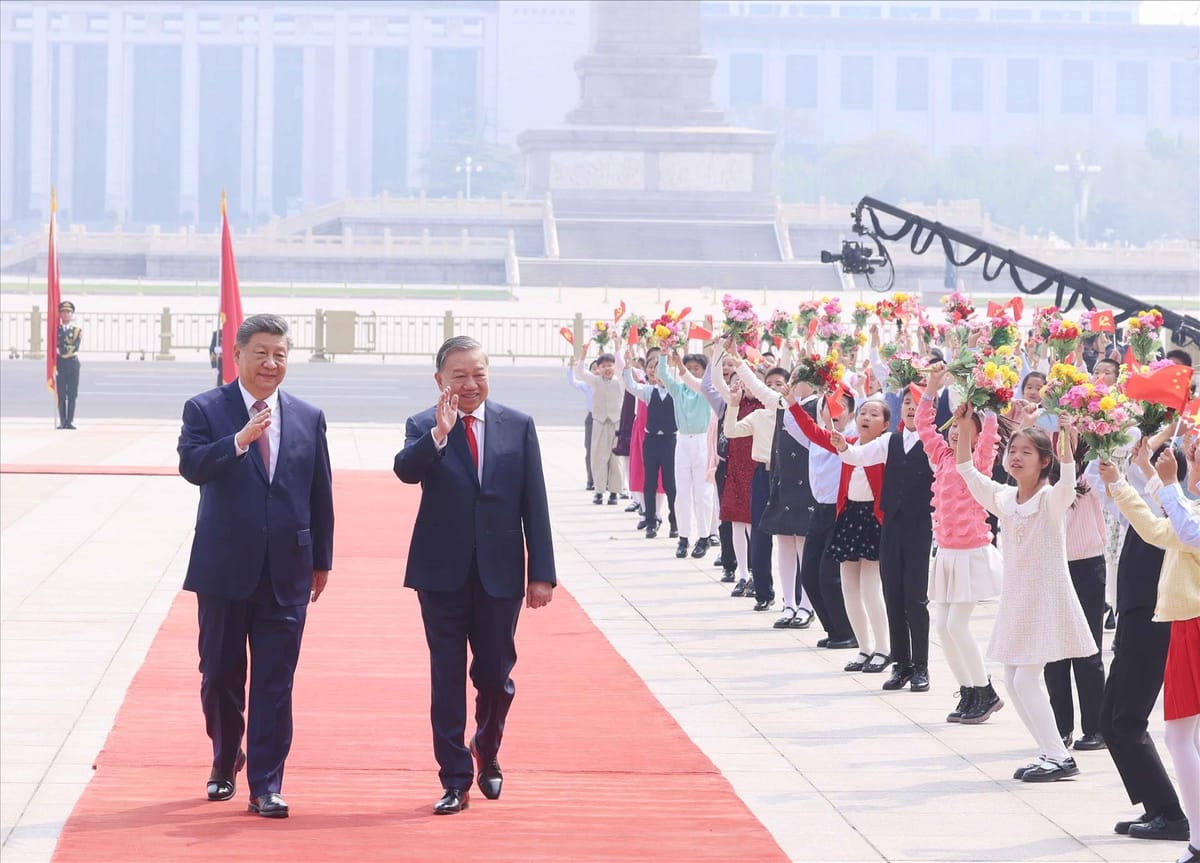
Vietnamese Party General Secretary and State President To Lam arrived in Beijing on April 14 for a four-day state visit, on Xi Jinping's invitation. He is traveling with his spouse, Ngô Phương Ly, and a high-ranking Vietnamese delegation.
This is his first trip abroad as state president. On April 7, Vietnam's National Assembly voted 495-0 to elect him to the 2026-2031 presidential term. Holding both the party chief and state president roles makes him the most powerful leader Vietnam has seen in decades.
▍ Why China, Why Now
Two timing coincidences stand out.
First, when To Lam took over as Party General Secretary in August 2024, his first foreign visit was also China. Going to Beijing again as state president repeats the same pattern.
Second, the trip falls in almost the same window as Xi Jinping's own state visit to Vietnam on April 14-15, 2025.
Add in the April 7 vote, which broke Vietnam's long-standing "four pillars" power-sharing arrangement, and traveling to China right after that consolidation is both an announcement at home and a statement abroad — the foreign policy center of gravity hasn't moved.
▍ Tsinghua Speech, Xiong'an Day Trip, Four of the Seven Standing Committee Members
April 14 was a full day. After landing at Beijing Capital International Airport in the morning, To Lam visited Xiong'an New Area in Hebei province — China's flagship new-city experiment, usually reserved for high-profile guests — then gave a policy speech at Tsinghua University in the afternoon.
On top of formal talks with Xi Jinping, To Lam is holding separate meetings with Premier Li Qiang, National People's Congress Standing Committee Chairman Zhao Leji, and Chinese People's Political Consultative Conference Chairman Wang Huning. China's Politburo Standing Committee has seven members, and meeting four in one trip is full state-visit protocol.
He is also scheduled to meet with Vietnamese embassy staff and the overseas Vietnamese community in China.
▍ USD 256 Billion and 5.28 Million Tourists: The Real Numbers
Why are both sides treating this trip as a big deal? Every number is growing in double digits.
In 2025, total Vietnam-China trade hit USD 256.4 billion, up 24.8% year on year. Vietnamese exports to China came in at USD 70.4 billion (+14.8%); imports from China reached USD 186 billion (+29%). China is Vietnam's largest trading partner, and Vietnam is China's largest trading partner within ASEAN.
Investment is on the same curve: Chinese FDI into Vietnam in 2025 hit USD 5.96 billion, up 33.4%. Tourism was even more striking — 5.28 million Chinese visitors, up 41.3%, about a quarter of all international arrivals.
The numbers set the stage. The real point of the visit is the cooperation list that comes next.
▍ Three Cross-Border Railways: A Real Timeline
In a pre-visit interview, Vietnamese Ambassador to China Phạm Thanh Bình laid out five pillars of cooperation: trade and investment, strategic connectivity, local cooperation, science and technology, and people-to-people exchange.
Strategic connectivity is the most concrete of the five, and it comes down to three cross-border standard-gauge railways.
First, the Lào Cai–Hà Nội–Hải Phòng line. The feasibility study is nearly complete, with full construction expected to start sometime in 2026. The line runs from Yunnan into northern Vietnam's industrial belt and all the way to Hải Phòng, northern Vietnam's largest seaport.
Second, the Lạng Sơn–Hà Nội line. Still in planning. This one handles the Guangxi-side cross-border flow.
Third, the Móng Cái–Hạ Long–Hải Phòng line. Also in planning. It forms the backbone of the northern coastal economic corridor.
Put together, the three lines would re-wire every major port and production base in northern Vietnam onto a single standard-gauge network. Add in the regular coordination meetings between Guangxi and six Vietnamese provinces, and the cost structure for overland logistics between southern China and northern Vietnam will look very different in a few years.
▍ The 3+3 Mechanism, Rare Earths, and Jet Fuel
In late 2024, the two countries announced a "3+3 strategic dialogue" — three ministers from each side, covering foreign affairs, defense, and public security.
The first ministerial-level meeting under this framework was held in Hanoi on March 16, 2026, just a month before To Lam's Beijing trip. Chinese Foreign Minister Wang Yi called it "the first of its kind globally" at that level.
In other words, on top of leader-level visits and economic commission meetings, China and Vietnam now have a standing minister-level "3+3" forum. A lot of sensitive issues that used to require escalation can now be handled directly.
Energy isn't on the official agenda, but it keeps surfacing in outside analysis. About 60% of Vietnam's jet fuel imports come from China and Thailand, and after the Middle East crisis flared, both countries suspended exports — cutting off Vietnam's biggest supply channel overnight. Starting in March 2026, Vietnam ran into an ongoing Jet A-1 shortage that forced domestic airlines to cut flights. We've tracked the whole story in a running series.
Nobody is going to frame this trip as Vietnam asking for help. But the timing, right after the fuel crunch with an active 3+3 mechanism in place, makes it hard to imagine energy not coming up at the table.
▍ What to Watch Next
Against the US-China tariff war, Vietnam's playbook is simple: open every backup channel. Negotiate tariffs with Washington, expand railways and investment with Beijing, and keep the two manufacturing backbones running — South Korea (Samsung alone exported USD 52 billion from Vietnam in 2024, about 13% of Vietnam's total exports) and Japan (the third-largest cumulative FDI source with over USD 79.4 billion). That is bamboo diplomacy in practice.
Before the visit ends on April 17, the two sides are expected to release a joint statement. What that statement says about rare earths, semiconductors, border trade, and digital cooperation will be the most important document for reading where practical cooperation goes next.