Vietnam Wants to Build a 99-Story, 500-Meter Skyscraper
Ho Chi Minh City has proposed a 99-story tower for its Thủ Thiêm district — taller than Landmark 81 and the centerpiece of Vietnam's new International Financial Center. But Thủ Thiêm's track record tells a more complicated story.
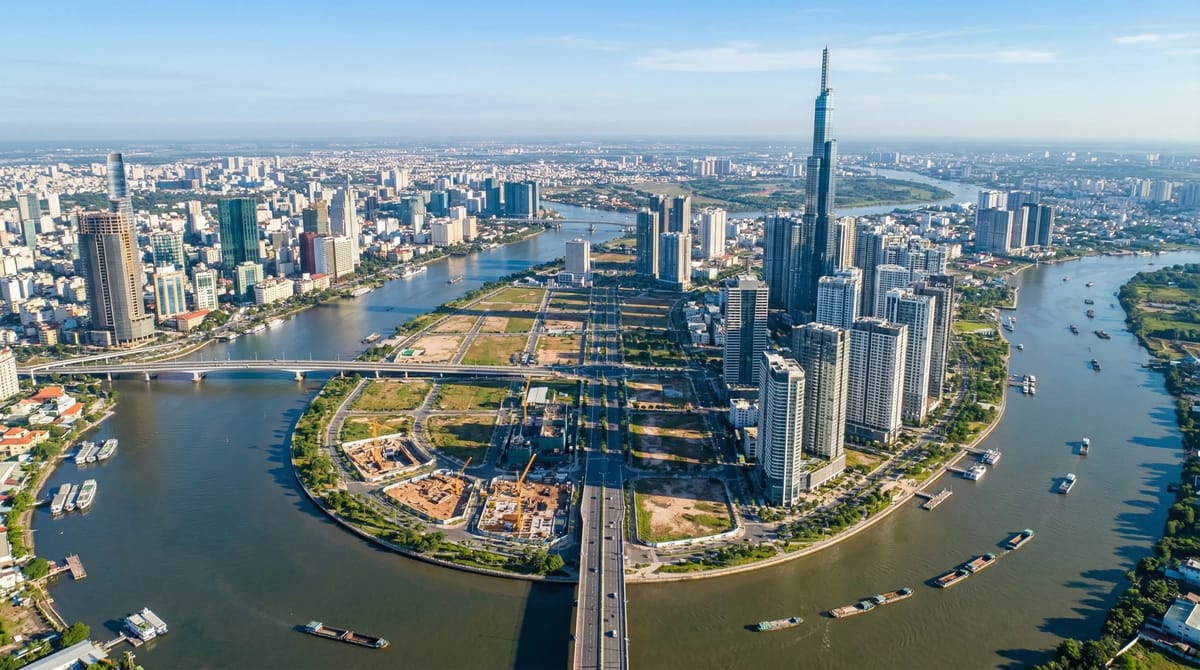
In February 2026, Ho Chi Minh City approved a revised master plan for the Thủ Thiêm New Urban Area, designating it as the site for a new international financial center and administrative hub.
The headline: a proposed 99-story tower, 500 meters tall, in Thủ Thiêm's core zone.
If built, it would surpass Landmark 81 as the tallest building in Vietnam.
The flagship of a financial center
The tower is designed to anchor the Vietnam International Financial Center (VIFC).
In late 2025, Prime Minister Phạm Minh Chính announced the center's creation. It formally launched in February 2026. Vietnam is running a "one center, two hubs" model: Ho Chi Minh City handles large-scale financial services, while Đà Nẵng focuses on fintech and green finance.
The Thủ Thiêm core area isn't just one tower. Plans call for over a dozen skyscrapers, with the financial center stretching from the old city center across the Saigon River into Thủ Thiêm.
Where the money comes from
The initial investment estimate for the entire financial center is roughly $7 billion. Officials say they've already secured close to $10 billion in commitments, with a target of bringing in 50 international financial institutions within three years. Binance was among the earliest to signal interest, signing a cooperation agreement with Ho Chi Minh City in late 2025.
The master plan is approved. Detailed planning for the 99-story tower is still underway. No developer has been named.
Thủ Thiêm's complicated past
Anyone who follows Vietnamese real estate knows to brace themselves when they hear "Thủ Thiêm."
This piece of land across the Saigon River has been designated as Ho Chi Minh City's future downtown since the 1990s. Three decades later, large stretches remain empty.
The most infamous episode came in late 2021. Four prime plots in Thủ Thiêm went to auction. A subsidiary of the Tân Hoàng Minh Group bid roughly $1 billion for one parcel.
The price stunned the market. Even the finance minister publicly called it "unusual."
A month later, Tân Hoàng Minh walked away, forfeiting its deposit. Another winning bidder did the same. All four auctions collapsed.
The scandal exposed a loophole in Vietnam's land auction system: bidders could submit inflated bids to pump up surrounding land values, then abandon their deposits and walk away with the gains. Vietnam revised its auction rules afterward.
New neighbors in Thủ Thiêm
The VIFC tower isn't the only marquee project in the district.
Trump Organization and Vietnamese developer Kinh Bắc City Development Corporation (KBC) plan a 60-story Trump Tower in Thủ Thiêm, with an investment of about $1 billion. Construction could start as early as 2026.
Ho Chi Minh City has also confirmed that a new political-administrative center and an international university will break ground in Thủ Thiêm during Q2 2026. At least 25 major projects are slated citywide for 2026, with Thủ Thiêm as the priority zone.
If everything stays on track, Thủ Thiêm's skyline will transform within a few years. But "if" has appeared too many times in this district's history.
Between the blueprint and reality
Vietnam wanting its own financial center makes sense.
Ho Chi Minh City generates over 20% of Vietnam's GDP, but its financial infrastructure has long lagged behind. The stock market was classified as a Frontier Market for years. FTSE announced in late 2025 that Vietnam would be upgraded to Emerging Market status in September 2026, but MSCI hasn't followed yet.
VIFC is dangling attractive terms: investors who hit obstacles can escalate directly to the prime minister's office through a "special channel." Phạm Minh Chính has also pushed government agencies to shift from "administrative management thinking" to "service facilitation thinking."
These are steps in the right direction. But getting international capital to actually flow in takes regulatory transparency, judicial independence, and free capital movement — not just a very tall building.
The blueprint for 99 floors is drawn. Thủ Thiêm's sky has room. The question is whether the ground can keep up.