Starbucks Has Been in Vietnam for 13 Years. Why Can't It Win?
In January 2026, Starbucks opened its 150th store in Vietnam. Sounds like a milestone — until you compare it to Highlands Coffee's 928 stores and the country's 500,000 coffee shops. The world's biggest coffee chain is still a bit player in the world's second-largest coffee-producing nation.
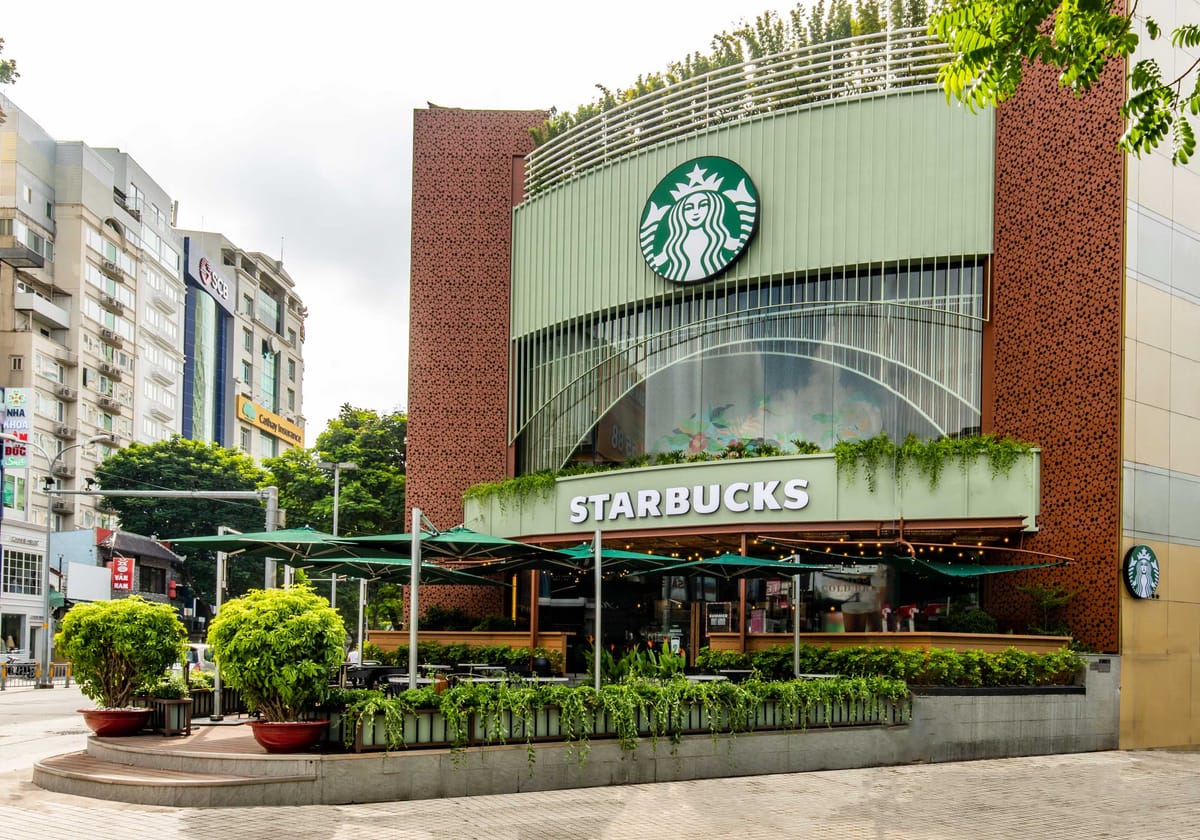
In January 2026, Starbucks opened its 150th store in Ho Chi Minh City.
That took 13 years. In the same market, Vietnam's own Highlands Coffee had 928 stores by September 2025, growing more than 50% in three years.
The world's dominant coffee chain, in the world's second-largest coffee-producing country, spent 13 years and still trails Highlands and Phúc Long in store count.
It's not the story you'd expect.
The coffee king's prophecy
January 2013. Starbucks opened its first Vietnam store beside the New World Hotel in Ho Chi Minh City's District 1. About a hundred people queued on opening day.
Đặng Lê Nguyên Vũ, the man Vietnamese media call the "coffee king," fired a public shot: "What they sell isn't coffee. It's sugar water that tastes like coffee."
He went further: "Even at their best, they'll have about 100 stores after ten years."
Đặng Lê Nguyên Vũ founded Trung Nguyên Coffee. His G7 instant coffee beat Nescafé in a 2003 blind taste test and once claimed 38% of Vietnam's instant coffee market.
Fast forward ten years. In September 2023, Starbucks opened its 100th Vietnam store — just past the decade mark, barely clearing triple digits. Several Vietnamese outlets ran the story under headlines like "the prophecy comes true."
The world's second-largest coffee producer
To understand why Starbucks hit a wall here, you need to understand Vietnam's relationship with coffee.
Vietnam is the world's second-largest coffee producer, trailing only Brazil. Exports hit a record $8.9 billion in 2025. Most production sits in the Central Highlands, with Đắk Lắk province alone accounting for 30% of national output.
Some 96% of Vietnam's coffee is Robusta — more bitter, more intense, and higher in caffeine than Arabica. People who grew up drinking Robusta tend to find Arabica weak and flavorless.
Starbucks uses 100% Arabica worldwide. In most markets, that signals quality. In Vietnam, it's a liability.
A 60-cent iced coffee
French missionaries brought coffee to Vietnam in 1857. Fresh milk was scarce, so they paired dark-roasted coffee with condensed milk. That pairing endures as Vietnam's national drink: cà phê sữa đá — iced condensed milk coffee.
It's dead simple: a metal drip filter (phin) perched on a glass, condensed milk at the bottom, coffee dripping slowly through. Stir, add ice. A street stall charges 15,000 to 20,000 VND — roughly $0.60 to $0.80.
Vietnam has about 500,000 coffee shops. Most are street stalls and tiny independents. Plastic stools, small tables, facing the road. People sit for an hour or two — talking, cutting deals, scrolling phones, doing nothing. This isn't a working-class thing. Lawyers and engineers park themselves on the same sidewalks after work.
A basic Starbucks runs about 55,000 VND. Popular drinks hit 80,000 to 100,000 VND — three to five times street coffee prices. The average monthly wage in Vietnam is around $330. One Starbucks equals roughly 1% of a monthly salary.
Price is the obvious gap. The deeper one: drinking coffee in Vietnam and the experience Starbucks is selling are fundamentally different activities.
From Seattle to Saigon
Vietnam's largest coffee chain, Highlands Coffee, has an origin story with an ironic twist.
Founder David Thái was born in southern Vietnam, moved to the U.S. at age seven, and landed in Seattle — Starbucks' hometown.
He studied business at the University of Washington, returned to Vietnam in 1995, and started Highlands Coffee in 1999 selling packaged coffee through supermarkets and hotels. The first cafe opened in 2002, across from Notre-Dame Cathedral in Ho Chi Minh City.
Why Highlands works:
Pricing. A cup runs 29,000 to 75,000 VND, averaging around 40,000 — more than street coffee, about half of Starbucks. Consumer surveys show 77.5% of Vietnamese will pay 21,000 to 50,000 VND for a cup. Highlands lands in the middle of that range.
Product. The PhinDi line keeps the Vietnamese drip coffee foundation but layers on almond, chocolate, and cream for younger drinkers. The menu also includes tea, smoothies, and bánh mì. One store handles breakfast, afternoon breaks, and work sessions.
Locations. Highlands has locked down nearly every high-traffic spot in the country: airport terminals, malls, office lobbies, tourist landmarks. In 2025, it rolled out "Mini Cabins" at gas stations — single-employee kiosks with the full menu. That July, it opened its first drive-through in Ho Chi Minh City.
In 2012, David Thái sold 50% to the Philippines' Jollibee Group for $25 million. Jollibee holds 60% now, but Thái remains CEO.
The numbers: Highlands posted EBITDA of 1.05 trillion VND (about $41 million) in 2024. Same-store sales grew 10.4% in the first nine months of 2025. The company plans an IPO within 18 to 24 months, targeting $300 to $400 million at a potential valuation above $1 billion.
Compare that with Starbucks Vietnam: 2023 revenue of 1.3 trillion VND, gross margin of 19%. Highlands' gross margin sits around 70%.
The difference is structural. Starbucks imports everything from the U.S. to maintain global consistency. Highlands uses local beans and in 2025 invested nearly 500 billion VND in its own roasting plant near Cái Mép port.
The graveyard for foreign brands
Starbucks is at least still standing. Other foreign coffee brands weren't so lucky.
Australia's Gloria Jean's entered in 2006, managed six stores in a decade, and closed the last one in 2017.
Singapore's NYDC arrived in 2009, peaked at six stores, and shut down by 2016.
Italy's Espressamente Illy also came in 2009 with two stores. Its local investment partner went bankrupt. The brand vanished.
America's Coffee Bean & Tea Leaf has survived 15 years but has about 15 stores — a rounding error.
The freshest casualty: Thailand's Café Amazon. Back home, it's a national brand with over 4,400 stores, mostly inside PTT gas stations. Drivers fill up and grab a coffee — simple, effective.
Café Amazon entered Vietnam in late 2020. The problems were immediate. Vietnam has no PTT gas stations, so the entire business model was DOA. The menu of iced lattes and caramel mochas had zero localization. Prices matched local brands, but nobody knew the name.
At peak, Café Amazon had 22 Vietnam stores. By November 2025, all were gone.
Every one of these brands made the same mistake: they copied a formula that worked somewhere else and pasted it into Vietnam without understanding what Vietnamese coffee drinkers actually want.
The dark horse: Katinat
If you only looked at the foreign brands' track record, you'd think this market was unwinnable. But a local upstart has been sprinting.
Katinat opened its first store in District 1 of Ho Chi Minh City in 2016. The name comes from "Rue Catinat," the French colonial name for Đồng Khởi Street. Founder Trương Nguyễn Thiên Kim is married to the chairman of Vietcap, one of Vietnam's leading brokerages.
For five years, Katinat had about ten stores, playing the long game. When COVID emptied storefronts, it pounced on prime locations at bargain rents.
In 2022, a rainbow gradient cup went viral on social media and ignited the brand. Revenue jumped 403%. Stores tripled. By September 2025, Katinat had 114 locations.
Its playbook is different from Highlands. Instead of traditional Vietnamese coffee, Katinat leads with fruit teas and matcha fusion drinks, targeting a younger crowd. The location strategy: own the prettiest corners. Đồng Khởi Street, the Bạch Đằng waterfront, next to Notre-Dame Cathedral, inside Landmark 81. Every store is designed to photograph well, giving the brand strong organic social media reach.
By Q3 2024, Katinat had 62,700 social media mentions — surpassing Highlands as the most-discussed coffee brand in Vietnam.
It hasn't been spotless. In September 2024, Typhoon Yagi devastated northern Vietnam. Katinat announced a donation of 1,000 VND per drink sold. At 50,000 VND a cup, that's 2%. The internet erupted.
Katinat apologized quickly, explaining it had already donated 1 billion VND before the campaign. An Ernst & Young audit later confirmed: 83 stores sold 888,696 cups in 19 days — 564 cups per store per day. The controversy accidentally proved Katinat's per-store sales power.
The acquired and the pivoting
Not every local brand is expanding.
The Coffee House is the cautionary tale. Founder Nguyễn Hải Ninh launched it in 2014, hit 100 stores in four years with a "neighborhood coffee" concept, then stepped back from management in 2019 and left entirely in 2021.
What followed: four CEO changes. Stores peaked around 150 in 2023, then slid. By late 2024, only 93 remained. The chain had pulled out of Đà Nẵng, Cần Thơ, and other cities. In January 2025, Golden Gate — Vietnam's largest restaurant group — bought 99.98% of the company for 270 billion VND (about $10.5 million).
Three years earlier, The Coffee House was valued at over $50 million. Golden Gate paid a quarter of that.
The only profitable year was 2018. Five straight years of losses followed. Gross margins were solid at 70%-plus, but operating costs never came under control. By late 2021, net assets had gone negative.
Phúc Long tells a different story. Founded in 1968 in Bảo Lộc, Lâm Đồng province, it sold wholesale tea and coffee for half a century before opening its first modern store in Ho Chi Minh City in 2012.
Between 2021 and 2022, the Masan Group poured about $280 million across three rounds for an 85% stake. The plan: stuff Phúc Long kiosks into Masan's WinMart+ convenience stores. In one year, kiosk count went from zero to over 1,000.
The kiosks hemorrhaged money. Q4 2022: kiosk revenue of 44 billion VND, losses of 100 billion. Masan slashed most kiosks and pivoted back to standalone stores.
After the reset, Phúc Long's standalone locations hit 65% gross margins — the best in Masan's portfolio. Full-year 2025 revenue reached 1.891 trillion VND with 195 billion in net profit, both records since Masan took over.
One telling detail: in late 2024, Phúc Long hired Patricia Marques — Starbucks Vietnam's former managing director — as CEO. Marques had spent 11 years building Starbucks' presence in Vietnam from the ground up. Now she's playing for the other team.
Why Starbucks can't speed up
Line up all the pieces and the picture is clear.
Wrong flavor. 96% of Vietnamese coffee is Robusta — strong, bitter, intense. That's the taste people grew up on. Starbucks insists on Arabica. Many Vietnamese drinkers shrug: "Doesn't taste like coffee."
Too expensive. Street coffee: 15,000 VND. Highlands: 40,000. Starbucks: 65,000 to 100,000. At an average monthly wage of $330, Starbucks is an occasional treat, not a daily habit.
Cost structure works against it. Starbucks doesn't source beans locally. Everything is procured, roasted, and shipped from the U.S. In the world's second-largest coffee-producing country, the coffee beans are imported. Gross margin: 19%. Local competitors: 65–70%. Prime rents are punishing — the Bitexco Tower Reserve store in Ho Chi Minh City reportedly pays 1.9 billion VND per month ($77,000).
Crushing competition density. 500,000 coffee shops, one every few steps. Brand loyalty is naturally thin when there's always another option within arm's reach.
Cultural mismatch. Starbucks sells the "third place" — a comfortable space between home and work. That's usually a differentiator. But Vietnam already has its own third place: a plastic stool on the sidewalk, an hour of sitting, chatting, dealing, watching the world go by. What Starbucks offers isn't scarce.
For context: Thailand has 507 Starbucks locations, the Philippines about 460, Indonesia 603. Vietnam has 150, with a population over 100 million. That's 1.5 stores per million people — the lowest among major Southeast Asian markets.
Starbucks has made localization attempts. It partnered with indigenous farmers in Đà Lạt for two Vietnamese single-origin beans sold in its global Reserve series. Its 2024 salted coffee (cà phê muối) line drew from the traditional salted coffee of Huế.
These moves are real but remain tiny against the scale of the problem.
A market with 500,000 coffee shops
An interesting shift is underway: small shops are shutting down in large numbers while chains keep growing.
In the first half of 2025, over 50,000 food and beverage outlets closed across Vietnam. Meanwhile, Highlands added a net 78 stores in nine months, Phúc Long added 79, and Katinat added 24.
Consolidation is picking up speed. Vietnam's chain coffee stores are projected to pass 5,200 locations in 2025, still climbing.
This trend is actually Starbucks' opening. As incomes rise, younger consumers warm up to international brands, and FTSE's emerging market upgrade brings in more foreign capital and white-collar workers, the target audience should grow.
But until then, Starbucks needs to accept something: in Vietnam, coffee isn't just a drink. It's culture. And that culture lives on the plastic stools lining the sidewalk, in the slow minutes as coffee drips through a metal filter into a glass of condensed milk.
Đặng Lê Nguyên Vũ was blunt thirteen years ago, but he was right about the core insight.
In this market, brand power and capital aren't enough. You have to understand what that cup of coffee means to the people drinking it.