A Century of Horses in Saigon: The Rise and Fall of Phú Thọ Racetrack
2026 is the Year of the Horse. Saigon's century-old Phú Thọ Racetrack — once Asia's largest — is being turned into a park. Here's the story it leaves behind.
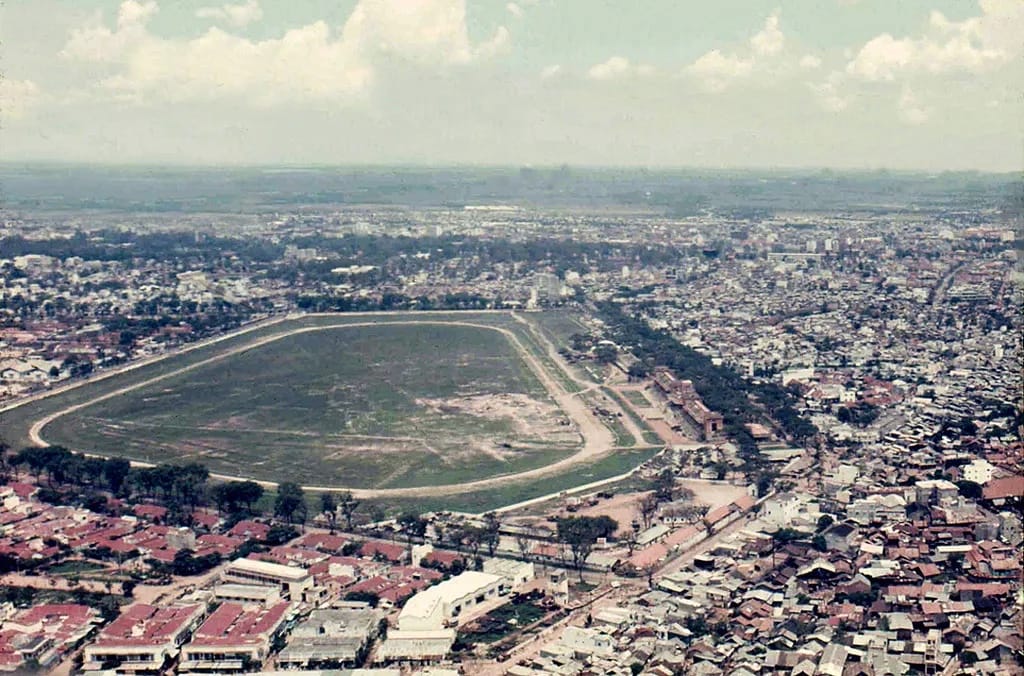
It's the Year of the Horse — the Fire Horse, which rolls around once every sixty years. In District 11 of Ho Chi Minh City, crews broke ground last year to turn the Phú Thọ Racetrack (Trường đua Phú Thọ) into a public park and road network. The project should wrap up this year.
For almost a century, this patch of land has been a colonial gambling palace, a battlefield, a parking lot, and a karaoke complex. This is the story of Saigon's racetrack.
Eight Arabian Horses From Hanoi
Horse racing in Saigon predates most people's assumptions. The first recorded race was in 1864, organized by French colonists near what's now the intersection of Cách Mạng Tháng Tám and Điện Biên Phủ streets.
The man who turned it into an industry was Jean Duclos, a French merchant. In 1906, he shipped eight Arabian horses down from Hanoi and built the first real track in Chợ Lớn — Saigon's ethnic Chinese quarter, where wealthy merchants had deep pockets and a taste for risk. Duclos read the room. In six months he staged close to 200 races and got rich.
By 1912, the Sài Gòn Hippique Club was formally established. Horse racing had become the social calendar's centerpiece.
Forty-Four Hectares of Prime Real Estate
The original venue ran out of space. In 1932, a French businessman named Monpezat paid one million Indochinese piastres for 44 hectares of land in Phú Thọ village and built a proper racetrack. It took seven years to recoup the investment, but the result was one of Asia's largest tracks, with courses from 800 to 3,000 meters.
The Vietnamese novelist Hồ Biểu Chánh painted the scene in a 1935 book: cars and horse-drawn carriages jammed the entrance, every seat sold out, nearly half the crowd women. At the peak, some 1,200 racehorses were active around Saigon. Counting breeding stock and foals, the total topped 4,000.
A shadow economy sprouted around the track. The French called the professional punters "turfistes." Cantonese merchants in Chợ Lớn built intelligence networks. Fixers known as "tuy-dô" peddled tips on horse fitness and jockey intentions. Others skipped the middlemen and paid jockeys and owners directly to rig results.
When the Grandstands Became a War Zone
World War II ended the party. Japanese forces occupying French Indochina (1940-1945) seized the racetrack and confiscated the horses. Racing resumed after the war but never recovered its former scale.
Then came January 30, 1968 — the Tết Offensive. Phú Thọ sat at the junction of five major roads and was central Saigon's only open ground where helicopters could land. North Vietnamese strategists saw the value. At 3 a.m., the Sixth Bình Tân Battalion — 200 fighters and 100 support personnel — moved in from the west and took the racetrack.
U.S. forces assembled Task Force Gibler and sent in M113 armored personnel carriers. The fighting dragged on until February 11. Chợ Lớn was declared a free-fire zone. Air strikes and artillery leveled the grandstands that once overflowed with punters.
After reunification in 1975, the new government banned gambling. The track went silent.
Teenage Jockeys and a Honda 67
In 1989, Vietnam's Đổi Mới reforms cracked the door open. Horse racing crept back as a "sport." The racetrack was rebranded the Phú Thọ Sports Club, running weekend events for crowds of two to three thousand.
In 2003, Nguyễn Ngọc Mỹ — a Vietnamese-Australian businessman — took over operations through his company Thiên Mã and invested in upgrades. About 900 horses were racing, ridden by more than 40 jockeys.
Most of those jockeys were teenage boys. Huỳnh Văn Tỏn started in 1969 at 32 kilograms. A win paid VND 60,000. A Honda 67 motorcycle cost VND 29,000. Two wins, one motorbike.
Before every race, jockeys went to a temple and swore they wouldn't throw the result. The ritual dated to colonial times and lasted until the track closed.
Child labor, though, was always the unresolved question. In 2009, city authorities banned minors from riding, citing child protection laws. Without light teenage jockeys, race quality dropped fast.
The Last Horse
On May 31, 2011, Ho Chi Minh City's People's Committee pulled the plug. Mismanagement and out-of-control gambling were the official reasons. The last horse left the track, and nearly a century of racing in Saigon was over.
For the next decade, the 360,000-square-meter lot became a patchwork of parking lots, restaurants, karaoke joints, and mini football pitches.
In 2025, District 11 began redevelopment. The city invested VND 200 billion (about USD 7.7 million) to cut five roads through the site. A 6.45-hectare park broke ground in November, along with a high school and sports facilities, all expected to open this year.
In the Year of the Horse, Saigon's last racetrack becomes a park. The old jockeys have four words for that era: "một thời lừng lẫy" — a time of glory.