Qualcomm's Vietnam Chief Says 2026 Is the Country's 'Golden Moment' for Tech. What Do the Numbers Say?
Qualcomm's Vietnam GM calls 2026 the golden moment for tech. Foreign money is flowing in, local players are breaking ground, and FTSE is upgrading Vietnam. The data is moving — but the talent gap and production timeline are the biggest unknowns.
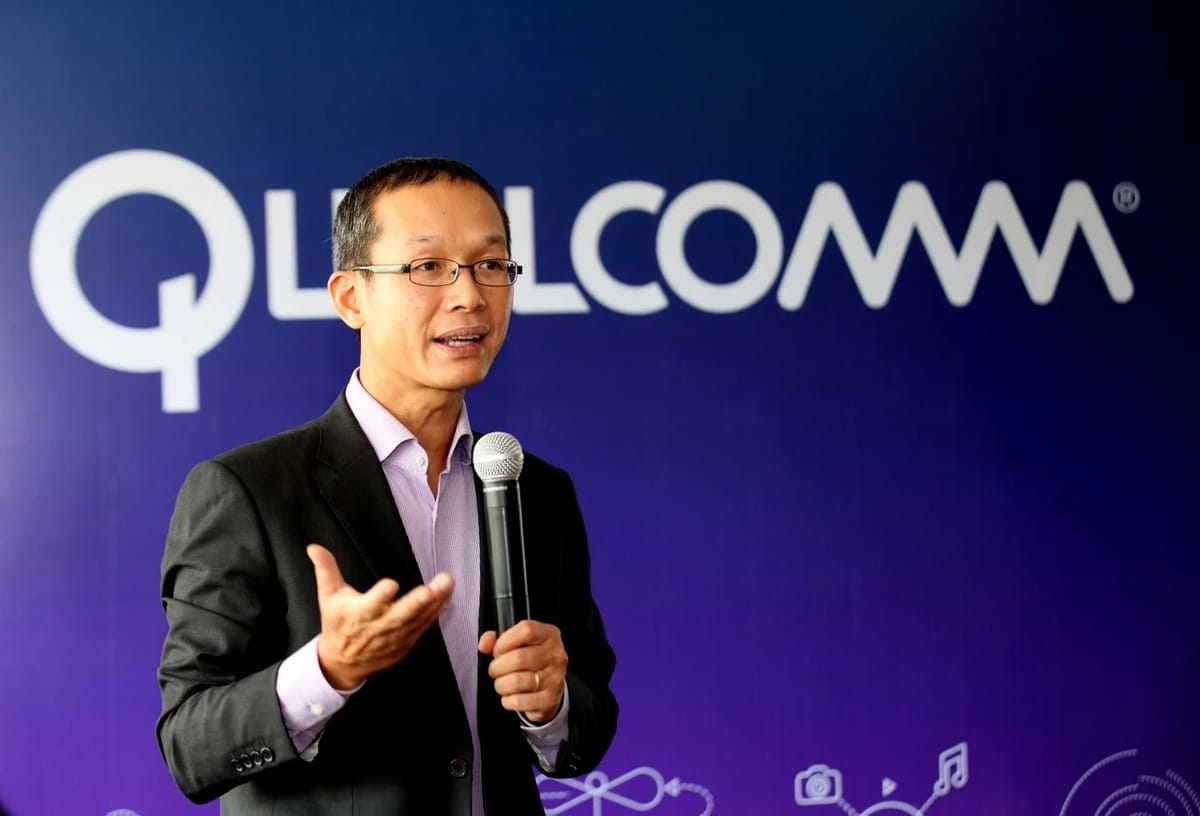
In a post-Lunar New Year interview with VnEconomy, Thiều Phương Nam — Qualcomm's general manager for Vietnam, Laos, and Cambodia — made a big call: "2026 is the golden moment for Vietnam's tech industry."
He's spent 25 years in Vietnam's tech world, working across Intel, IBM, and Qualcomm. A claim like that, from someone with that resume, is worth examining.
Who he is
Thiều Phương Nam got an engineering doctorate in Russia, returned to Vietnam, and joined Intel at 29. He stayed a decade, rising to business director. Then he moved to IBM Vietnam as regional vice president, covering finance, telecom, and government. In late 2012, Qualcomm tapped him to run Vietnam, Laos, and Cambodia. He's been in the role for over 13 years.
He's one of a small number of Vietnamese professionals who went from engineer to regional head of a multinational. From 3G to 5G to AI, he's been present for every inflection point in Vietnam's tech industry.
What "golden moment" means
Thiều Phương Nam made three observations in the interview.
First, digital infrastructure has reached the point where it matters. Cloud, edge computing, and data governance frameworks are mature enough for companies to deploy AI at scale.
Second, capital is shifting. Vietnamese venture money used to go almost entirely into consumer apps. Now it's starting to reach semiconductors and AI.
Third, the talent pipeline is forming. Vietnam is developing real capability in systems engineering, AI, and IC design — enough to take on higher-value work.
Where the foreign money is going
Vietnam has 174 semiconductor-related FDI projects with registered capital approaching $11.6 billion.
In 2025, U.S.-based Coherent opened a $127 million silicon carbide plant in Đồng Nai province. Amkor, also American, is investing about $1.6 billion in Bắc Ninh across three phases. South Korea's Hana Micron has committed roughly $930 million through 2026. NVIDIA set up an R&D center.
But most of this money sits in packaging and testing — the downstream end of the chip value chain. Foreign companies are coming for Vietnam's labor costs and geographic position, not its design talent. There's still a wide gap between that reality and Thiều Phương Nam's vision of Vietnam as a "design hub."
Qualcomm's own move is more interesting. In June 2025, it opened AI R&D centers in Hanoi and Ho Chi Minh City — its third AI research sites outside the U.S., after India and Ireland. The teams are entirely Vietnamese engineers working directly on global products, led by Hung Bui, formerly of Google DeepMind.
That's one of the few cases of genuine R&D investment, not just assembly.
Is Vietnam ready on its own terms?
Local companies are moving with more urgency than ever.
In January 2026, military-run telecom giant Viettel broke ground on Vietnam's first wafer fabrication plant, targeting trial production by late 2027. The same month, FPT announced a packaging and testing facility in Bắc Ninh — Vietnam's first domestically owned OSAT plant — with six test lines planned for phase one. FPT Chairman Trương Gia Bình put it simply: "Whatever Viettel produces, FPT will package and test."
In early March, FPT, Viettel, and VNG all joined Qualcomm's global 6G alliance.
The direction is unmistakable. But everything is still early. Viettel's fab is at least two years from mass production. FPT's OSAT plant won't complete phase one until 2027. Plans and production are not the same thing.
Talent is the other bottleneck. Vietnam has about 15,000 semiconductor workers — roughly 7,000 in IC design, 7,000 to 8,000 in packaging and testing. The government wants 50,000 semiconductor engineers by 2030, including 15,000 in IC design. Ho Chi Minh City now hosts over 50 fabless design firms and multinational R&D centers. The ecosystem is growing, but the talent gap remains the single biggest variable in whether any of these plans actually deliver.
The bigger picture
In October 2025, FTSE Russell announced that Vietnam will be upgraded from Frontier Market to Emerging Market in September 2026. An estimated $6 billion in passive index-tracking capital is expected to flow in. Not all of it goes to tech, but the broader boost to the investment environment and corporate valuations lifts everyone.
For semiconductors specifically, the market confidence from the FTSE upgrade may carry more weight than any government policy.
Five years ago, asking whether Vietnam could earn a seat at the global semiconductor table would have drawn skepticism. Today, the money is moving, the people are moving, and the policies are moving. Whether Thiều Phương Nam's "golden moment" has already arrived or is still on its way — only time will tell.