Takaichi's 48 Hours in Hanoi: Japan to Unveil Reworked Indo-Pacific Strategy on Vietnamese Soil
Sanae Takaichi makes her first visit to Vietnam as Japan's prime minister. The 48-hour trip packs both summits and a major foreign-policy speech into a single day. Hanoi has been picked as the launch pad for Japan's reworked FOIP framework.
[Takaichi's 48 Hours in Hanoi: Japan to Unveil Reworked Indo-Pacific Strategy on Vietnamese Soil]
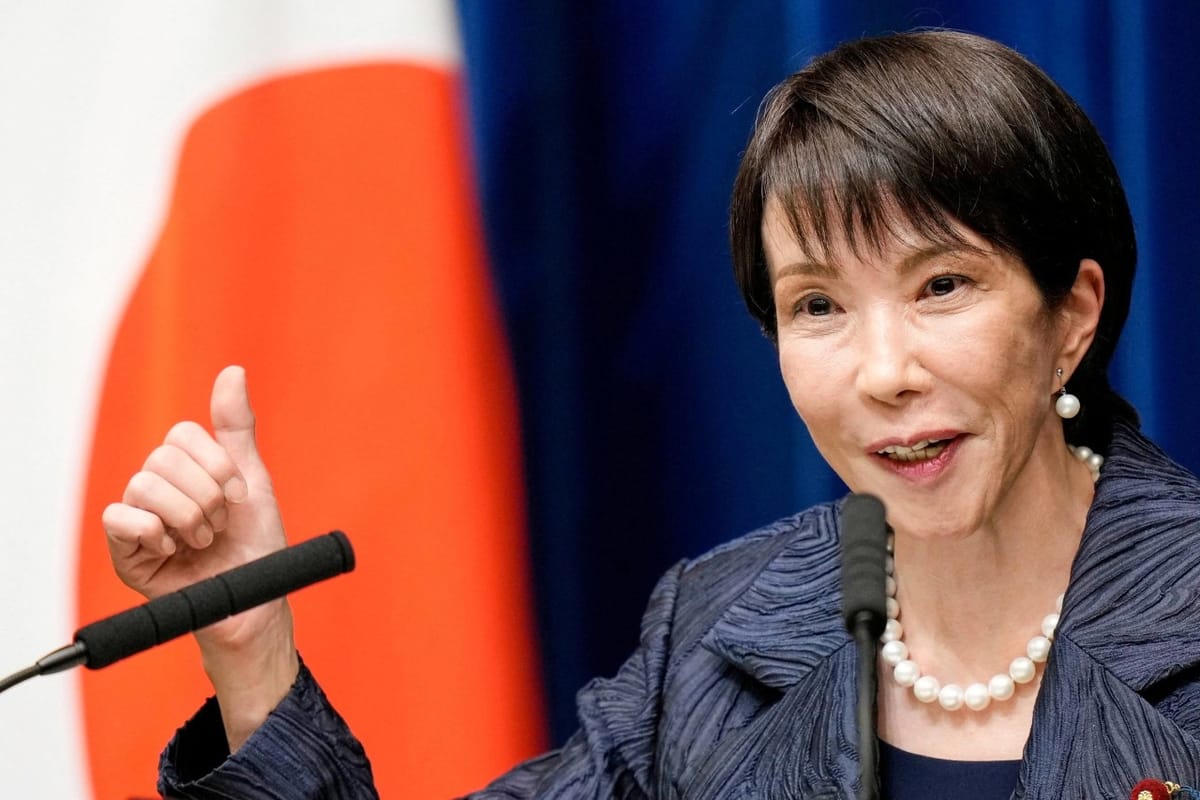
Japanese Prime Minister Sanae Takaichi left Tokyo on the morning of May 1 and landed in Hanoi the same evening, kicking off a three-day official visit to Vietnam.
It is her first trip here since taking office in October 2025, and her first as prime minister.
The schedule is tight.
On May 2, she will meet separately with Vietnamese Communist Party General Secretary and State President Tô Lâm and Prime Minister Lê Minh Hưng, then deliver a foreign-policy address at Vietnam National University, Hanoi (VNU-Hanoi).
She flies to Canberra the next morning.
Her actual time on Vietnamese soil works out to less than 48 hours.
But the substance of this visit is much more than a polite bilateral handshake.
What matters is the May 2 speech — Takaichi's first full public address on foreign policy as prime minister, and Tokyo chose Hanoi to host it.
01|A 48-Hour Itinerary, with Everything Crammed into May 2
Japan's Ministry of Foreign Affairs released the schedule on April 28. It is unusually clean:
➤ Fri, May 1 — Tokyo to Hanoi
➤ Sat, May 2 — Japan-Vietnam summits and policy speech
➤ Sun, May 3 — Hanoi to Canberra
➤ Mon, May 4 (holiday) — Japan-Australia summit
➤ Tue, May 5 (holiday) — Canberra to Tokyo
The trip falls during Japan's Golden Week holidays — part of the Takaichi cabinet's broader outbound diplomatic push this season.
On the Vietnam leg, the entire substance of the visit is concentrated on May 2: bilateral summits, the policy speech, and meetings with other Vietnamese leaders all happen back-to-back that day.
She meets two people.
The first is Tô Lâm, who holds both the Communist Party chief and head-of-state positions and has become Vietnam's most powerful single leader in years.
The second is Prime Minister Lê Minh Hưng, who is hosting a Japanese prime minister on his own turf for the first time.
After Vietnam, Takaichi flies straight to Australia.
2026 marks the 50th anniversary of the Japan-Australia Basic Treaty of Friendship and Cooperation. Tokyo has packaged the Vietnam and Australia visits as a single trip, and the framing is clear: Japan is reasserting two pillars of its Indo-Pacific posture — a Southeast Asian strategic partner and a South Pacific treaty ally.
02|The "New FOIP" Tackles Problems the Abe Version Never Addressed
Before going further, one editorial choice worth surfacing: this article could have been framed as Japan's anti-China push into Southeast Asia. We chose not to.
Centering the story on China-Japan rivalry would pull focus away from what this visit is actually about. The May 2 speech isn't really about China. It's about how Tokyo wants to redefine FOIP.
That speech has been previewed by multiple Japanese outlets in the days leading up: Takaichi will unveil an updated version of Japan's Free and Open Indo-Pacific (FOIP) framework.
FOIP was launched by Shinzo Abe in August 2016 at TICAD VI in Tokyo. The original version was built around rule of law, freedom of navigation, and free trade — wrapped in the language of "connectivity" through cross-regional infrastructure.
It was, in essence, a doctrine of order and infrastructure cooperation, designed mainly as a counterweight to China's Belt and Road expansion.
Two things have happened over the past decade that the Abe version never addressed.
First, the US-China tech war pushed semiconductors, rare earths, and critical minerals into national security territory.
Second, the war in Ukraine and the conflict in the Middle East rewrote energy and food supply chains. "Cutoff risk" became a state-level threat.
Takaichi's reworked FOIP is meant to plug those two gaps.
According to reporting from Jiji Press, Nikkei, and Mainichi Shimbun, the new version layers a fresh set of keywords on top of the law-and-order foundation: "autonomy and resilience" (自律性と強靱性).
Unpacked, the two terms mean:
➤ "Autonomy" — countries should not depend on a single supplier for critical materials, energy, or technology. The unspoken target is over-dependence on China.
➤ "Resilience" — supply chains should keep functioning when external shocks hit.
Wrapped around these keywords is a still-in-planning concrete framework: an energy-support architecture for Asian countries, tentatively called Power Asia (パワー・アジア).
On April 22, Jiji cited "multiple government sources" as saying Power Asia will sit alongside reinforced supply chains for critical materials, medical supplies, and strategic minerals — together forming the pillars of the new FOIP.
Put differently: the old FOIP was about order. The Takaichi FOIP is about cutoff risk.
The new version doesn't replace the old one. It adds a layer on top, importing "economic security" — a concept that originated in Japanese domestic policy — into a regional foreign-policy framework.
That layer turns FOIP from a piece of diplomatic rhetoric into something closer to operational industrial policy.
The choice of VNU-Hanoi as the venue is itself a signal.
At a Hanoi press conference on April 28, Japanese Ambassador to Vietnam Ito Naoki said picking VNU-Hanoi reflects Japan's recognition of ASEAN's central role.
The message Tokyo wants to send: the new FOIP is meant to serve ASEAN countries' own interests, not just the agenda of the US-Japan alliance.
03|Why Vietnam, and Not Singapore or Jakarta
If you wanted a debut venue for a reworked FOIP, you could have picked Singapore (the regional financial hub), Jakarta (home to the ASEAN secretariat), or Manila (a US treaty ally).
Takaichi picked Hanoi.
Four reasons explain that choice.
➤ First: rare earths.
On April 13, when Takaichi spoke with Tô Lâm by phone, the readout published by the Japanese Prime Minister's Office explicitly noted that Vietnam holds the world's sixth-largest rare-earth reserves — and tied that fact directly to economic-security cooperation.
Japan and Australia have spent a decade building up Lynas Rare Earths into a major non-China supplier. Vietnam has the deposits but lacks the mining and processing capacity, making it the obvious next partner.
➤ Second: strategic autonomy.
The other notable element of that April 13 phone call was Takaichi's personal endorsement of Vietnam's "strategic autonomy" (戦略的自主) line.
Vietnam has long pursued a non-aligned posture, maintaining working ties with the US, China, Russia, Japan, and Europe in parallel.
For Takaichi, debuting a reworked FOIP in a country that practices strategic autonomy carries a different weight than debuting it in a treaty ally like Australia. The implicit message: this framework is something even non-aligned states can sign onto.
➤ Third: people.
There are now over 680,000 Vietnamese living in Japan, the second-largest foreign community in the country.
That number isn't just labor — it's the human-capital backbone for future cooperation in semiconductors, manufacturing, and elder care.
On the semiconductor front, the two sides are planning for Vietnam to train 500 doctoral-level researchers by 2030, with roughly half being absorbed through Japanese international research programs. The pipeline is just getting started.
➤ Fourth: the prep work is already done.
That April 13 call had already put rare earths, energy, and the Middle East situation on the table.
It happened during a stretch when Middle East tensions were squeezing oil supply, and the two sides confirmed they would cooperate on energy resilience across Asia as a whole.
By the time the May 2 summit happens, the energy and rare-earth talks are essentially pre-negotiated. May 2 is more about formalizing outcomes and turning high-level intent into concrete cooperation lists.
04|The Bilateral Foundation Is Already Thick
There's another reason — one not stated in diplomatic press releases — for picking Vietnam to debut the new FOIP. The economic relationship is already substantial enough that nothing has to start from scratch.
Japan and Vietnam established diplomatic ties in 1973 and upgraded to a Comprehensive Strategic Partnership in 2023, the highest tier of bilateral relationship in Vietnam's diplomatic system.
Two-way trade topped USD 51.43 billion in 2025. The first quarter of 2026 grew 12.7% year-on-year, and the next target is USD 60 billion by 2027.
Investment is just as solid.
As of January 31, 2026, Japan had 5,722 active investment projects in Vietnam, totaling USD 78.9 billion — third among 153 source countries.
Japan is also Vietnam's largest ODA donor. Bridges, metro systems, airports, thermal power, hospitals: yen loans have underwritten a large share of Vietnam's hardware upgrades over recent decades.
Ambassador Ito broke the visit's cooperation agenda into four buckets at the April 28 press conference:
➤ Innovation, science and technology, green transition
➤ Energy security and strategic infrastructure
➤ Diplomacy, defense, security, and contributions to regional peace
➤ People-to-people exchange and cultural and academic cooperation
Concrete items under those four buckets include the semiconductor doctoral pipeline (500 by 2030, half through Japan), LNG and renewable-energy investment under the energy transition, supply-chain cooperation on rare earths and critical minerals, and the social ties anchored by the 680,000-strong Vietnamese community in Japan.
What this list does is line up Japan's needs (rare earths, labor, new energy markets) with Vietnam's needs (capital, technology, talent development) in a way that nearly clicks together.
That's the foundation that lets the reworked FOIP debut in Hanoi. Whether the May 2 speech actually names these cooperation items in the text is something we'll only know once the full text is released.
05|The VNU-Hanoi Lecture Hall, Saturday Afternoon
On Saturday afternoon, Takaichi will walk into a lecture hall at VNU-Hanoi and deliver her first complete foreign-policy address as Japan's prime minister.
This article is published before the speech happens, so we won't speculate on her exact wording.
What can be said with confidence: words like "autonomy," "resilience," "Power Asia," and "economic security" will recur. Critical minerals, energy supply chains, and semiconductor cooperation will be the three narrative threads. And the choice of Hanoi as the venue itself sends a message — Japan wants to redefine "Indo-Pacific" not just for Tokyo, Washington, and Canberra, but for ASEAN as well.
What concrete outcomes the 48-hour visit produces will only become clear once the joint statement and follow-up implementation lists are released.
The real thing to track: whether Power Asia, rare-earth cooperation, and the semiconductor doctoral pipeline — all currently at concept stage — actually turn into bilateral agreements and capital flows.
The Viet Media Monthly
A curated monthly digest of the most important political, economic, tech, and industry developments in Vietnam.
Designed for reading on desktop or tablet — no algorithm, no noise. Just the stories that matter.
Delivered before the 10th of each month. Cancel anytime.