Saigon's Hà Tâm Gold Shop Has Quietly Closed. Vietnam's 2026 FX Rules Are the Bigger Story
Saigon's well-known Hà Tâm gold shop near Bến Thành Market has quietly shut its doors after 21 years, right as Vietnam's new 2026 currency rules tighten enforcement on unlicensed exchange.
[Saigon's Hà Tâm Gold Shop Has Quietly Closed. Vietnam's 2026 FX Rules Are the Bigger Story]
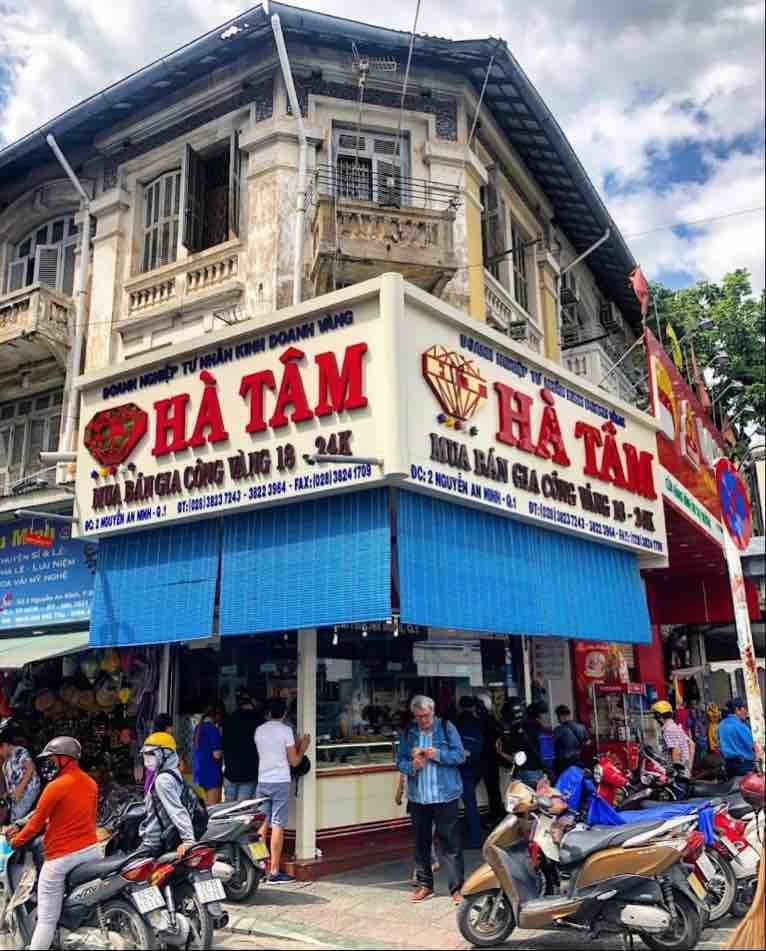
If you have ever changed money in Ho Chi Minh City, you probably know the small gold shop on the west side of Bến Thành Market.
2 Nguyễn An Ninh Street, the corner with the rate boards facing the sidewalk. Hà Tâm.
In recent days, that shop has closed.
01|The Storefront Is Closed. The Company Is Not.
Start with what is verifiable.
According to Vietnam's tax registry, the shop's full name is DNTN Kinh Doanh Vàng Hà Tâm. It opened in March 2005, which makes it 21 years old.
The legal representative is Dương Thị Thu Hoa.
Its registered scope is "retail of gold jewelry (excluding gold bars)" plus "agency for foreign currency exchange (only when permitted by the State Bank of Vietnam)."
That parenthesis at the end deserves a pause.
"Only when permitted by the State Bank of Vietnam" means the registration says Hà Tâm "may" act as an FX agent — but actually doing so requires a separate license from the central bank.
Business registration and a financial license are not the same thing.
Whether Hà Tâm ever actually held an SBV currency-exchange license is not visible in any public system.
About the closure itself: Vietnamese vloggers have been uploading clips of the shop with the shutters down. One video title reads "đóng cửa nghỉ" (closed for now). Another says "đã nhiều ngày" (closed for several days).
VnExpress, Tuổi Trẻ, CafeF — none of Vietnam's major outlets have reported on it. There is no official statement.
I checked the tax registry on May 2. Hà Tâm's registration status is still listed as "Đang hoạt động" — active. There is no record of dissolution or suspension.
So the storefront is dark, but the legal entity is not. An internal pause, a strategic shutdown, waiting something out — all are still possible. None has been confirmed.
I considered headlining this piece with "permanent closure" or "the end of an era." But one vlogger's title pegs a specific date, while another says it had already been shuttered for days. The two contradict each other. The factual ground is not solid enough, so this article will not give you a closing date and will not call it permanent.
02|The Real Change Is Legal
Read alone, Hà Tâm closing is a local story. Read against Vietnam's 2026 regulatory environment, it makes more sense.
On December 25, 2025, the government issued Decree 340/2025/NĐ-CP, a new framework for administrative penalties in the monetary and banking sector.
The decree took effect on February 9, 2026.
It redefines what it means, in legal terms, to change money at an unlicensed gold shop.
03|A Tiered Penalty Scale
The decree turns "buying or selling foreign currency at an unauthorized institution" into a clear violation, with fines scaled to amount.
➤ Under USD 1,000: warning
➤ USD 1,000 to under 10,000: fine of VND 10–20 million
➤ USD 10,000 to under 100,000: fine of VND 20–30 million
➤ USD 100,000 and above: fine of VND 80–100 million
These are individual penalties. For organizations — including the shop itself — fines double.
VND 100 million is roughly USD 4,000. For a casual tourist swapping USD 100, the rule is just a warning. The moment the amount crosses USD 1,000, fines jump into the thousands of dollars.
The decree also covers gold: violations of cross-border gold transport rules carry the same VND 80–100 million ceiling.
04|The Enforcement Cadence
After the decree took effect, the HCMC Market Surveillance Department (Chi cục Quản lý thị trường TPHCM) started moving.
Between March and April 2026:
➤ Team 5 (covering Xóm Chiếu, Khánh Hội, Vĩnh Hội, Chợ Quán, An Đông, and Chợ Lớn — areas dense with gold shops in the city's Chinese-influenced districts) cited 3 businesses, totaling VND 210 million in fines.
➤ Team 9 (Thủ Đức) cited 9 businesses, totaling more than VND 506 million in fines, plus 39 confiscated jewelry items.
➤ The merged former provinces of Bình Dương and Bà Rịa–Vũng Tàu, now part of expanded HCMC, saw 12 inspections and roughly VND 700 million flowing into the budget.
The flagged violations were mostly "goods of unclear origin" and "failure to display prices."
On the morning of April 27, Nguyễn Quang Huy, deputy head of the HCMC Market Surveillance Department, publicly announced that teams had been instructed to "step up patrols, inspections, and oversight of gold business activity."
That report came from Sài Gòn Giải Phóng, the city party committee's official paper.
Not long afterward, Hà Tâm's shutters came down.
The timeline lines up. But timeline alignment is not the same as causation. All I can say honestly is that the two events happened close together. Not that A caused B. There is no official document, no statement from the shop, and no major Vietnamese outlet linking the two.
05|From Gray to Black
This article will not list "alternative gold shops to use instead." I considered it and dropped it. Any shop named here could be on Team 5's next inspection list next week. A list that goes stale in days, and could mislead readers, is worse than no list.
But the structural change is worth being clear about.
The clearly legal channels for currency exchange in Vietnam are airport authorized counters, foreign exchange windows at major banks, and SBV-licensed exchange agents. None of these have been touched by the new rules.
What has changed is the layer underneath.
Money exchange at private gold shops used to live in a gray zone — everyone used it, everyone knew about it, but the licensing picture was murky.
Decree 340/2025/NĐ-CP paints that gray zone black. It is now an explicit violation.
The legal exposure goes both ways. The shop has it. So does the person changing money. Foreign tourists are not exempt — getting caught means a warning or a fine.
Has the rate gap itself changed? No. Banks still offer slightly worse rates than private gold shops. That spread has always been there.
What has changed is the question hanging over it: whether to take on the legal risk. The terms of that decision are no longer the same.
—
This article is a summary of public laws and publicly reported events. The starting date and reason for Hà Tâm's closure have not been confirmed by any official source or major Vietnamese media outlet as of publication. The description of the closure is based solely on local Vietnamese vlogger footage and should not be read as a legal accusation against the shop. Before exchanging currency or carrying foreign cash or gold across borders, consult a Vietnamese bank or lawyer to confirm current rules. This article does not constitute legal or financial advice.
The Viet Media Monthly
A curated monthly digest of the most important political, economic, tech, and industry developments in Vietnam.
Designed for reading on desktop or tablet — no algorithm, no noise. Just the stories that matter.
Delivered before the 10th of each month. Cancel anytime.