Hanoi's 100-Bowls-of-Pho Minimum Wage: The ILO's Case for a Living-Wage Reform
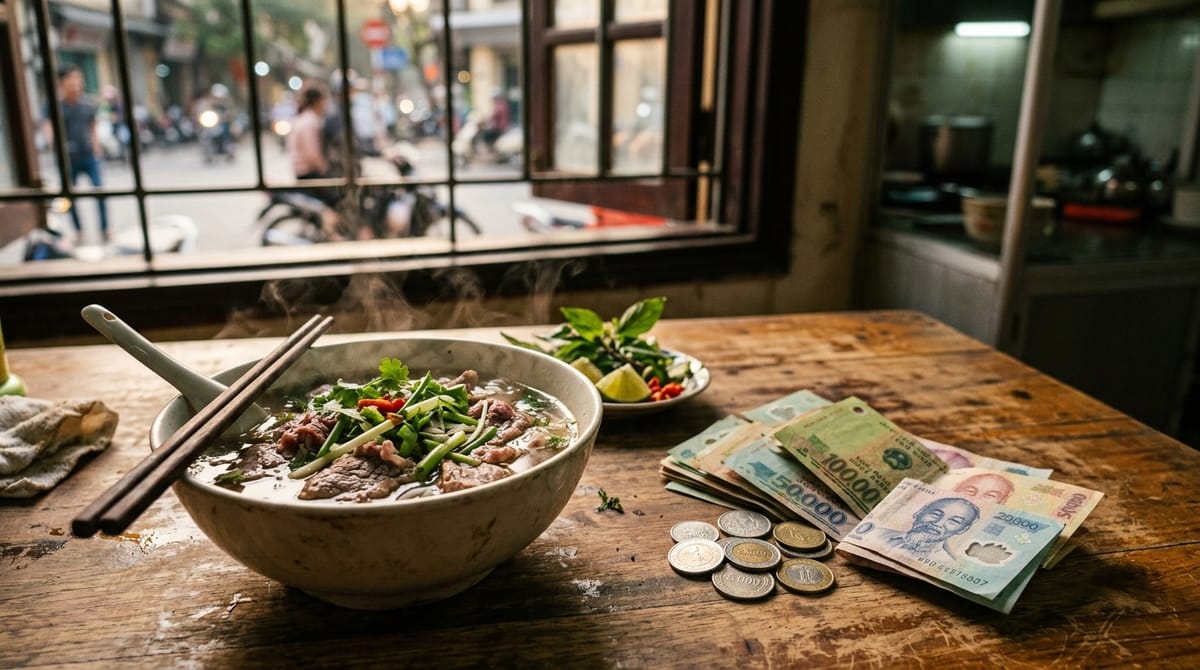
Hanoi's Region 1 minimum wage — VND 5.31 million a month — buys about 100 bowls of pho. The calculation comes from an ILO advocacy argument, not a Big Mac-style index. The real point is the gap between Vietnam's minimum wage and what it actually costs to live.
[Hanoi's 100-Bowls-of-Pho Minimum Wage: The ILO's Case for a Living-Wage Reform]
In mid-April, Vietnamese outlet Vietcetera ran a piece headlined "In Hanoi, an average monthly salary buys just 100 bowls of pho."
The framing sounds like the Economist's Big Mac Index, but it isn't. The Big Mac Index compares exchange rates across countries using a standardized product. The 100-bowls-of-pho figure is a rhetorical device from the International Labour Organization (ILO), and it's pointing at something different: the gap between Vietnam's statutory minimum wage and the actual cost of living.
▍ Whose Salary Is the "100 Bowls" Calculation Actually Based On?
The math is simple. Starting in 2026, Vietnam's adjusted Region 1 minimum wage — the rate for Hanoi, Ho Chi Minh City and other tier-one economic zones — is VND 5.31 million per month, or about USD 201. The hourly rate is roughly VND 25,500. Divide the monthly figure by an estimated VND 50,000 per bowl of pho and you land on about 106 bowls — three bowls a day.
One clarification matters: "100 bowls of pho" is based on the statutory minimum wage floor, not the average salary. Vietcetera's English headline used "average monthly salary," which is easy to misread. Vietnam's actual average monthly income for 2025 was VND 8.4 million, and Q4 hit VND 8.7 million (around USD 330) — both rising year on year.
Sinwon Park, director of the ILO Country Office for Vietnam, deliberately chose the floor to spotlight the survival pressure on workers at the bottom.
▍ Is Hanoi Really Vietnam's Most Expensive City?
Vietnam's General Statistics Office (GSO) publishes an annual Spatial Cost of Living Index (SCOLI), where 100 marks the most expensive province.
The 2024 reading: Hanoi 100, Quang Ninh 99.94, Ho Chi Minh City 99.8. The 2025 version, based on the post-merger 34-province structure: Hanoi still at 100, HCMC at 97.96. Hanoi has topped the list for seven straight years (2018–2024), but the gap to HCMC is only about 3%.
The real difference is in the breakdown. In the 2024 SCOLI, HCMC's education category was 35.23% more expensive than Hanoi's, while Hanoi led on housing. The "capital premium" is structural, not across-the-board.
▍ Where the Capital Premium Actually Comes From: Rent, Materials, Electricity
If Hanoi is only 3% pricier than HCMC overall, where does the "most expensive city" feeling come from? It's buried in the inflation breakdown.
Vietnam's CPI rose 3.31% in 2025, with core CPI at 3.21%. Hanoi's CPI was 3.63% — not much higher. But cut Hanoi's CPI by category and the "housing, utilities, fuel and materials" group jumped 8.30%, nearly 2.5 times the headline rate.
The sub-components are blunter:
➤ Hanoi rent, full-year 2025: +11.65%
➤ Construction materials: +12.31%
➤ Electricity: +7.16%
Concretely: a 20-to-30-square-meter studio in central Hanoi now rents for VND 3.5 to 7 million a month, up 10–15% year on year. Apartment sales have moved even faster. Q3 2025 saw Hanoi apartment prices hit VND 95 to 100 million per square meter (around USD 3,800), more than 40% above a year earlier.
Wage growth can't keep up with that kind of curve. GSO's official explanation points to the Red River Delta's concentrated industry and urbanization pressure, pushing up land demand against limited supply.
One Hanoi office worker put the pressure more plainly: "My salary is VND 12 million a month. I spend VND 8 to 9 million of that just on food."
▍ Wages Are Actually Rising — Just Not Fast Enough to Beat Rent and Power
The common shorthand — "wages in Vietnam can't keep up with prices" — doesn't hold up to the macro numbers.
➤ 2025 full-year average monthly income: VND 8.4 million, YoY +8.9%
➤ Q4 2025: VND 8.7 million (USD 330), YoY +6.2%
➤ 2021–2026 minimum-wage average annual increase: 8–10%
➤ CPI over the same period: 3.31%
On paper, Vietnam's real purchasing power is up. The gap appears when you look at which items outran wage growth. Rent, materials and electricity all rose faster than pay. For Hanoi's wage-earning middle, the squeeze lands squarely on those three bills.
And averages can mislead. In Q4 2025, urban workers averaged VND 10.4 million a month while rural workers earned VND 7.6 million — a 1.4x gap. High earners pull the urban average up; workers at the bottom feel a number well below the headline figure.
For someone on a low wage, central Hanoi rents of VND 3.5 to 7 million are simply unaffordable. The options are share, commute from further out, or move into company dormitory housing. That's where "wages never keep up" really comes from.
▍ The ILO's Prescription: Write "Living Wage" Into Policy
Sinwon Park's proposal is to use living wage — not minimum wage — as the anchor for Vietnam's wage policy.
Minimum wage is a statutory floor, negotiated between workers, employers and the government, weighted heavily by what employers can bear. Living wage works backward from what people actually spend on food, shelter, transport, healthcare and education.
Using standard international living-wage benchmarks, Vietnam's Region 1 living wage is roughly double the current minimum wage. Even after the 2026 minimum-wage adjustment (+7.1%), the floor still only reaches 57% of the benchmark.
That's why the ILO reaches for "100 bowls of pho" as a rhetorical frame. The aim is to move policy debate from "how much should the minimum wage rise" to "how much does a basic decent life cost."
Vietnam's government has offered a partial response. Starting in 2028, the country plans to publish an annual Minimum Living Standard as a reference point for wage policy. That's a first institutional step toward the ILO's framework, though still some distance from replacing minimum wage with living wage as the anchor.
▍ One Bowl of Pho, One Whole Structure
Pho as a measurement unit is rhetoric, not economics. But the substance it points at is real: on paper, Vietnam's real wages are rising, but the median worker doesn't feel it — because housing, building materials and electricity keep outpacing pay.
Cheap labor has been one of Vietnam's main FDI pitches for decades. What the ILO, academics and unions are pushing now is to write the living-wage concept into formal policy. The 2028 Minimum Living Standard launch will be the marker to watch; how far Vietnam moves from a "floor" logic to a "decent" one will depend on the policy package around it.
The 100 can become 150, or 200. As long as rent, materials and electricity keep outrunning wages, the metaphor's underlying point doesn't change.