Dong Nai Becomes Vietnam's 7th Centrally-Governed City: 4.49 Million People, Effective April 30
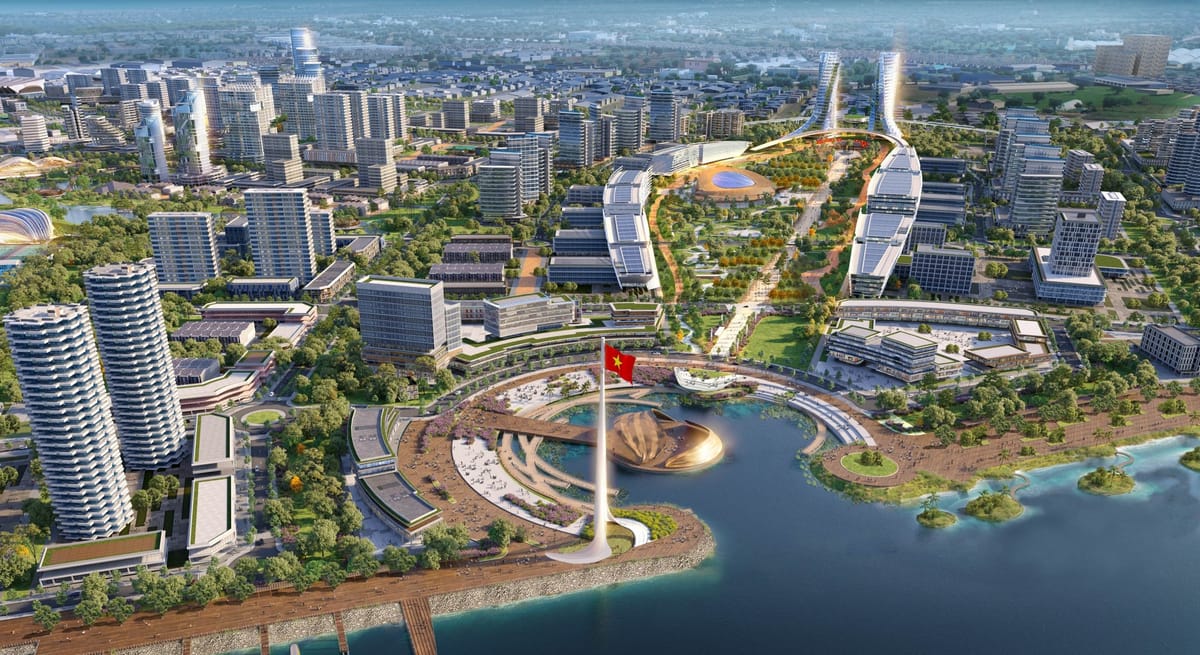
Vietnam established Dong Nai as its 7th centrally-governed city on April 30 — 38 days after the Politburo's March 23 endorsement. With 4.49 million people, GDP rank #4, and Long Thanh Airport opening this year, the upgrade aligns with Vietnam's southern metropolitan reset.
[Dong Nai Becomes Vietnam's 7th Centrally-Governed City: 4.49 Million People, Effective April 30]
Vietnam's administrative map gained a new entity on April 30, 2026.
The National Assembly passed the resolution to establish Dong Nai City on April 24 with 478 votes in favor (out of 487 present, 95.6% approval), taking effect six days later.
From the Politburo's March 23 endorsement (Document No. 1184-CV/VPTW), through the Central Committee's second plenary on March 25 (Resolution No. 03-NQ/TW), to April 30 effect — the entire process took just 38 days.
The former Dong Nai Province has been wholesale upgraded to a centrally-governed city, the seventh after Hanoi, Ho Chi Minh City, Hai Phong, Da Nang, Can Tho, and Hue.
In Vietnam's administrative hierarchy, centrally-governed cities sit at the same first-tier level as provinces — but report directly to the central government rather than any province, and receive direct budget allocation and master planning approval from the central level.
The new Dong Nai City takes the entire former province's land, population, and administrative units intact, with no boundary redrawing.
▍ The Scale
Dong Nai City covers:
➤ Area: 12,737 sq km (roughly one-third the size of Taiwan)
➤ Population: over 4.49 million
➤ Administrative units: 95 commune-level units, comprising 33 wards (urban) and 62 communes (suburban and rural)
➤ Borders: Ho Chi Minh City to the west, Lam Dong Province to the north, Tay Ninh Province to the northwest, and a stretch of border with Cambodia
This border configuration places Dong Nai at the intersection of a major metropolis, the Central Highlands, and an international border.
The administrative system itself stays unchanged: organizational structures, civil servant rosters, and special policies for the former province continue until they expire or are superseded.
For existing officials, April 30 brings no real job change. What changes is the city's standing in central-local relations.
▍ Meeting All 5/5 Conditions and 7/7 Standards
The decision wasn't sudden. The Southeast Region's 2030 master plan had long positioned Dong Nai as a future centrally-governed city, designed to share, connect, and complement Ho Chi Minh City's development.
Under the Local Government Organization Law (No. 72/2025/QH15) and the National Assembly Standing Committee's Resolution No. 112/2025, Dong Nai cleared every benchmark:
➤ Population 4.49 million (standard ≥ 2.5 million)
➤ Natural area 12,737 sq km (5x the standard)
➤ Wards-to-units ratio 33/95 = 34.7% (standard ≥ 30%)
➤ Urbanization rate 54.1%, urban population over 2.42 million (standard ≥ 45%)
➤ On April 16, 2026, the Ministry of Construction recognized Dong Nai as a Grade-I urban area (Decision No. 502-QD/BXD)
Socioeconomic indicators — per capita income, three-year GRDP growth, fiscal balance, industry-services share, poverty rate — also passed all thresholds.
▍ Dong Nai's Economic Foundation
Dong Nai ranked fourth in national GDP in 2025, after Hai Phong, Hanoi, and Ho Chi Minh City.
Foreign investment is where Dong Nai really stands out. In the first 11 months of 2025, it attracted nearly USD 2.5 billion in FDI — 132% of the full-year USD 1.9 billion target.
In the first seven months, Dong Nai ranked fourth nationally in FDI, one of nine provinces clearing the USD 1 billion mark.
By the end of 2025, Dong Nai hosted over 2,200 FDI projects from 51 countries and territories, with cumulative registered capital exceeding USD 42 billion.
The top five investing countries: South Korea, China, Japan, Taiwan, Singapore.
Transport-wise, Dong Nai has all five modes — road, air, rail, sea, and inland waterway.
▍ Aligning with Long Thanh Airport
The timing of the upgrade clearly aligns with Long Thanh International Airport's commercial launch.
The "airport city" concept is already written into Dong Nai's 2035 long-term vision.
Long Thanh covers about 5,000 hectares, is rated Grade 4F, and once fully built will handle up to 100 million passengers and 5 million tons of cargo annually. Commercial operations are targeted to begin by year-end (we have a separate piece on Long Thanh's launch timeline and the surrounding controversies).
Dong Nai's railway plan has scaled up alongside the upgrade. The previously approved seven rail lines have been expanded to twelve, including two metro lines that connect directly to Long Thanh — the Ben Thanh-Suoi Tien extension and the Thu Thiem-Long Thanh metro — plus newly proposed lines including a Long Thanh Airport-Thu Dau Mot metro and an inter-provincial Bien Hoa-Dong Xoai-Hoa Lu railway.
The administrative upgrade reshapes Dong Nai's position in planning, fiscal allocation, and central-government negotiations.
Bao Chinh Phu's April 15 headline put it directly: "Not just an administrative renaming" (Khong chi la nang tam danh xung hanh chinh). The article emphasized that the change is fundamentally a shift from "rural management" to "urban management."
National Assembly Deputy Trinh Xuan An called the upgrade "a historic step."
▍ What to Watch
April 30 itself won't bring any immediate concrete change.
Over the next one to two years, several signals are worth tracking:
➤ Master planning: Dong Nai must complete its general and urban plans within 2026, targeting 50% of commune-level units classified as urban by 2030.
➤ Policy transition: The special mechanisms previously applied to the former province will be reset after they expire — expect a wave of new regulation.
➤ Integration with Ho Chi Minh City: Whether the two centrally-governed cities can balance population, logistics, and industrial spillover will determine how Vietnam's southern metropolitan area takes shape.
Dong Nai's next moves on urban planning and on coordination with Ho Chi Minh City are the concrete entry points for watching how southern Vietnam's metropolitan landscape reorganizes.
The picture will sharpen further once Long Thanh Airport opens.