Taiwan Professionals in Vietnam: 4 Cultural Shocks When J-Types Meet P-Types at Work
Using Hofstede's cultural dimensions, we examine four culture shocks Taiwanese workers most commonly encounter in Vietnamese workplaces—starting with the surprising realization that it's rarely about the job itself.
This article is written by career coach Sunny.
Sunny spent years working at foreign companies overseas and now lives in Hanoi, specializing in helping cross-border professionals make career decisions.
Newsletter: Steps Never Stop
Facebook: Sunny's Career Lab
Many people ask, "What do I need to prepare if I want to work in Vietnam?" The usual answers are: English skills, industry opportunities, salary expectations.
But in reality, the first shock most people experience in Vietnam isn't the work itself — it's the work culture.
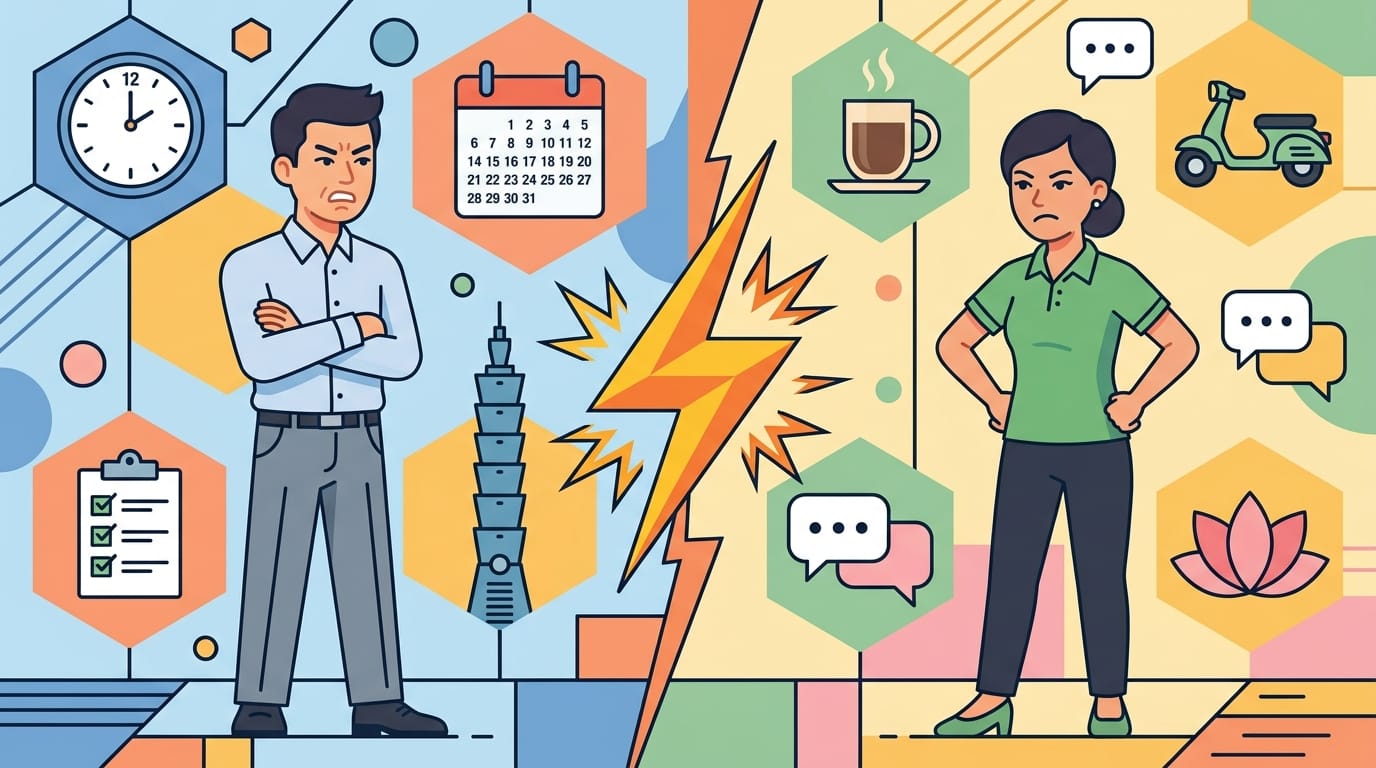
The simplest analogy: Taiwanese professionals are like J-types — everything needs a plan. Vietnamese workplaces are more like P-types — figure it out as you go.
But cultural differences go far beyond just this one dimension.
Dutch social psychologist Geert Hofstede's Cultural Dimensions Theory is one of the most widely used tools for understanding cross-cultural differences in global business.
It uses six dimensions to explain cultural tendencies across societies, such as power distance, collectivism, and attitudes toward uncertainty.
If you translate these dimensions into "workplace feel," you'll find that many common frustrations when working in Vietnam actually have cultural roots.
Based on Hofstede's Country Comparison Tool, here are the 4 biggest cultural shocks when Taiwanese professionals enter the Vietnamese workplace.
Shock 1: The Boss Is the Boss
Power Distance measures how much a society accepts unequal distribution of power.
Higher scores mean the society accepts hierarchical differences more readily, with power concentrated among a few.
Lower scores mean the society emphasizes equality, where authority can be more easily questioned.
In Hofstede's data, Taiwan scores 58 and Vietnam scores 70.
Both are relatively hierarchical cultures, but Vietnam's hierarchy is stronger.
This means Taiwanese professionals working in Vietnam may encounter:
Why does everyone wait for me to decide, even though I want their input?
I just want to solve the problem, but when I ask around, everyone says "It wasn't me!"
Calling a manager by name instead of title can cause offense.
Here, taking responsibility isn't a capability issue — it's a cultural habit.
Self-check questions:
If I clearly see a problem but can't point it out directly in a meeting — instead needing to use a more indirect approach or address it privately — can I do that?
If team members don't proactively speak up or take ownership the way I expect, but instead wait for the manager to set direction, will I understand this as a cultural difference, or will I quickly interpret it as "they're not motivated or reliable"?
Can I accept an environment where hierarchy is more explicit than in Taiwan? Where a manager is a manager, seniority matters, and some things aren't unsayable — they just need the right time, place, and audience.
Where's my red line? Is it that I can't accept strong authority? Or as long as I retain basic respect and professional judgment, I can actually adjust how I communicate?
Shock 2: "WHO" Usually Matters More Than "WHAT"
Individualism / Collectivism measures the degree of interdependence among members of a society.
Higher scores indicate more individualistic cultures, where people emphasize personal independence and self-actualization.
Lower scores indicate more collective cultures, where people emphasize group relationships and loyalty.
In Hofstede's data, Taiwan scores 40 and Vietnam scores 30.
Both are collective cultures, but Vietnam's collectivism is stronger.
In Vietnam, the operating logic for many things isn't "system then execution," but rather "relationship then collaboration."
In collective cultures, people rarely make decisions with only themselves at the center. They simultaneously consider the group, relationships, and overall atmosphere.
In the workplace, decisions often need to accommodate different people's feelings, and maintaining team harmony takes priority over pure efficiency or individual achievement.
So when Taiwanese and Vietnamese work together, you'll often find decisions require many people to agree, meetings drag on, or nobody publicly says "no." In some teams, colleagues treat the workplace as a kind of "second family."
Working with Vietnamese colleagues, Taiwanese professionals often think: "Can't we just follow the process? Why do we need to eat, drink coffee, and chat first?"
Because in collective culture, building relationships IS part of the work.
Self-check questions:
Can I truly accept that "building relationships is part of the work"? Or do I actually prefer things to just follow the process without spending too much energy on people?
If managers, colleagues, or clients expect me to attend dinners, drinks, KTV, holiday exchanges, or other after-work interactions, will I see this as a necessary trust-building process, or will I feel my personal boundaries are being invaded?
Do I simply dislike socializing, or can I actually accept "strategic socializing"? Not attending everything, but knowing which occasions I can't completely skip.
Where's my red line? Is it that I don't want any work relationships after hours? Or can I accept limited participation, but not endless obligation?
Shock 3: Rules Are Often "Guidelines," Not "Laws"
Uncertainty Avoidance measures how much a society tolerates uncertainty and ambiguity.
Higher scores mean the society prefers rules, systems, and plans to reduce uncertainty.
Lower scores mean the society is more comfortable with change and ambiguity, with less dependence on rules.
In Hofstede's data, Taiwan scores 69 and Vietnam scores 30.
This is a significant gap.
Using MBTI as an analogy, Taiwan is a J-type that prefers having plans; Vietnam is a P-type that prefers "playing it by ear."
For Taiwanese professionals accustomed to plans, processes, and punctuality, working with Vietnamese colleagues brings challenges including last-minute schedule changes, rules that adjust based on circumstances, decisions made on the fly, and agreements that may be revisited.
Taiwanese professionals often develop the impression that Vietnamese are "unreliable and careless," needing to repeatedly confirm everything to prevent business risks from sudden changes, creating additional management pressure.
In Vietnam's cultural logic, systems are the foundation, but relationships matter more.
Self-check questions:
If meeting times frequently change, previously agreed matters get renegotiated, and many arrangements aren't finalized in one go but adjusted along the way — can I accept this as normal, or will I be chronically anxious and distrustful?
How dependent am I on "punctuality, planning, and processes"? Are these just preferences, or are they my core standard for judging whether a team is professional?
When things keep changing, can I translate it into a management issue rather than immediately escalating it emotionally? For example, instead of getting angry, proactively confirm, prepare backups, and hold tight on key milestones.
Where's my red line? Can I accept flexibility but not broken promises? Or does high-frequency change make me start doubting this environment isn't worth investing in?
Shock 4: "Not Saying It" Doesn't Mean "Not Thinking It"
Indulgence / Restraint measures a society's attitude toward desires and enjoyment.
Higher scores mean the society encourages people to enjoy life, express emotions, and pursue personal happiness.
Lower scores mean the society emphasizes self-control and following social norms.
In Hofstede's data, Taiwan scores 49 and Vietnam scores 35.
Vietnam leans more toward a restrained culture.
In Vietnam, you'll find that people rarely express dissatisfaction directly, their facial expressions and body language are more reserved, and they seldom argue strongly in meetings. Foreigners often can't tell "do they actually agree or disagree?"
The result is meetings that drag on with no real conclusions — a huge waste of time.
Because the real opinions come out in post-meeting private discussions, informal chats, or small group conversations.
A recent anecdote from a Taiwanese professional: "In Vietnam, if you don't play pickleball, you lose half your business opportunities!"
Self-check questions:
Before entering this communication culture, ask yourself:
Am I very dependent on clear, direct, say-it-all-now communication? If someone doesn't spell things out, will I immediately get anxious, misjudge, or lose patience?
When someone says "okay" on the surface but their tone is reserved, their expression is subtle, and their follow-up actions aren't proactive — can I recognize that this might not be agreement, but a polite reservation?
Can I accept that some important information won't come out in formal meetings, but rather in one-on-one post-meeting chats, small group conversations, or only after trust is built?
Where's my red line? Can I accept indirectness but not perpetual guessing? Or does any non-direct communication make me feel the whole collaboration cost is too high?
Final Thoughts: Understanding Culture Isn't About Forcing Yourself to Fit In — It's About Making Clearer Choices
Many expats' problems in Vietnam, when viewed only through "efficiency" or "capability," tend to make you angrier and feel the market is unprofessional.
But if you're willing to shift perspective, you'll find these aren't just personal issues — there's an entire cultural logic operating behind them.
Adapting doesn't mean denying your own work habits or telling yourself "when in Rome, do as the Romans do." It means first figuring out: which differences are just different methods, and which truly cross your values and work boundaries.
So before coming to work in Vietnam, the truly important preparation isn't just language, industry knowledge, or salary expectations — it's whether you understand yourself clearly enough.
You need to know what kind of environment brings out your best, what management style makes you feel secure, what level of ambiguity and flexibility you can handle, and what relationship burden will drain you long-term.
The better you understand yourself, the better you'll know what adaptation strategies to adopt and where your red lines are.
This way you won't dismiss everything at the first sign of discomfort, nor will you ignore that this place fundamentally isn't somewhere you should stay long-term just because you want to prove you can tough it out.
Another equally important reminder: don't enter the market wearing filters.
Don't assume "the Taiwanese way is the normal way," and don't over-romanticize the differences, thinking the Vietnamese market is just more free, more flexible, more personal.
The truly helpful approach is to first understand it as it is: strengths, costs, opportunities, trade-offs.
Being open-minded doesn't mean having no judgment; embracing differences doesn't mean losing boundaries.
Truly mature cross-cultural professionals aren't the most enduring — they're the ones who best know how to adjust when facing differences, how to identify risks, and when to stay versus when to leave.
—
Sunny has prepared a "Vietnam Workplace Survival Index" assessment tool. If you're considering working in Vietnam but aren't sure whether you can adapt to the local work culture, this tool can help you quickly identify potential cultural friction points.
Sunny's Career Lab
https://www.facebook.com/sunny.mamalifelab/