Vu Lan and Ghost Month in Vietnam: North, South, and the Three Altars
The full moon of the seventh lunar month is two festivals at once in Vietnam: Buddhist Vu Lan and the folk day for wandering souls. Families set three altars, and in Chợ Lớn shop owners throw banknotes into the street for people to grab.
[Vu Lan and Ghost Month in Vietnam: North, South, and the Three Altars]
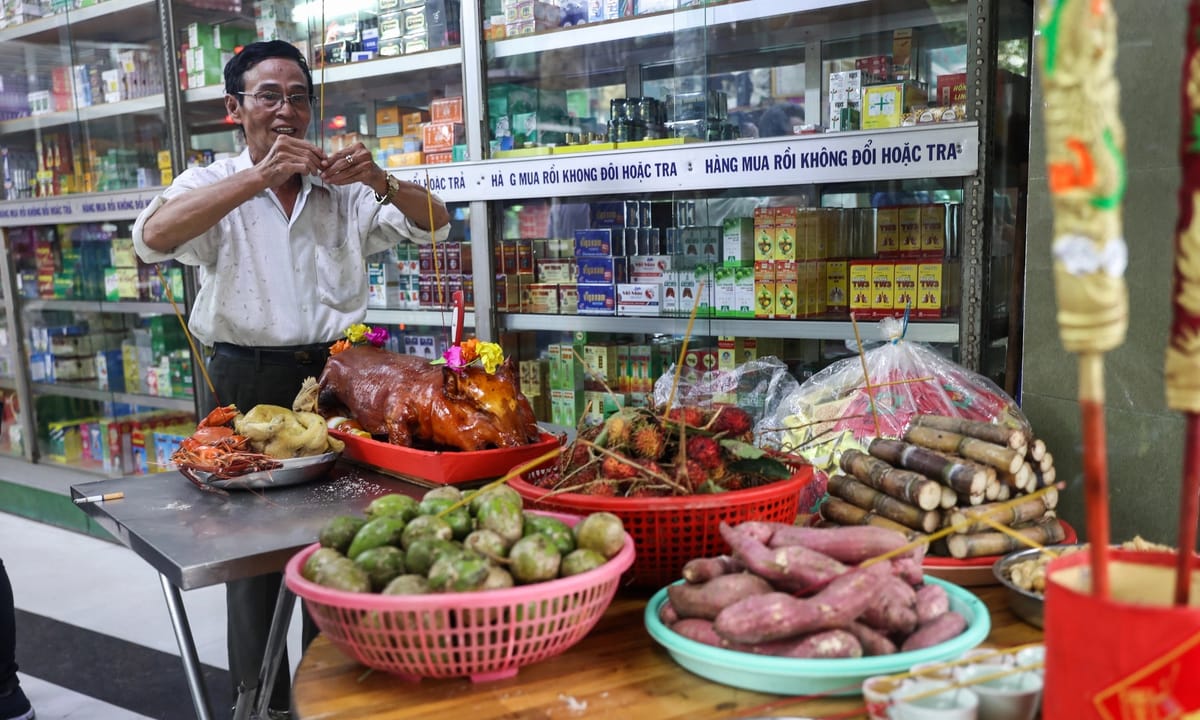
Come the seventh lunar month, Ho Chi Minh City news regularly carries the same scene: a Chợ Lớn shop owner finishes the offering to the wandering souls, throws the food and banknotes into the road, and dozens of people crowd in to grab them.
The full moon of that month, Rằm tháng Bảy, is two festivals on one date. The Buddhist Vu Lan báo hiếu tells the story of Mục Liên rescuing his mother and is about gratitude to parents. The folk xá tội vong nhân, the day wandering souls are pardoned, is about giving lost ghosts a meal. Taiwan's Ghost Festival draws on the same two sources; the difference is that Vietnam leans one way or the other by region. In the south the day is about parents and ancestors. In the north, the wandering souls get fed first.
A typical family sets three altars. One for the Buddha, vegetarian only. One for the household gods and ancestors, indoors. And one for the wandering souls, cúng cô hồn, outdoors or at the front gate. That last altar is where Vietnam differs most from Taiwan. It must have thin rice porridge, cháo loãng, usually twelve small bowls, with slab sugar, fruit in five colours and paper clothes in bright colours. The old explanation is that wandering souls have throats too narrow for ordinary food. The outdoor offering happens at dusk, because daylight weakens the spirits. Afterwards, salt and rice are scattered in all directions and votive paper, vàng mã, is burned outside the door, so the souls take what they are given and do not follow anyone in.
On the Vu Lan side there is a scene you will not find at a Taiwanese Ghost Festival: a rose pinned to the chest. After the sermon at the temple ceremony, monks pin a red rose on those whose parents are living and a white one on those who have lost them. It is not an ancient custom. The Zen teacher Thích Nhất Hạnh brought it back from Japan in the 1960s and wrote the essay Bông hồng cài áo, "A Rose for Your Pocket", in 1962; Vietnamese Buddhism has treated the pinning as a fixed part of the festival ever since. Once a year, in public, everyone can see whether your parents are still alive.
The people who treat this month as the biggest event of their year are the ethnic Chinese shop owners of Chợ Lớn, in what used to be Districts 5, 6 and 11. On the full moon in 2023, a 66-year-old pharmacy owner stood at a street corner in the old District 5 and threw 10,000 and 20,000 đồng notes into the road, close to VND 10 million (about NT$12,000) in all. Nearly a hundred people scrambled for twenty minutes. He did not mind; he wanted as many grabbers as possible. The Chợ Lớn explanation is that whoever takes the offerings takes the bad luck with them: the more is snatched, the more misfortune leaves. The same day he handed out 500 parcels of instant noodles, rice and sweets to people in need.
The grab is called giật cô hồn, snatching from the wandering souls. It has the same root as Taiwan's Toucheng qianggu in Yilan, both descended from the qianggu of Fujian; Toucheng climbs greased towers, Chợ Lớn picks banknotes off the road. In recent years some families have switched: no more cash in the street, just rice and noodles handed straight to the poor.
The seventh month also goes by tháng cô hồn, the month of wandering souls, or tháng Ngâu. For many Vietnamese it is not only a month of offerings but a month for putting big decisions on hold. Weddings, ground-breakings, shop openings, buying a house or a car: many people steer clear of all of them, and some avoid even new furniture. Property and car sales cool off every year at this time. Figures from the Vietnam Automobile Manufacturers' Association (VAMA) show August sales running 10 to 20% below July in recent years, and dealers say that even with promotions on, customers either do not buy or buy and push delivery into the following month.
The taboo is loosening, though. Younger buyers go by need, budget and discount rather than the calendar, and carmakers and dealers now treat the month as promotion season, with price cuts, free insurance, and subsidies on registration fees and loan interest, which makes it a good time to bargain-hunt. Buddhist leaders are blunter still: senior monks of the Vietnam Buddhist Sangha have said publicly that there is no "ghost month" in scripture, that the seventh month is auspicious, and that trading and travel need no avoidance; in 2018 the Sangha also told temples to stop burning votive paper. Ordinary households burn anyway, and check the calendar anyway.
—
📢 A quick word from our sponsor
Heading to Vietnam and dreading the SIM card counter at the airport? I use Saily eSIM instead — buy it online before you fly, scan the QR code in the app, and your data connects automatically the moment you land.
Saily also lets you switch your virtual location in the app — traffic routes through a NordVPN server, so it works much like a VPN, though it doesn't encrypt data on the device — and it blocks malicious sites, ads, and trackers. Vietnam plans start at US$3.99 for 1GB/7 days, with 3GB/30 days at US$7.99 and 10GB/30 days at US$17.99. Unlimited plans are available too.
👉 Get your Saily eSIM → and use code Special10 for an extra 10% off