Vietnam Retain the ASEAN Cup and the Whole Country Hits the Streets: What Is Đi Bão?
Vietnam retained the ASEAN Cup on August 26 and, minutes later, the streets of Hanoi and Ho Chi Minh City were a sea of red flags and motorbikes. This is đi bão.
[Vietnam Retain the ASEAN Cup and the Whole Country Hits the Streets: What Is Đi Bão?]
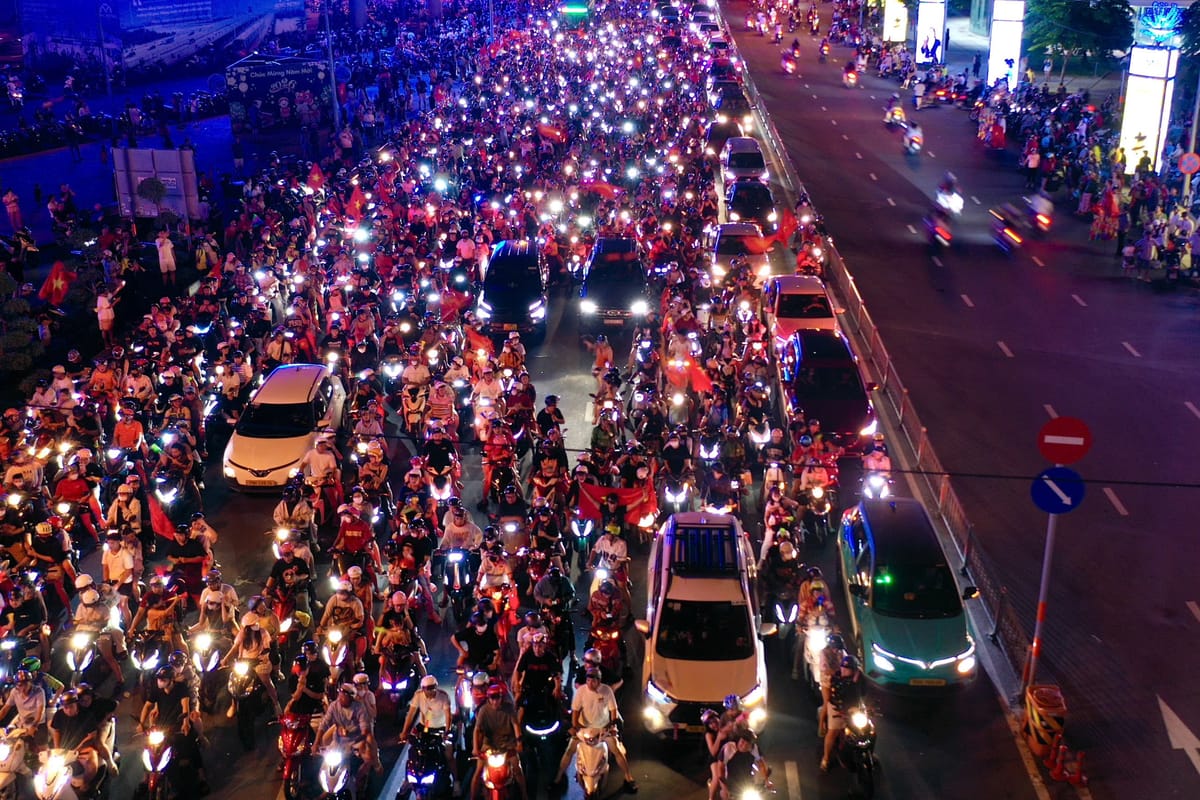
On the night of August 26, Vietnam drew 2-2 with Thailand at Mỹ Đình National Stadium in Hanoi. Added to the 2-0 win in Bangkok four days earlier, that was a 4-2 aggregate victory and the ASEAN Cup title. It is the first time Vietnam have successfully defended the regional crown, and their fourth title overall. The moment the final whistle went, the streets of Hanoi, Ho Chi Minh City and Cần Thơ filled with people. Motorbikes and cars took over the main roads, flags flew, pots and pans clanged, and the chant of "Việt Nam vô địch!" — Vietnam are champions — rolled across the cities. It was the third time in eight days: fans had already been out on August 19 after the semi-final win over Malaysia, and again on August 22 after the first leg in Bangkok.
This is đi bão, a celebration that exists only in Vietnam.
Đi bão translates roughly as "riding into the storm." In practice it is a spontaneous street party. When the national team wins a big match, fans pour out on motorbikes, in cars, even standing on the backs of trucks, waving flags, banging pots and blasting patriotic songs from loudspeakers as they head for the city centre to join everyone else. Nobody organises it. Nobody sends out a call. Within ten minutes an entire city turns red.
The tradition dates to the 1995 SEA Games. Vietnam went all the way to the final in Chiang Mai and came home with silver, and from the very first group win over Malaysia fans took to the streets on their own; the further the team went, the bigger the crowds. When the squad flew home on December 18, tens of thousands were waiting at Tân Sơn Nhất airport, and the team bus took nearly four hours to get from the airport into the city. Dương Vũ Lâm, an assistant coach that year, later recalled: "We had heard about this đi bão while we were still in Thailand, but we never imagined the fans would be that wild." Đi bão has been part of Vietnamese football ever since.
For a foreigner seeing it for the first time, the scene is close to surreal. Less than ten minutes after full time, quiet streets are suddenly under water with traffic. Three or four people on a motorbike is standard. Someone is standing on a truck bed waving a giant flag; someone else has hauled a speaker into the road and turned it all the way up. Red lights are advisory. Traffic rules are suspended. The whole city feels like a hidden switch has been flipped into party mode. What surprises foreigners even more is who takes part, because it is not just the young: grandparents clap from the kerb, office workers run out still in their shirts, children ride on their fathers' shoulders waving flags. People come out in pyjamas, banging a wok, some with the family dog in tow for the "parade." On the night of August 22 in Ho Chi Minh City, a Dutch tourist marched with a replica trophy held aloft, and foreign visitors on an open-top bus crossing Ba Son Bridge joined in the chanting with the crowd below.
Vietnamese love football, but they love the red flag with the gold star more. Outside National Day and Reunification Day, a football win is about the only thing that brings the entire population onto the streets at once. When eleven players pull on the national shirt, they carry the hopes of 100 million people. So đi bão was never only about a goal. It is a public celebration of "we won," a shared identity. The noise, the flags, the collective euphoria: for one night, even foreigners get to feel what it is like to be Vietnamese.
If you are travelling in Vietnam and happen to run into it, there is no need to worry. This is simply how the country celebrates a win. Find a safe spot, watch the street carnival roll past, and you will understand.