In Vietnam, Closing a Company Costs 20 Times More Than Opening One
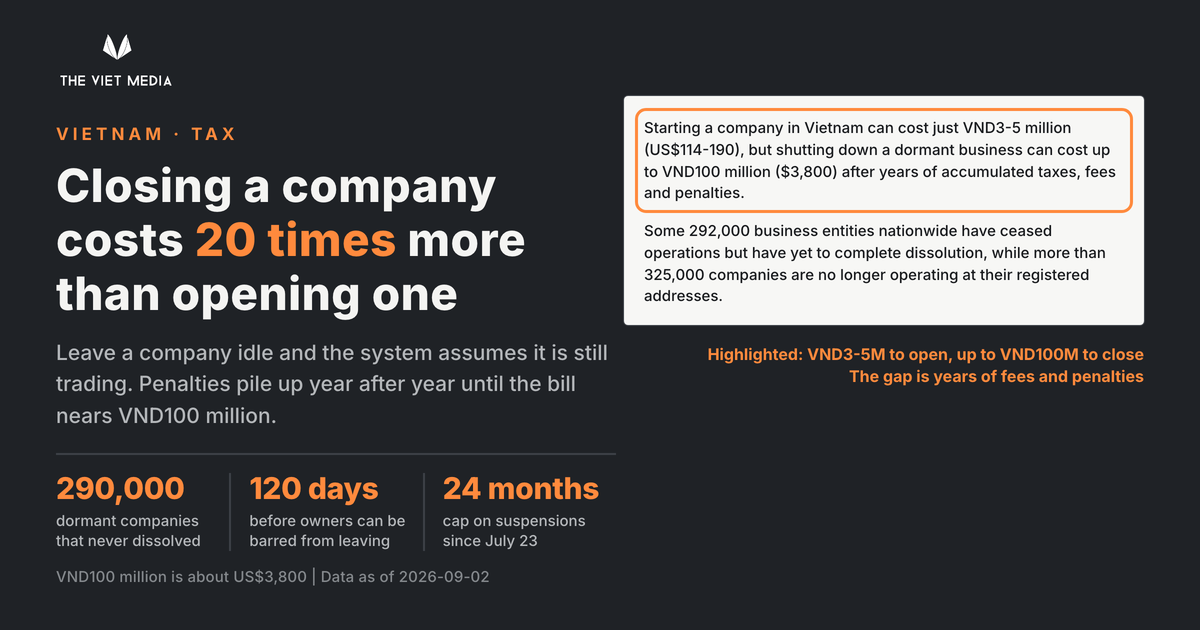
Leave a Vietnamese company idle and the system assumes it is still trading. Penalties pile up year after year, the tax authority is now chasing 290,000 such firms, and owners can be barred from leaving the country.
[In Vietnam, Closing a Company Costs 20 Times More Than Opening One]
Registering a company in Vietnam costs VND3 to 5 million, about US$114 to 190, and the paperwork takes days. Closing one that has sat idle for a few years is another matter. Owners are finding bills close to VND100 million, roughly US$3,800, which is 20 times what it cost to open.
One Hanoi business owner set up a construction and trading company in 2011. Business dried up around 2019, so he stopped. No revenue, no invoices, and no filings after that. When the tax authority began cleaning up its registry this year, he looked up his company online and found it flagged as "not operating at its registered address". An accounting service quoted VND35 million to handle the dissolution. On top of that came VND30 to 40 million in back license fees and late-filing penalties. Around VND75 million in total, and possibly more.
Here is how the bill builds up. A company that stops trading is supposed to notify the business registry of a temporary suspension, valid for at most 12 months at a time. If no new notice is filed before it expires, the system automatically flips the company back to "active". Once active, the obligations return: tax returns, the annual business license fee, year-end tax finalization, whether or not the company does any business. Returns that are not filed attract penalties. The license fee, VND1 to 3 million a year depending on registered capital, accrues every year. Unpaid amounts collect late-payment interest daily. The longer a company sits, the bigger the pile. The license fee was abolished from January 2026, but everything owed through 2025 is still being collected.
Nguyễn Thị Cúc, chair of the Vietnam Tax Consultants' Association, cited a company that stopped operating in 2013 and applied this August to close its tax code. The bill came to just over VND61 million. None of it was tax on actual business. All of it was late-filing penalties, license fees and interest.
Many owners have no idea any of this is happening. Mạc Quốc Anh, vice chairman of the Hanoi Association of Small and Medium Enterprises, says small business owners often cannot tell the difference between simply stopping, registering a suspension and terminating a tax code, and assume they can walk away. The Ministry of Finance's position is that stopping without notifying the authorities is itself a violation.
The scale is large. The tax authority's cleanup list this year includes 292,000 companies that stopped operating without completing dissolution, plus more than 325,000 that no longer operate at their registered address and owe tax. Some have been dormant for 10 to 20 years. The campaign began in May. In July an urgent directive gave provincial tax offices a matter of days to notify owners, move to revoke licenses and publish the names, describing the effort as "a particularly important political task".
Three new rules took effect in July under the new Law on Tax Administration and its implementing decrees. First, tax authorities can petition a court to open bankruptcy proceedings against companies with long-standing tax debts. Second, once a company is flagged as not operating at its registered address, if the owner does not restore or terminate the tax code within 120 days, the legal representative and the beneficial owners can be placed on the list of people barred from leaving Vietnam. Third, suspensions are now capped at 24 months in total, which closes the old trick of renewing the suspension every year indefinitely.
Accountants want the rules to separate "never did the paperwork" from "deliberately evaded tax". Lê Văn Tuấn, who runs the accounting and tax firm Keytas, argues that a company that genuinely did not operate should not owe license fees for those years, and that unfiled nil returns should not be penalized as late filings. Under the current approach, he says, only owners who can afford it get to dissolve, and the rest keep drifting. Nguyễn Văn Được, a lawyer and general director of Trọng Tín, takes the opposite view: the law has to apply uniformly, and what needs fixing is processing speed and oversight of tax officers. The ministry has not moved. All debts must be settled before a company can dissolve, and companies flagged as absent from their address must close their tax code first.
For anyone who owns a company in Vietnam, the point is simple. The bill does not stop because the company did. It stops on the day the tax code is closed. Foreign-invested companies have extra steps, including returning the investment registration certificate and obtaining a customs clearance confirmation. Two advisory firms put the full process at four months to a year even with clean books.
This article is a news summary and does not constitute legal or tax advice. Consult a licensed accountant or lawyer in Vietnam for your own situation.
—
📢 A quick word from our sponsor
Heading to Vietnam and dreading the SIM card counter at the airport? I use Saily eSIM instead — buy it online before you fly, scan the QR code in the app, and your data connects automatically the moment you land.
Saily also lets you switch your virtual location in the app — traffic routes through a NordVPN server, so it works much like a VPN, though it doesn't encrypt data on the device — and it blocks malicious sites, ads, and trackers. Vietnam plans start at US$3.99 for 1GB/7 days, with 3GB/30 days at US$7.99 and 10GB/30 days at US$17.99. Unlimited plans are available too.
👉 Get your Saily eSIM → and use code Special10 for an extra 10% off