Half of All Nike Shoes Are Made in Vietnam. Eighteen Months of Tariffs Didn't Change That
US tariffs on Vietnam changed four times in eighteen months. Nike's Vietnam share of footwear went from 44% to 52% anyway. The reason has less to do with tariffs than with who actually owns the factories.
[Half of All Nike Shoes Are Made in Vietnam. Eighteen Months of Tariffs Didn't Change That]
Nike's latest annual report puts a number on it: in fiscal 2026 (June 2025 to May 2026), 52% of Nike Brand footwear was made in Vietnam, 27% in Indonesia and 16% in China. Vietnam also leads in apparel at 34%. Line up the last five annual reports and Vietnam's footwear share reads 44%, 50%, 50%, 51%, 52%. Three straight years above half, and still rising.
Those five years were the harshest for US tariffs on Vietnam. Since April 2025, when Donald Trump announced a 46% "reciprocal" tariff, the rate has changed four times: 46%, then 20%, then 10%, and since late July 12.5% under Section 301, this time justified as a penalty for not effectively banning imports made with forced labor. Higher tariffs should push factories out. Nike's Vietnam share went up instead. There are three reasons.
First, there is nowhere obviously cheaper to go. Indonesia is Nike's second-largest source, and for most of the past eighteen months its tariff was only one or two points below Vietnam's: 32% against Vietnam's 46% at the April announcement, 19% against 20% after both countries struck deals, then 10% for both. Since late July it is 10% for Indonesia and 12.5% for Vietnam, a 2.5-point gap, but that is barely three weeks old and does not show up in fiscal 2026 numbers. China, at 16% of Nike footwear, pays 12.5% on top of the Section 301 duties it already had. The tariffs of the past year and a half hit the whole Asian footwear industry, not just Vietnam. Move the factory and you still pay.
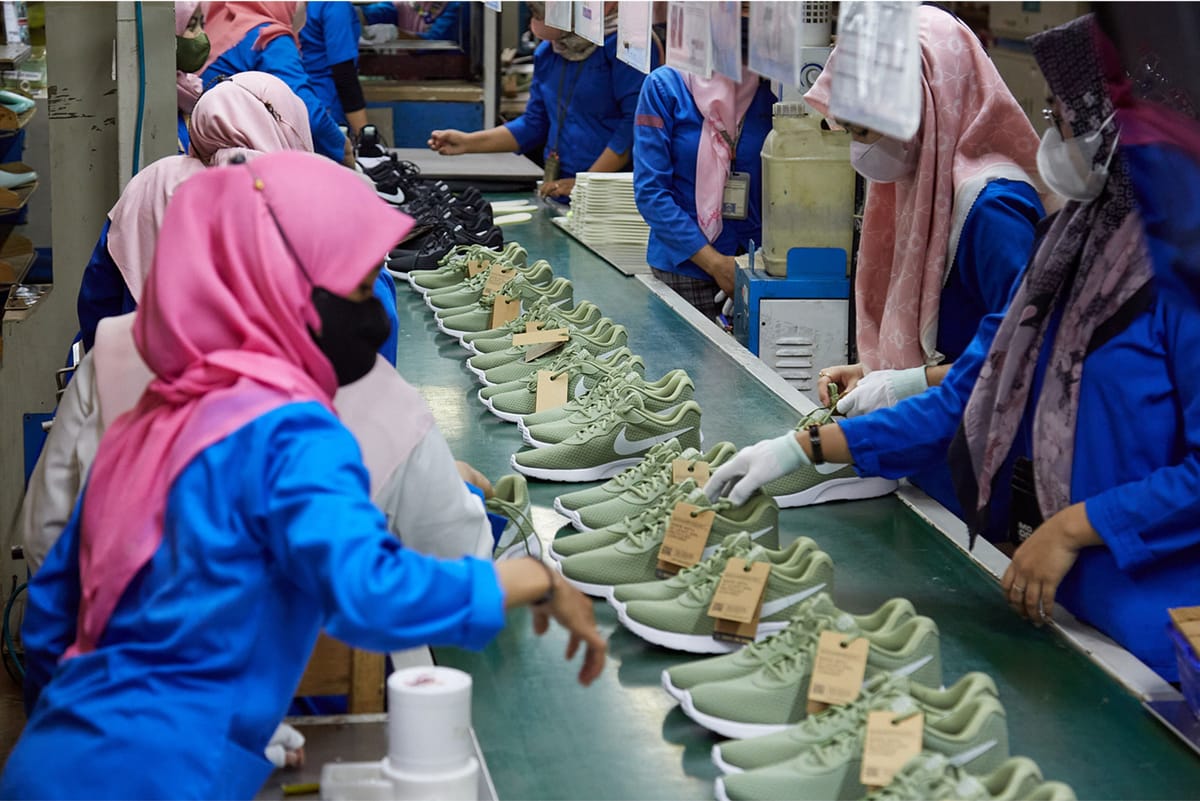
Second, Nike's supply chain is already built in Vietnam. A shoe is not just an assembly plant. Nike's 10-K lists 205 strategic upstream materials suppliers for rubber, foam, leather and synthetics. Air Manufacturing Innovation, Nike's wholly owned subsidiary that makes Air-Sole cushioning, runs three plants: two in the US and one in Đồng Nai, Vietnam, its only facility outside America. Nike's own manufacturing map shows roughly 140 finished-goods factories in Vietnam employing about 460,000 workers, concentrated in the industrial belt running from Ho Chi Minh City (including former Bình Dương) to Đồng Nai. Moving means moving materials, components and assembly together, not one building.
Third, the people who decide where factories are located are not Nike. They are the contract manufacturers. Nike Brand footwear is made by 15 contract manufacturers; four of them each account for more than 10% of production and together about 60%. Nike does not name the four. By headcount on its manufacturing map, the biggest employers in Vietnam are South Korea's Taekwang, the Taiwanese-founded and China-headquartered Huali, Taiwan's Feng Tay, South Korea's Changshin and Taiwan's Pou Chen. These relationships predate every round of tariffs. Adidas, whose footwear is also Vietnam-first at 41%, discloses that 65% of its manufacturing partners have worked with it for over ten years and 37% for over twenty. It is less that Nike chose Vietnam than that its suppliers did, years ago, and Nike's orders followed their capacity. Relocating is not one company's call. It takes the whole chain.
The factories stayed, but somebody still paid the tariff. In late September 2025 Nike's CFO raised the company's estimate of tariff costs for the year to USD 1.5 billion. Nike's first move was pricing: DataWeave, which tracked about 3,300 products, found Nike's online footwear prices up 17% and apparel up 14% over one year. For the full fiscal year Nike reported revenue of USD 46.4 billion, flat; gross margin of 42.9%, up 0.2 percentage points; and net income of USD 3.11 billion, down 3%. But that gross margin already includes a refund. After the US Supreme Court struck down the reciprocal tariffs in February, importers could reclaim what they had paid, and Nike booked USD 986 million in expected IEEPA tariff recoveries in its fourth quarter, of which about USD 300 million had arrived in cash by quarter end. Strip out the refund and Nike's full-year gross margin fell. Put together: consumers paid more, Nike fronted the tariffs, and Nike then recognized nearly USD 1 billion coming back.
On Vietnam's side, footwear exports in the first half of 2026 came to just under USD 12 billion, up only 0.5% year on year; exports to the US were USD 4.55 billion, up 6%. Industry figures cited by Vietnam News Agency say footwear export prices have risen only about 5% in twenty years. Eighteen months of tariffs did not break Vietnam's factories, but they did not enrich them either. Orders held; prices did not move. Eighty percent of Vietnam's footwear exports come from foreign-invested firms. Half the world's Nike shoes are made here, but how many and at what price is mostly decided elsewhere.
The contract manufacturers sit between the two, and the Taiwanese numbers are worth a look. Feng Tay is one of Nike's core suppliers: Nike is about 80% of Feng Tay's revenue, and Feng Tay makes roughly 16% to 17% of Nike's footwear. In 2025 Feng Tay produced 120 million pairs, 52 million of them in Vietnam (43%) and 42 million in India (35%). But Feng Tay is moving the opposite way from Nike as a whole: its Vietnam output fell 3% while India and Indonesia each grew 13%. Nike's Vietnam share is rising even as one of its main Taiwanese suppliers puts its growth in India; the 52% is being filled by other manufacturers while Feng Tay diversifies. Pou Chen's consolidated gross margin slipped from 24.7% to 23.1% in 2025, which the company attributes to uneven capacity loading across plants, rising labor costs and new capacity still ramping up. Vietnam's minimum wage rises another 7.8% in 2027. The cost pressure lands on the factory floor, not on the brand.
So the factories did not move, not because tariffs did not hurt, but because a tariff is one line item among many, the supply chain took twenty years to build, and there is a tariff waiting wherever you go. Whether that reverses depends on two things: where suppliers like Feng Tay put their next increment of capacity, and whether Vietnam's forced-labor import ban, in force from September, is enough to negotiate its rate back down from 12.5% to 10%.
—
📢 A quick word from our sponsor
Heading to Vietnam and dreading the SIM card counter at the airport? I use Saily eSIM instead — buy it online before you fly, scan the QR code in the app, and your data connects automatically the moment you land.
Saily also lets you switch your virtual location in the app — traffic routes through a NordVPN server, so it works much like a VPN, though it doesn't encrypt data on the device — and it blocks malicious sites, ads, and trackers. Vietnam plans start at US$3.99 for 1GB/7 days, with 3GB/30 days at US$7.99 and 10GB/30 days at US$17.99. Unlimited plans are available too.
👉 Get your Saily eSIM → and use code Special10 for an extra 10% off