The Vietnamese Noodle-Stall Worker in Left-Handed Girl Is a Real Court Interpreter
Left-Handed Girl went from Cannes to the Oscar shortlist to two more Taiwanese awards in July 2026. The Vietnamese woman working the noodle stall on screen is Chen Chiu-liu, born in Ho Chi Minh City in 1983, a shoe-factory worker who married into Taiwan in 2003.
[The Vietnamese Noodle-Stall Worker in Left-Handed Girl Is a Real Court Interpreter]
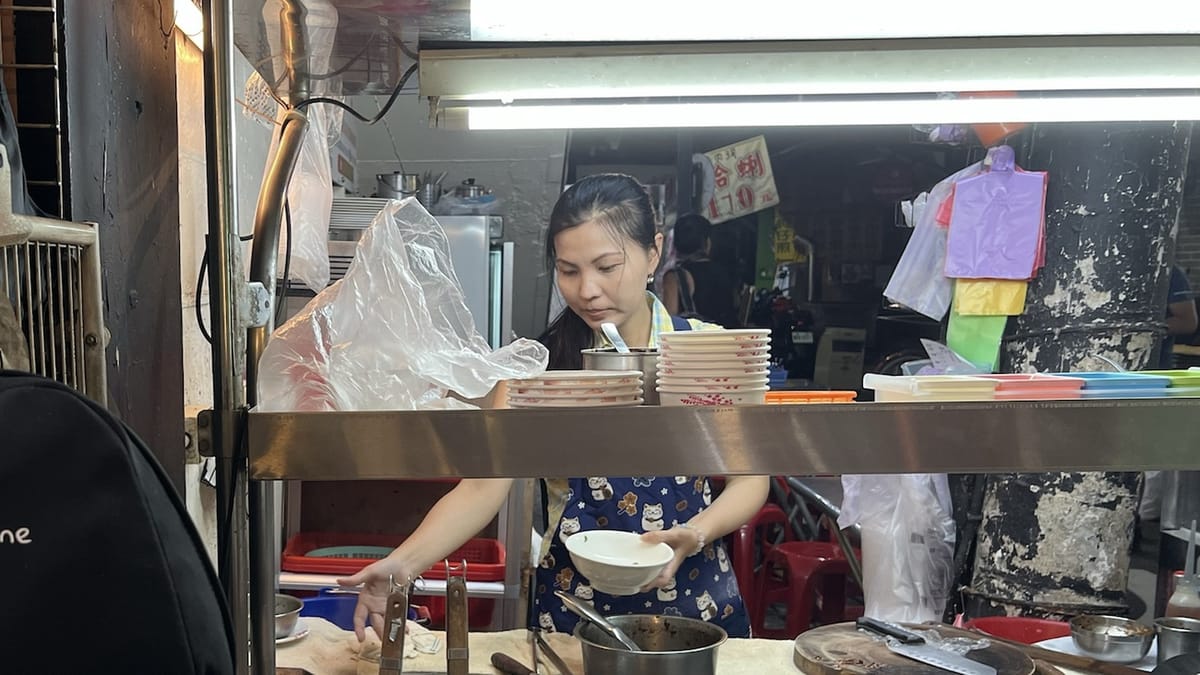
Left-Handed Girl, released in 2025, follows a mother who moves back to Taipei with her two daughters to start over. She opens a noodle stall in a night market. The older daughter sells betel nut. The younger one roams the market's alleys. Her grandfather tells her that using her left hand is doing the devil's work. She starts lying, and a family secret comes out.
The "devil's hand" line comes from director Shih-Ching Tsou's own childhood. She was scolded with the same words by her grandfather for holding a knife in her left hand. Left-Handed Girl is her first solo feature. She co-wrote it with Sean Baker, the Oscar-winning director, who also edited and co-produced. The two met in 1999 at The New School in New York. In 2010 they went to Taipei together, walked through night market after night market, and finished the script.
The film is a Taiwan-US-UK-France co-production. It premiered in Critics' Week at the 78th Cannes Film Festival. Netflix then bought worldwide rights, with more than a dozen territories carved out, including Taiwan, Japan, South Korea and France. Within three days of its Netflix release it was ninth on the platform's global daily film chart. At the 62nd Golden Horse Awards in November 2025 it had nine nominations, including Best Narrative Feature. Shih-Yuan Ma, who plays the older daughter, won Best New Performer.
On December 16, the Academy released its 15-film shortlist for Best International Feature at the 98th Oscars. Left-Handed Girl made it, out of 86 submissions, the first time a film by a Taiwanese woman director had gotten that far. When the nominations came out on January 22, 2026, it was not among the final five. The awards kept coming at home, though. On July 10, the Taiwan Film Critics Society gave it Best Film and Best Director. Two days later, at the 28th Taipei Film Awards, where it had nine nominations, Ma won Best New Performer and Baker won Best Editing.
None of those lists have her name on them. There is a supporting character called A-Li who works at the mother's noodle stall and has a few scenes with the older daughter. She is played by Chen Chiu-liu, Vietnamese name Trần Thu Liễu, a Vietnamese immigrant who has lived in Taiwan for more than two decades. As she puts it, A-Li is how migrant workers and immigrants ended up in the frame at all. During the shoot she mostly thought it was "so cool" that the whole film was being made on iPhones. Only when she saw the finished cut did she realize how much screen time she had. At the Golden Horse ceremony, Tsou and the producers invited her onto the red carpet even though she was a supporting player. Standing there, she says, the only thing in her head was: "Why on earth am I standing here?"
A-Li's situation is not foreign to her. Chen was born in Ho Chi Minh City in 1983, one of five siblings, and worked in a shoe factory as a young woman. In 2003 she married and moved to Taiwan, settling in Sanchong, New Taipei City. In the early years she did manicures for people in Sanchong's Bihua Park to help with household money. Later she went to the New Taipei City Family Service Center for New Immigrants to learn Mandarin, and picked up other skills there too. That is where she learned to perform.
Her first film role came when director Lin Jing-jie cast her in Elena as the mother of an immigrant student. The part was small, but she sang a song called "I Came From Vietnam." The roles kept coming: a stage play, Miriam's Trick, in 2016; Qibla at the National Theater in 2017, with her daughter; and in 2018 the two of them led Three Days and Two Nights, a television film for Taiwan's public broadcaster PTS. She has also performed with the Nanyang Sisters Theater, a troupe of immigrant women, and led a team that won a top prize in a National Immigration Agency competition.
Outside acting she holds two other jobs. She interprets for Vietnamese nationals in Taiwan's courts and government offices, and she hosts a radio program. In 2025 she was named one of New Taipei City's ten "cross-field" figures of the year, and the National Immigration Agency gave her a service contribution medal.
In interviews she talks about how Taiwan has changed over those two decades. When she first arrived, strangers looked at her with suspicion. Vietnamese women did not dare speak Vietnamese on the street, tried to pick up a Taiwanese accent, and would not even teach their children their mother tongue. Now, as she sees it, things are different: migrants and immigrants speak their own languages in public. She never dropped her accent, "because it's part of who I am," and she has always taught her daughter Vietnamese, "so she knows where her mother comes from and can talk to her grandparents."
People have asked whether she regrets marrying into Taiwan. Her old answer was: "There's no medicine for regret, and I can't go back, so why dwell on it." Lately her answer has changed. "I realized that if I'd stayed in Vietnam instead of coming to Taiwan, my dream might never have had a chance." Both places are home, she says. Vietnam is where she grew up; Taiwan is where she plans to grow old. "I've put down roots here. How could I go back to Vietnam to live?" What she wants to do next is use performance to help Taiwan and Vietnam understand each other a little better. "Communicate through culture. A bit more understanding means a bit less misunderstanding."
—
📢 A quick word from our sponsor
Heading to Vietnam and dreading the SIM card counter at the airport? I use Saily eSIM instead — buy it online before you fly, scan the QR code in the app, and your data connects automatically the moment you land.
Saily also lets you switch your virtual location in the app — traffic routes through a NordVPN server, so it works much like a VPN, though it doesn't encrypt data on the device — and it blocks malicious sites, ads, and trackers. Vietnam plans start at US$3.99 for 1GB/7 days, with 3GB/30 days at US$7.99 and 10GB/30 days at US$17.99. Unlimited plans are available too.
👉 Get your Saily eSIM → and use code Special10 for an extra 10% off