From Millions in Debt to 400 Stores in Vietnam: The Wujia Tea Story
Wujia Tea Ice isn't well known in Taiwan, but in Vietnam it used a tea cart model to open 400 stores in 6 years, surpassing Gong Cha and KOI to become the Taiwanese bubble tea brand with the most outlets in Vietnam.
In Taiwan, Wujia Tea Ice is perhaps not as well known as major chains like 50 Lan or Qingxin Fuquan.
But in Vietnam, it has more stores than any other Taiwanese bubble tea brand.
In May 2025, Vietnamese business outlet CafeBiz reported that Wujia had 389 locations, surpassing Gong Cha (51) and KOI Thé (64) for the widest coverage of any Taiwanese tea chain in the country.
By June 2025, it crossed 400.
Zero to 400 in six years.
From Millions in Debt to a Cup of Iced Tea
Wujia Tea Ice was founded by Wu Long-zhong, who in his early years opened a French restaurant with his brother.
It was well-received by critics but not by customers, and they walked away with over ten million NTD in debt.
He tried a beef noodle shop, then a hot pot restaurant. More than a decade passed and the debt was still there.
Then he tried a cup of iced red tea in Taichung and decided to start over with traditional Taiwanese-style red tea.
That was how Wujia Tea Ice began.
Along the way, he noticed something: labor costs in beverage shops account for roughly 35% of revenue.
If headquarters brewed the tea and delivered it daily, franchisees wouldn't need to hire staff for brewing, and getting started would be much easier.
This idea of "central kitchen + cart franchise" became the core of Wujia's business model.
Entering Vietnam
In 2019, he brought the brand to Vietnam, investing in a factory and central kitchen in Ho Chi Minh City.
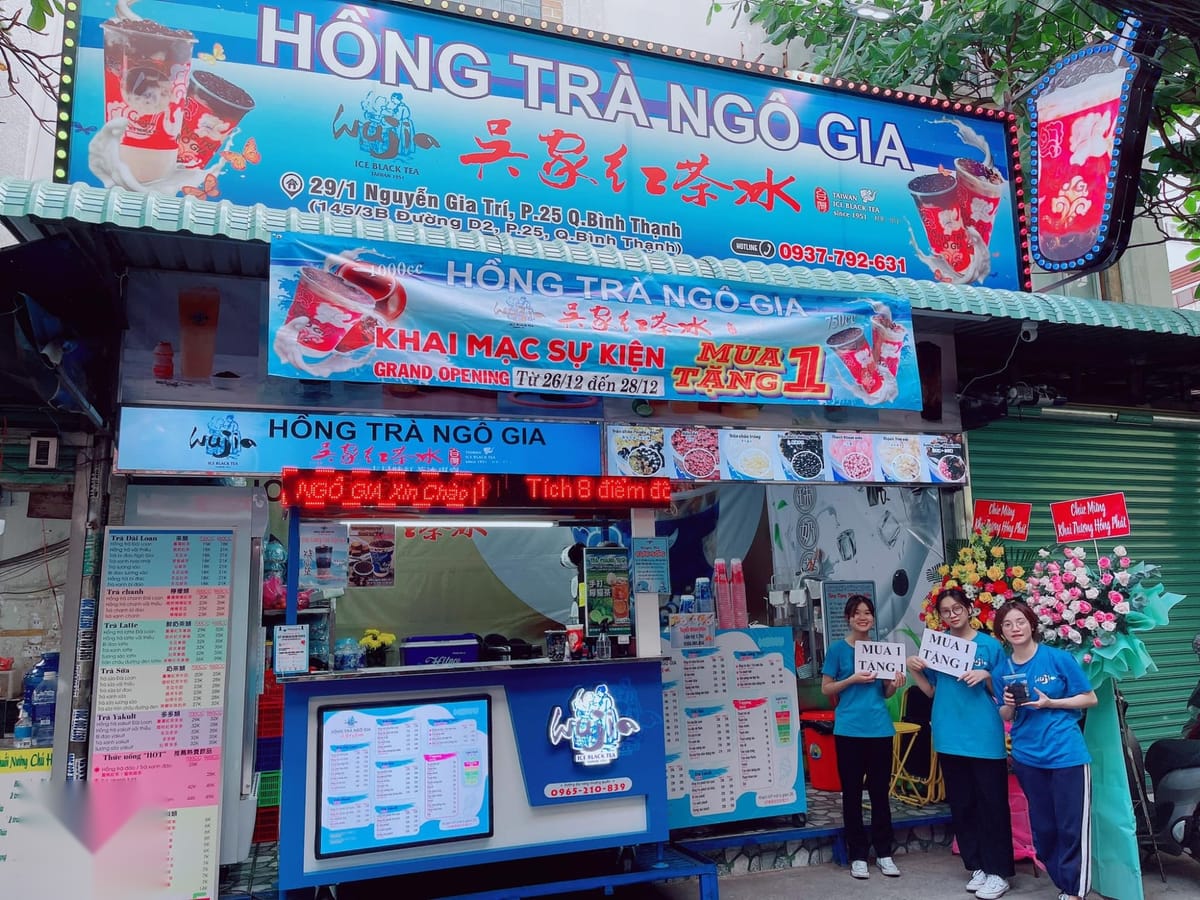
The Vietnamese brand name is "Hồng Trà Ngô Gia" (Red Tea Wu Family).
Vietnam's bubble tea market was already crowded at the time.
Gong Cha, KOI Thé, Phúc Long, and Toco Toco all had established market share.
But he didn't compete for the same segment.
Instead, he did something different: set the lowest possible barrier to entry so franchisees could open in places the big brands wouldn't go.
Stores started opening in late 2019. By the end of 2020, there were nearly 20. By 2021, around 60.
In September 2024, VietnamBiz data showed 263.
In May 2025, CafeBiz reported 389.
In July 2025, the first Hanoi location opened, launching the push north.
Breaking Down the Model: Why It Scaled So Fast
Wujia's rapid expansion in Vietnam comes down to three things.
First, the tea cart model keeps the franchise barrier low.
Franchisees don't need a big storefront — a single cart is enough to get started.
Some locations are cart-only, while others pair a small shop with a cart out front serving as both signage and workstation.
Roadsides, market entrances, school gates, residential alleys — wherever there's foot traffic, that's where they set up.
According to several Vietnamese franchise information sites, the total franchise cost is roughly VND 500 million (about USD 20,000), covering the franchise fee, equipment, deposit, and other items.
Opening a Gong Cha or Phúc Long costs far more.
This cart franchise model isn't new to Vietnam.
Bánh Mì Má Hải, a local fish cake bánh mì brand, runs on the same playbook.
Founder Hồ Đức Hải was a student at Ho Chi Minh City University of Economics when he set up his first bánh mì cart near campus in 2013, starting with just VND 2 million (under USD 100) in savings.
He incorporated in 2015 and began franchising.
The franchise fee is just VND 7.5 million (about USD 300). Headquarters supplies the fish cakes and ingredients; franchisees handle selling.
Today, Má Hải has over 1,000 locations and sells nearly one million bánh mì a month — making it Vietnam's largest cart-based franchise chain.
Wujia applied the same logic to bubble tea: start with a cart, supply from a central kitchen, and keep the barrier low so franchisees can jump in fast.
The difference is that Wujia's franchise fee (VND 500 million) is far higher than Má Hải's, but still low by bubble tea standards.
Second, the central kitchen handles all tea preparation.
Franchisees don't brew their own tea. Headquarters delivers daily.
This solves two problems at once: quality consistency and labor costs.
The operational flow is simplified to: receive tea, sell tea, collect payment.
Third, pricing targets daily consumption, not occasional treats.
Wujia's core drinks are priced at around VND 20,000 to 30,000 per cup (roughly USD 0.80 to 1.20), with some items starting as low as VND 19,000.
For basic pure tea, a 960cc large cup sells for VND 18,000, about the same as a glass of sugarcane juice from a street vendor.
Other Taiwanese brands typically charge VND 40,000 to 60,000 for a 500cc cup.
This price gap means Wujia's target customers aren't people who "occasionally grab a drink," but students and office workers who buy one every day.
The Math of Repeat Customers
Customer loyalty across Vietnam's consumer market is generally low.
According to a 2025 Vietnam customer experience report, overall consumer satisfaction scores 7.45 out of 10, but brand loyalty sits at just 20%.
The bubble tea market is no exception.
Wujia's management team is well aware of this, which is why they ran the numbers.
For trend-chasing tea brands, customers typically try a drink once or twice, with a customer lifetime value (LTV) of about VND 50,000 to 60,000.
Wujia's customers buy 50 to 100 cups a year, contributing VND 1.5 to 3 million per person in a single year alone.
The gap is tens of times over.
This is also why Wujia doesn't spend big on traditional advertising.
The strategy: keep the product and operations steady, and grow through repeat customers and social media word-of-mouth rather than expensive customer acquisition campaigns.
The marketing tools are traditional: buy five get one free, VIP loyalty cards, VIP discounts of VND 2,000 per cup.
Across all markets, the brand has accumulated around 500,000 members.
Store placement follows the same logic: density first, with the goal of "always having a branch within 2 kilometers of the customer."
CafeBiz noted that despite a low media profile, Wujia has an extremely wide footprint.
Stores are placed in residential areas, small towns, and near schools, where rent is low, competition is sparse, and premium brands don't bother.
On the product side, the focus is traditional red tea and milk tea.
In 2021, Wujia's classic red tea and Jin Xuan green tea earned three stars from the International Taste Quality Institute (iTQi) in Europe.
Many Vietnamese customers note that the default sweetness is on the high side, recommending half sugar.
The Market Is Reshuffling
Wujia's expansion happens to coincide with a particular moment.
In 2025, Vietnam's budget tea segment went through a wave of consolidation.
VietnamBiz called it a "năm thanh lọc" (cleansing year).
Chinese brand Mixue (Honey Snow Ice City) cut stores in Vietnam for the first time.
Local brand Toco Toco shrank from a peak of 600 locations to roughly 234.
Bobapop fared even worse, collapsing from 90 stores at the start of the year to just 14.
Amid this shakeout, Wujia is one of the few budget brands still expanding.
The premium segment is a different battle entirely.
KOI Thé (64 stores), Phê La (59), and Gong Cha (51) are competing for mid-to-high-end consumers, with China's Chagee also entering Vietnam.
But that's a different playing field from Wujia's.
What Comes Next
The 400-store number looks impressive, but a few things are worth watching.
Quality consistency is the biggest concern.
The cart model is lightweight by design, but each location operates in a different environment, with varying hygiene and storage conditions.
With hundreds of franchise locations spread across different provinces, quality control is no small task.
Franchisee survival is also worth watching.
Vietnam's franchise market is fiercely competitive, and many franchisees shut down within six months.
Franchisee renewal and closure rates are key indicators of a franchise system's health, but such data is rarely made public across the industry.
The northern market still needs time.
Wujia has spent six years building its base in the south, and Hanoi has different consumer habits and competitive dynamics.
The Hanoi debut in July 2025 attracted attention, but long-term performance remains to be seen.
Simple Models Move Fastest
From millions in debt to 400 stores in Vietnam, Wujia's journey took over a decade.
The model tapped into a structural gap: big brands have high store costs and are concentrated in urban centers.
Wujia uses carts, a central kitchen, and per-cup pricing under VND 20,000 to reach places they can't cover.
A lean model that delivered solid results.
From millions in debt to 400 stores in Vietnam, the Wujia story is still unfolding.