Vovinam: The Vietnamese Martial Art Practiced in 70 Countries
Vovinam was born in Hanoi in 1938, growing from an anti-French resistance martial art to a sport practiced in 70 countries today. Its signature flying scissor kick, distinctive belt system, and UN partnership — everything you need to know about Vietnam's martial art going global.
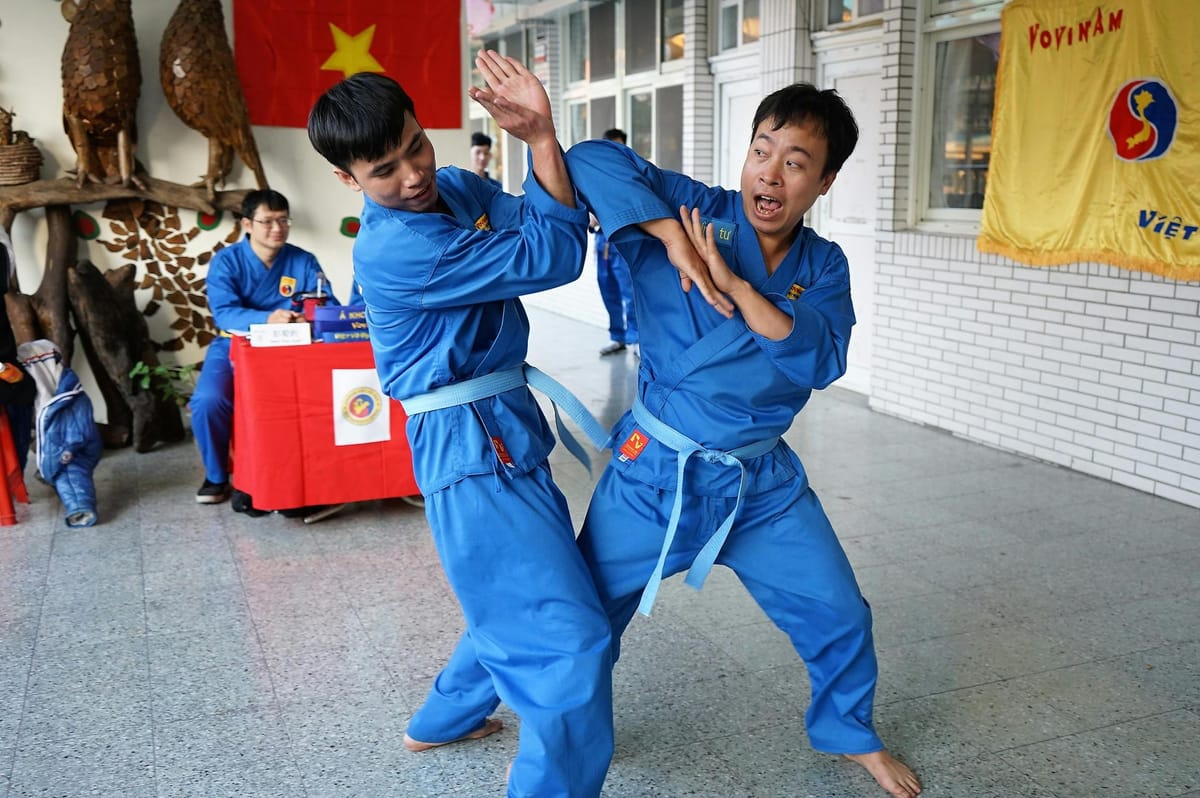
When people think of Vietnam, they think of pho, motorbikes, and coffee.
But Vietnam has its own martial art system called Vovinam (Viet Vo Dao), born in Hanoi in 1938 and now practiced in over 70 countries.
In 2023, the Vietnamese government designated it a national intangible cultural heritage.
In 2025, the United Nations Population Fund (UNFPA) and the Japanese Embassy chose to partner with Vovinam on a global program to combat violence against women.
How did a Vietnamese martial art get here?
An Underground Art in Colonial Times
Vovinam's founder, Nguyen Loc, was born in 1912 in Thach That district near Hanoi, now part of Hanoi city.
He was a sickly child, so his family had him learn martial arts to build strength.
As he grew up, he fused traditional Vietnamese martial arts with Chinese and Japanese techniques, and in 1938 began teaching a group of friends privately.
In 1939, he gave his first public demonstration at the Hanoi Opera House, drawing attention.
In 1940, he opened his first formal class at Hanoi's Ecole Normale (now Hanoi National University of Education).
The timing matters: Vietnam was still a French colony.
Nguyen Loc's purpose was explicit — to use martial arts to awaken national consciousness among young people.
When the French colonial authorities noticed, they banned him from teaching.
After the 1954 north-south partition, he moved south to Saigon with his students and started over.
In April 1960, Nguyen Loc died in Saigon at age 48.
On his deathbed, he named his disciple Le Sang as his successor.
In 1964, Le Sang formally christened the art "Viet Vo Dao" — the Vietnamese Martial Way.
The Signature Move: Flying Scissors
Vovinam's most recognizable technique is the flying scissors kick (don cat keo).
The practitioner leaps into the air, wraps both legs around the opponent's head or body like scissors, and takes them to the ground.
You almost never see this in other martial arts. It's Vovinam's calling card.
The technique demands explosive power, aerial control, and precise timing.
When executed well, it's nearly impossible to defend against.
But the risk is high — not just for the person being thrown, but for the attacker too.
In Brazilian jiu-jitsu competitions, a similar technique (kani basami) has been banned by multiple major organizations because of the injury risk.
Vovinam classifies the flying scissors as a "finishing technique" — when you use it, you're ending the fight.
A Different Belt System
Most martial arts use a black belt for high ranks. Vovinam doesn't.
Vovinam's belt progression from lowest to highest:
Light blue: Beginners, learning basic self-defense.
Blue: Formal students, studying the full range of Vovinam techniques.
Yellow: Instructor level, equivalent to a black belt in other martial arts.
Red: Master level, responsible for regional development.
White: Grandmaster level, reserved only for Vovinam's supreme leader.
In Vovinam's world, white represents the highest level — not the starting point.
From Southeast Asia to the World
Vovinam's domestic promotion has been aggressive.
In 2010, Vietnam's Ministry of Education directed schools at all levels to introduce Vovinam instruction.
FPT Group's K-12 schools and universities have made Vovinam a formal part of their physical education curriculum.
In Ho Chi Minh City, group Vovinam practice sessions are a common sight in parks every evening.
Internationally, the World Vovinam Federation (WVVF) was established in 2008 and now has members in over 60 countries.
Surprisingly, Vovinam is especially popular in Europe and North Africa.
At the 7th World Vovinam Championship held in Ho Chi Minh City in 2023, 35 countries competed.
Vietnam took first place with 18 gold medals, followed by Algeria and Cambodia.
France, Belgium, Italy, and Spain all have active Vovinam schools, with growing enrollment.
A United Nations Partnership
In September 2025, the World Vovinam Federation signed a global cooperation memorandum with Guardian Girls International in Hanoi.
The "Guardian Girls Vovinam" program, backed by UNFPA and the Japanese Embassy in Vietnam, aims to use Vovinam training to build women's confidence and self-defense skills, reducing gender-based violence.
The Vietnam Vovinam Federation (VVF) has officially joined the program and is rolling it out nationwide.
It's uncommon for a martial art to be selected by a UN agency as a vehicle for global outreach — especially an Asian one.
From an underground art in colonial times to a discipline practiced in over 70 countries with UN backing, Vovinam has carved out a unique path.
Next time you're in Vietnam, take an evening walk in the park. You might just see a group of people practicing flying scissors kicks.