What to Wear in Vietnam in Winter? North and South Climates Differ Greatly
Many people picture Vietnam as hot year-round — sunny skies, shorts and t-shirts all day. Think that going into a Hanoi winter, and you may deeply regret it.
Vietnam stretches more than 1,600 kilometers from north to south. Summers are hot everywhere, but winters split the country in two.
Same day: down jackets in Ha Noi, t-shirts in TP. Ho Chi Minh
In December, the temperature gap between north and south can exceed 20 degrees Celsius.
Ha Noi starts cooling in November, with temperatures ranging from 14 to 22°C. Cold fronts can push it below 10°C. High humidity and strong winds make it feel even colder — a damp chill that cuts straight through.
Meanwhile, TP. Ho Chi Minh sits at around 30°C in the daytime. Locals commute in short sleeves as usual.
Cold enough to cancel school: winter cold fronts in northern Vietnam
Winter in northern Vietnam is serious. From December through February, cold fronts sweep down from China in waves, dropping temperatures in Ha Noi by 7 to 8 degrees overnight.
Ha Noi and other northern areas follow a specific rule: kindergartens and primary schools close when temperatures fall below 10°C; secondary schools follow when it drops below 7°C. In the northern highlands, this happens nearly every winter.
The 2025–2026 winter is expected to run colder than usual due to La Niña. The phenomenon brings harsher winters and more frequent cold fronts to East Asia. Forecasters predict several strong cold waves in January, with possible snow and ice in the northern highlands.
Snow in Vietnam? The white spectacle of Sapa
Yes, it really does snow in Vietnam.
Sapa sits in the northern highlands at around 1,500 meters above sea level. Winter temperatures sometimes drop below zero. When a strong enough cold front hits between late December and early January, Sapa turns white.
Fansipan — Vietnam's highest peak at 3,147 meters — draws visitors for its snow-capped summit, a sight that surprises many people who assume this is Southeast Asia.
Snow in Sapa is not guaranteed every year, and it usually melts within hours. Late December to early January gives you the best chance.
What to pack for a winter trip to Vietnam
It depends on where you're going.
TP. Ho Chi Minh and the south? Summer clothes are fine. A light jacket for air-conditioned rooms is enough.
Ha Noi or the north? Bring proper winter gear: a heavy coat, sweaters, long pants, and a scarf. Ha Noi winters are cold and damp, so a windproof and water-resistant jacket will serve you better than a standard down coat.
Heading to Sapa or the highlands? Pack like you're facing a serious cold snap: thermal base layers, a down jacket, a wool hat, gloves, and thick socks. Bring all of it.
If someone asks whether Vietnam gets cold, the answer is: the north does, the south doesn't.
Ha Noi winters are colder than you expect, and Sapa can see snow. Don't let "Southeast Asia" fool you. Check the weather at your destination before you leave — otherwise you may land with a suitcase full of t-shirts.
One exception: TP. Ho Chi Minh in early 2026
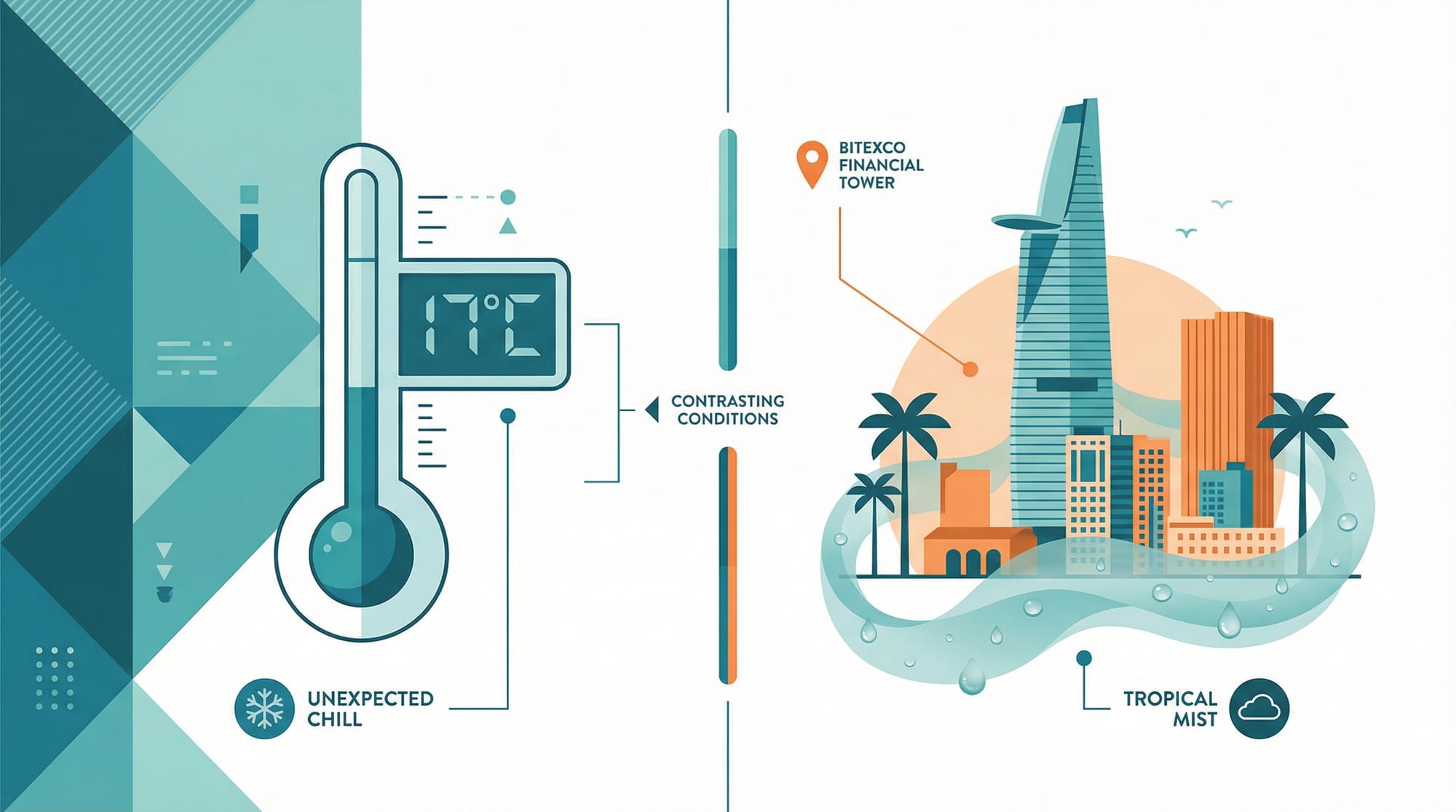
On the morning of January 9, temperatures in TP. Ho Chi Minh dropped to 16–17°C — the lowest recorded in nearly a decade.
Other southern cities also broke records: Vung Tau fell to 19.5°C, breaking its 1996 record of 19.7°C; Tay Ninh Province dropped to 16°C, the coldest reading in thirty years. La Niña combined with a powerful northeast monsoon pushed cold air all the way from the north into the south.
That morning, an unusual scene played out on TP. Ho Chi Minh's streets: motorbike commuters in jackets and gloves. For southerners used to 30°C all year, it felt like waking up in Da Lat.