Vietnam-US Trade Deal Enters Final Stage as To Lam Signs USD 37.2 Billion in Contracts
Three days in Washington, USD 37.2 billion in contracts, and a reciprocal trade deal nearing the finish line. From a 46% tariff threat last April to a near-final agreement — Vietnam moved fast.
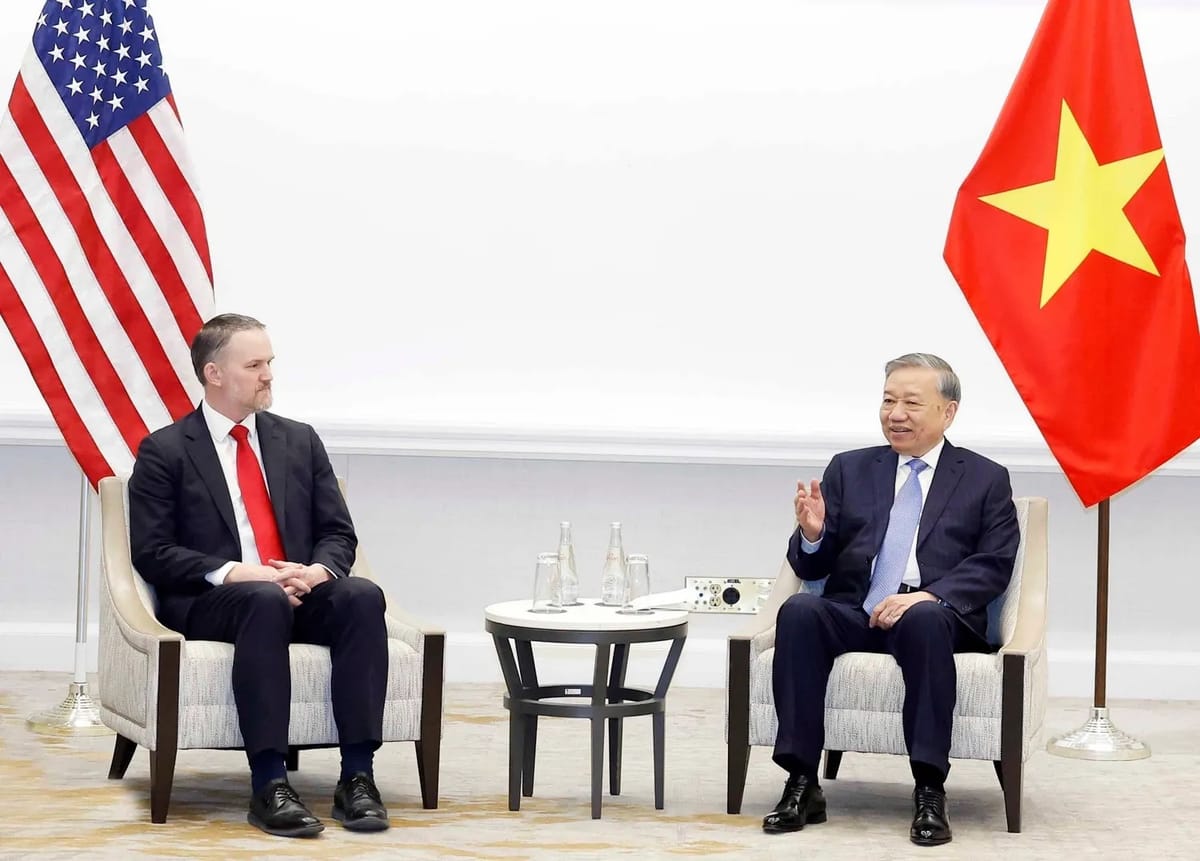
On February 19, General Secretary To Lam met US Trade Representative Jamieson Greer in Washington.
Both sides confirmed that negotiations on a US-Vietnam reciprocal trade agreement have reached the "decisive stage," with final text expected to be completed within the coming weeks.
To Lam's US trip was nominally to attend the inaugural session of the "Gaza Peace Commission" launched by Trump.
But the real centerpiece of the itinerary was trade.
From 46% to 20%: A Sharp Reversal in Under a Year
The story starts in April 2025.
Trump announced "Liberation Day" tariffs. Vietnam was hit with a 46% reciprocal tariff — among the highest of any country.
The formula was blunt: take the US trade deficit with that country, divide by total imports from that country, then halve it.
Vietnam's deficit-to-import ratio exceeded 90%, which produced 46%.
The Trump administration's logic: a deficit that large means Vietnam has too many barriers against American goods.
White House adviser Peter Navarro went further, calling Vietnam "the poster child for non-tariff cheating."
In 2024, the US goods trade deficit with Vietnam hit USD 123.5 billion — the third-largest deficit partner.
The 46% rate had not even taken effect when global stock markets crashed.
Trump promptly announced a 90-day pause, with a universal 10% rate in the interim.
That 90-day window was Vietnam's negotiating opening.
In July 2025, after a call between To Lam and Trump, both sides announced a preliminary agreement: Vietnam's rate dropped from 46% to 20%, transshipped goods would face 40%, and Vietnam would apply near-zero tariffs on US goods.
In October, the two countries issued a joint statement confirming the trade deal framework.
Five rounds of talks followed. By February this year, negotiators were in the home stretch.
What Vietnam Agreed To
Based on the October framework statement and disclosures by the Office of the US Trade Representative (USTR), Vietnam's concessions are wide-ranging:
Accept imports of automobiles that meet US safety and emissions standards — effectively opening the door for American pickup trucks and large SUVs.
Allow imports of remanufactured goods.
Speed up approval processes for US medical devices and pharmaceuticals.
Implement World Intellectual Property Organization internet treaty obligations.
On digital trade: no customs duties on electronic transmissions, and no licensing requirement for cross-border data transfers.
In short, Vietnam traded market access for lower tariffs.
Whether the math works out depends on how much of its export interest Vietnam can protect.
The USD 37.2 Billion "Gift Basket"
Traveling with To Lam to Washington was a large contingent of Vietnamese businesses.
During the visit, Vietnamese and American companies signed contracts and memoranda of understanding totaling USD 37.2 billion.
Aircraft alone accounted for nearly 100 planes: Vietnam Airlines signed for 50 Boeing 737-8s (USD 8.1 billion), Sun PhuQuoc Airways signed for 40 Boeing 787-9s (USD 22.5 billion), and Vietjet signed a USD 6.3 billion engine and maintenance deal with Pratt & Whitney.
On agriculture, Vietnamese firms signed 20 memoranda to purchase American agricultural products, estimated at about USD 2.9 billion.
On energy, Binh Son Refining (BSR) signed crude oil and ethanol supply agreements with American companies including Chevron and ADM.
The political signal in these contracts is unmistakable: Vietnam is buying American, seriously.
Every order tells Washington that Vietnam is willing to use actual purchases to narrow the trade deficit.
How Big Is the Deficit?
As noted, Trump used the deficit ratio to calculate tariffs.
So how big is Vietnam's deficit with the US?
In 2024, the US goods trade deficit with Vietnam was USD 123.5 billion.
In the first ten months of 2025 alone, Vietnamese exports to the US reached USD 126 billion, up 28% year-on-year. Electronic components surged nearly 80%.
For the full year of 2025, the figure expanded to USD 178.2 billion.
Vietnam's top export categories to the US — electronics, textiles, and footwear — are largely produced by multinationals with factories in Vietnam.
Goods exported from Samsung, Intel, and Nike's Vietnamese plants all count toward Vietnam's surplus.
The Trump administration is also focused on transshipment.
Some Chinese goods are routed through Vietnam to the US to dodge tariffs — which is why transshipped goods face the higher 40% rate.
What Is Still on the Table
Both sides say "nearly done," but several thorny issues remain.
Vietnam has long pushed for the US to recognize its "market economy status."
The US still classifies Vietnam as a non-market economy, which puts it at a disadvantage in anti-dumping investigations.
To Lam raised the issue again during this visit. The US side gave no public response.
State-owned enterprise reform is another unresolved point.
The US wants Vietnam to commit to reducing the market-distorting effects of SOEs. This touches the core of Vietnam's economic system and is not something that can be resolved quickly.
There is also the question of high-tech export controls.
Vietnam wants the US to ease restrictions on certain high-tech products, a particularly sensitive area in semiconductors and AI.
What It Means for Taiwanese Businesses
Once a US-Vietnam trade deal is officially signed, the impact on Taiwanese companies with factories in Vietnam is direct.
A 20% tariff is much lower than the initial 46%, but still significantly higher than the near-zero rates of the past.
Higher production costs will show up in quotes. Some orders may shift to other countries.
Transshipment is another risk.
If a company is found to be transshipping, the 40% rate is enough to erase margins entirely.
Vietnam's government has stepped up origin verification. Taiwanese businesses need to ensure their supply chains are fully compliant.
The silver lining: once the deal is signed, the rules become clear.
Compared to the months of uncertainty, a defined framework — even a tough one — is better for long-term planning.