Why Do Urban Universities in Vietnam Have Only a Few Buildings? The Space Crisis of Old Campuses
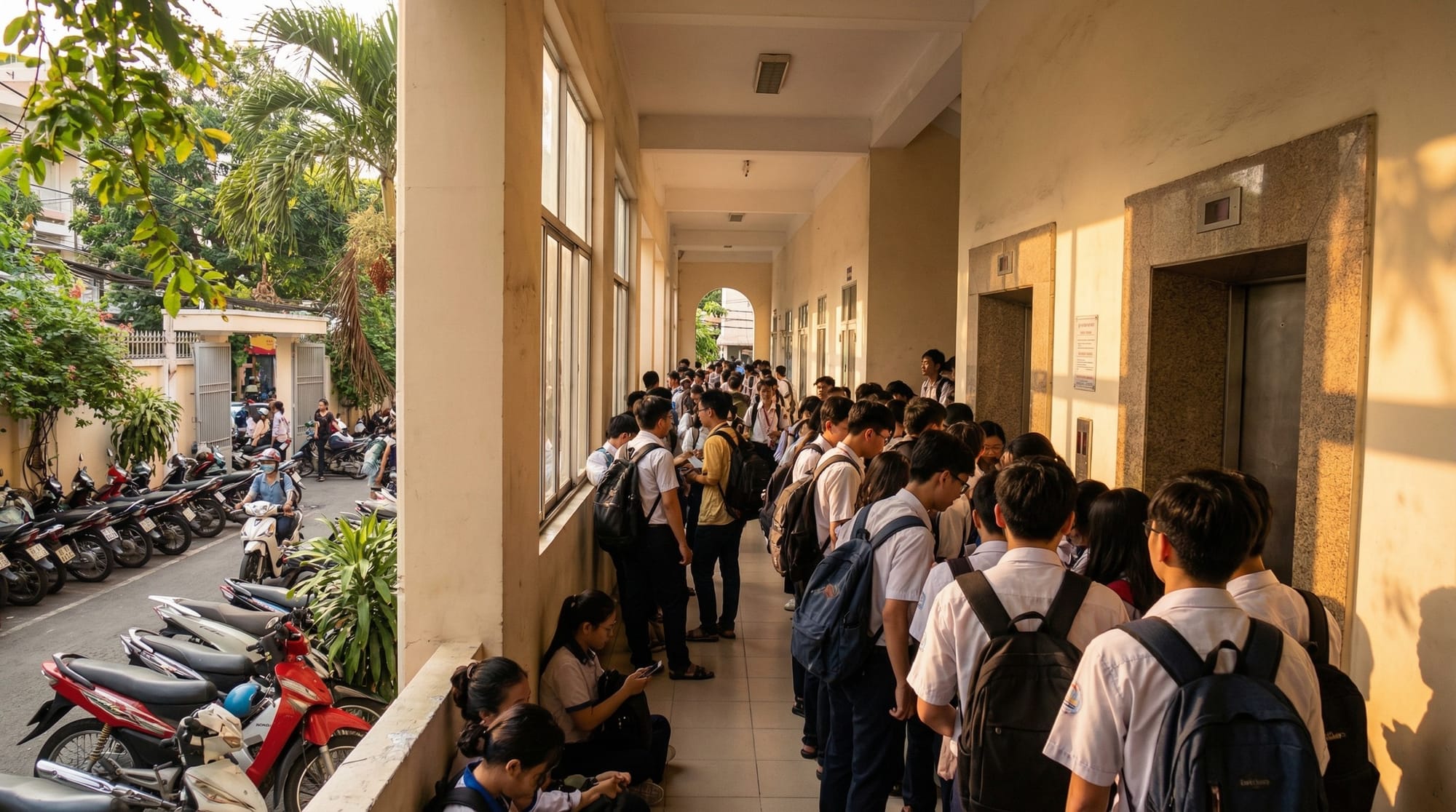
Walk into a university in central Ho Chi Minh City or Ha Noi, and the first thing you notice is this: the entire school is just a few buildings. Every department, tens of thousands of students, all packed inside. No lawns, no campus paths, no above-ground parking.
This isn't true across all of Vietnam — but in the city centers of Ha Noi and Ho Chi Minh City, it's the norm.
One building, one university
Take the Ho Chi Minh City campus of Foreign Trade University. The entire grounds cover just 5,000 square meters — about half a football pitch — yet thousands of students study there every day. The Ha Noi main campus is somewhat larger, at around 2.7 hectares, but its core is a single 12-story teaching block with 32 classrooms stacked inside.
Ho Chi Minh City University of Architecture tells the same story. The campus is narrow with little room to expand, so architects built upward: one eight-story block, one four-story block. Thousands of students move through them each day. The elevators are always full.
These "vertical campuses" exist for one reason: no land. The only way is up.
A desk's worth of space per student
Vietnam's Ministry of Education requires at least 10 square meters of campus space per student. That standard is already modest — yet reality is worse. Surveys show that many urban universities provide just 2 to 5 square meters per student, barely enough for a desk and chair.
Ha Noi's urban core has 26 universities crowded together. Three of them sit on less than 1 hectare. One report found seven universities and colleges packed along a single 1-kilometer stretch of road.
The contrast with Taiwan is stark. National Taiwan University's main campus covers around 106 hectares; National Chengchi University about 100 hectares. Foreign Trade University's Ho Chi Minh City branch has 0.5 hectares — more than 200 times smaller.
The impact on learning is direct: not enough library seats, no sports facilities, lab time must be scheduled in shifts, student clubs have nowhere to meet.
A legacy problem: how universities got trapped downtown
Many of Vietnam's well-known universities are decades or even a century old. When they were founded, they sat at the city's edge. Now they are surrounded by high-rises and traffic, land is prohibitively expensive, and expansion is impossible.
There is another factor: Vietnam's higher education system was modeled on the Soviet approach for decades, emphasizing narrow specialization — one school, one field. Campuses were never meant to be large. But as enrollment grew and disciplines merged, the old campuses were quickly overwhelmed.
Ha Noi University of Science and Technology is the largest university inside the city, at 26 hectares. That sounds substantial — until you consider it serves 35,000 students, giving each person roughly 7 square meters. Still below standard.
Vietnam does have large campuses
To be clear, large campuses do exist in Vietnam. The issue is the gap between city centers and the periphery.
Vietnam National University Ha Noi's Hoa Lac campus covers more than 1,100 hectares. Vietnam National University Ho Chi Minh City's university town spans 643 hectares — large by any global measure. Da Lat University has 38 hectares, Nong Lam University's Ho Chi Minh City campus has 120 hectares, and Vinh University covers 270 hectares.
But all of these are in suburbs or smaller cities. The established universities in central Ha Noi and Ho Chi Minh City simply do not have that kind of space.
Twenty years of relocation plans: why so little progress?
The Vietnamese government announced a university relocation policy back in 2007. Schools with urban campuses smaller than 2 hectares were to move to the outskirts, with each university eventually holding at least 10 hectares.
Nearly two decades later, progress remains slow.
The reasons are practical. New campuses sit in undeveloped areas: no dormitories, no restaurants, no convenience stores. Student life becomes difficult. Faculty do not want a two-hour daily commute. And for many schools, the bigger fear is that moving to the suburbs will hurt enrollment — location still matters to students and families.
The current compromise: keep postgraduate programs, research, and international partnerships at the old city campus, while gradually shifting undergraduate programs to new suburban campuses. Foreign Trade University is developing a 33-hectare campus in Bac Ninh province, expected to open in 2026.
From buildings to campuses: a long road ahead
Anyone used to Taiwan's sprawling university grounds will be surprised by what they find at urban Vietnamese universities. But these campuses are a product of specific historical conditions — they do not represent the whole of Vietnamese higher education.
Change is underway. Metro Line 5, connecting central Ha Noi to Hoa Lac, is under construction. Vietnam National University Ha Noi has already moved into its thousand-hectare new campus. From a few overcrowded buildings to a modern university town — Vietnam has spent twenty years on this transition. It may take another ten.