Vietnam''s Tet: Days 1, 2, and 3 Each Come With a Different Mission
Vietnamese have a saying: Day 1 for father, Day 2 for mother, Day 3 for teacher. Compared to Taiwan's Lunar New Year, some things feel familiar — others are entirely different.
In Taiwan, Lunar New Year goes like this: Day 1 is for temple visits, Day 2 is for visiting the wife's family, Day 3 is for sleeping in.
Vietnam also celebrates Lunar New Year and has a similar structure — but what to do each day, whose house to visit, and what gifts to bring are spelled out more precisely.
There is an old Vietnamese saying: "Mung 1 Tet cha, mung 2 Tet me, mung 3 Tet thay."
In English: Day 1 for father, Day 2 for mother, Day 3 for teacher.
Three days, three obligations, three meanings.
Day 1: The Husband's Family, Ancestor Worship
Day 1 belongs to the father's side of the family.
Married couples take their children to the husband's home. The entire extended family gathers for the first formal ancestor worship of the new year.
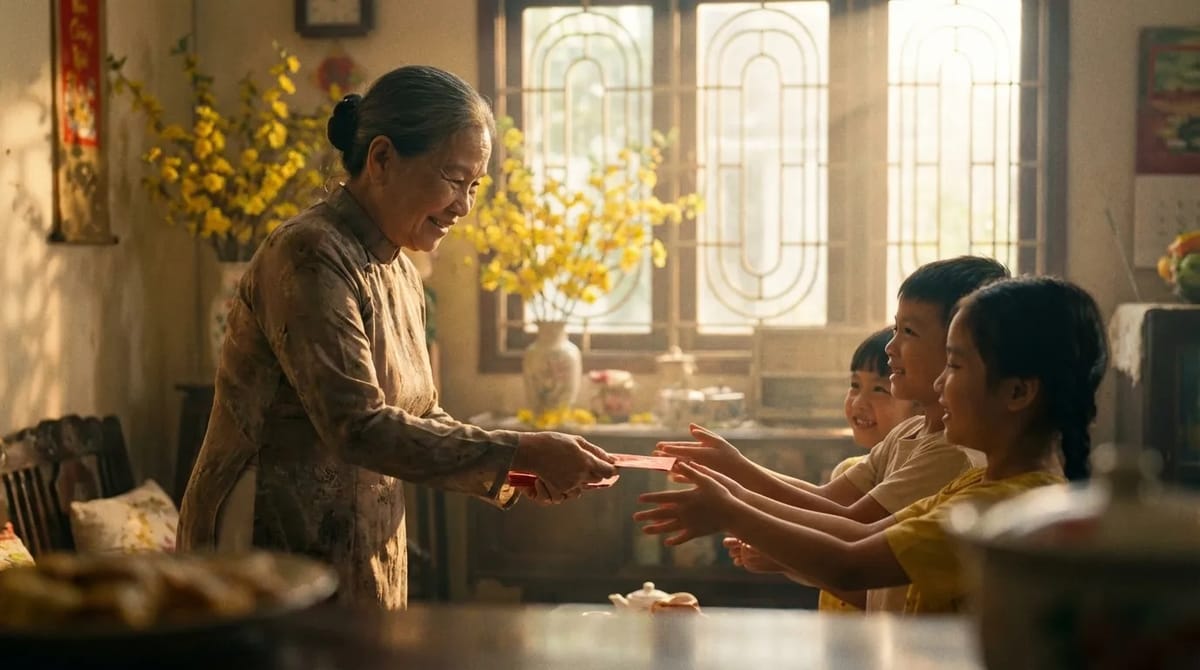
After the ceremony, younger family members pay their respects to elders in order of seniority. Elders give red envelopes — called "li xi" in Vietnamese, borrowed from the Cantonese "lai see."
Then everyone sits down for the New Year meal.
In the north, the centerpiece is banh chung — square sticky rice cake. In the south, it is banh tet, a cylindrical version. Side dishes vary by region but typically include braised meats, pickled vegetables, and sticky rice.
Day 1 also features a custom called "xong dat" — literally "stepping on the earth."
Vietnamese traditionally care deeply about who the first outsider to enter their home is on New Year's Day.
That person's personality, fortune, and zodiac sign are believed to influence the household's luck for the entire year.
The old way: families would pre-arrange for someone with a cheerful disposition, a successful career, and a compatible zodiac sign to visit on the morning of Day 1.
Most young families today do not take it as seriously, but they still treat xong dat as a fun New Year ritual — more about good vibes than superstition.
If you have Vietnamese friends and get invited to "stop by for a bit" during Tet, you might be their chosen xong dat guest.
Day 2: The Wife's Family
This is similar to Taiwan's custom.
Day 2 belongs to the mother's side. The couple takes their children to the wife's parents' home.
The routine mirrors Day 1: worship at the maternal family's ancestor altar, greet the grandparents, uncles and aunts, then share a meal.
Common gifts to bring include fruit baskets, tea, candy, or a case of beer.
In Taiwan, there used to be taboos around the Day 2 visit — for instance, the daughter should not stay for dinner, and return gifts should come in even numbers. But most families have relaxed those rules.
In Vietnam, it is even more casual. Most people stay the whole day. Some even spend the night before heading back.
Day 3: Visit the Teacher
This one has no equivalent in Taiwan.
Taiwanese typically stay home on Day 3. The old custom calls it "Red Dog Day" — an inauspicious time to go out.
Vietnam is different.
Day 3 is "Tet thay" — the day students visit their teachers.
The tradition comes from Confucian values of respecting educators. An old Vietnamese saying goes "Quan, Su, Phu" (ruler, teacher, father) — placing teachers above parents in the social hierarchy.
Traditionally, students would visit their teacher's home in groups, sometimes turning it into a class reunion.
Teachers would serve tea and sweets. Some would even give red envelopes to visiting students.
But according to Vietnamese media, this tradition has faded noticeably in recent years.
Many young students do not even know about "mung 3 Tet thay." Those who do often just send a text or leave a social media comment rather than making an in-person visit.
Some teachers have told reporters that Day 3 used to be busy with students all day; now it is much quieter.
This custom is rare in other East Asian countries, making it a distinctly Vietnamese tradition — though one that is slowly fading.
Tet Taboos
During the first three days, Vietnamese observe a number of taboos. Some overlap with Taiwanese customs; others differ significantly.
No sweeping.
Do not sweep the floor or take out the trash from Day 1 to Day 3 — it sweeps away wealth.
This is identical to the Taiwanese tradition.
No black or white clothing.
Vietnamese consider black and white funeral colors. Wearing them during Tet brings bad luck.
Taiwan is less strict about this — at most, people say red is more auspicious.
No borrowing money.
Lending or borrowing money during Tet signals financial trouble for the rest of the year.
Taiwan has a similar belief.
No breaking things.
Smashing a bowl, cup, or mirror symbolizes "breakage" — suggesting the family may experience separation during the year.
In Taiwan, the fix is to quickly say "sui sui ping an" (broken pieces bring peace). Vietnamese take it more seriously. People are extra careful throughout the entire holiday.
No dog meat or duck.
Traditional belief holds that dog meat and duck should be avoided during Tet.
Dogs symbolize loyalty — eating them is inauspicious. Ducks waddle when they walk, symbolizing unsteady progress.
Older generations care about these rules more than younger people.
Taiwan has no equivalent taboo.
The Biggest Difference
Taiwan's Lunar New Year runs from New Year's Eve through the Lantern Festival on the 15th day.
Vietnamese Tet is shorter. Many families consider the holiday over after Day 3, at most extending to Day 7.
In Taiwan, the focus is on food and red envelopes. The reunion dinner on New Year's Eve is the main event.
In Vietnam, the emphasis is spread across three days, each carrying a different social obligation.
Worship the ancestors on Day 1, take care of the wife's family on Day 2, and — traditionally — visit your teacher on Day 3. It is a packed schedule.
Not every Vietnamese person follows the full sequence anymore, especially younger generations, but the basic framework holds.
Vietnam's xong dat custom also has almost no parallel in Taiwan.
The closest equivalent might be racing to burn the first incense at a temple on New Year's Day, but Taiwanese do not deliberately arrange for a specific person to be the first visitor to their home.