Vietnam Strikes Southeast Asia''s Biggest Oil Find in 20 Years, With Over 400 Million Barrels
The Hai Su Vang field in Vietnam's Cuu Long Basin holds over 400 million barrels of recoverable oil — Southeast Asia's third-largest find since 2000. Full production is expected around 2029.
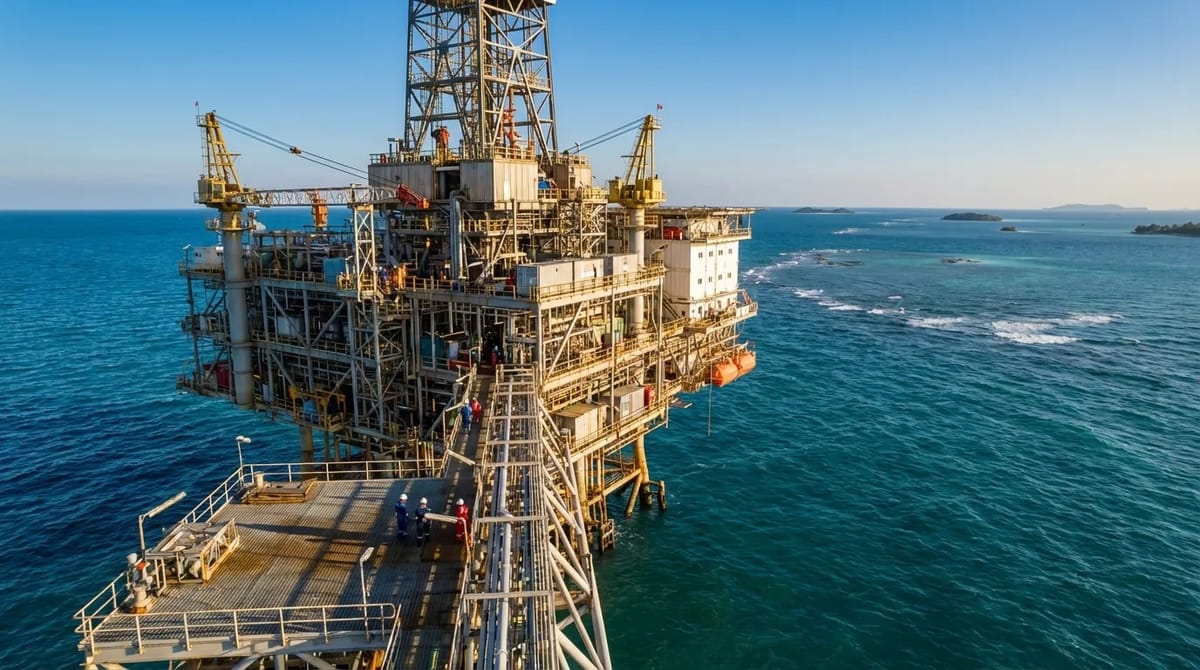
In late January 2026, Vietnam's Ministry of Industry and Trade officially announced that an offshore oil field, after more than a year of exploration and evaluation, had been confirmed as having major development potential.
The field is called Hai Su Vang (Golden Sea Lion). It sits in Block 15-2/17 of the Cuu Long Basin, about 64 kilometers off the Vietnamese coast.
Energy consultancy Wood Mackenzie rated it the third-largest oil discovery in Southeast Asia since 2000, behind only Indonesia's Banyu Urip and Malaysia's Gumusut fields.
From one well to two
The story starts in January 2025.
U.S.-based Murphy Oil released results from the first exploration well, HSV-1X, drilled to about 4,000 meters below the seabed. It found approximately 113 meters of net oil pay across two reservoir zones.
The market took notice, but the real surprise came later.
In October of the same year, the second appraisal well, HSV-2X, was drilled.
Results were even better: combined net oil pay of 131 meters — 101 meters in the deep main reservoir and 30 meters in a shallower zone.
Flow testing produced 6,000 barrels per day of light crude at 37 degrees API — solid quality.
Murphy Oil updated its resource estimate: the mid-case recoverable resources for the main reservoir now approach the high end of the earlier 170-to-430-million-barrel range.
Including the additional upside from the shallow reservoir (not yet formally booked), total recoverable resources could exceed 430 million barrels.
The oil column reaches about 488 meters — a substantial scale.
Vietnam's oil anxiety
This discovery comes at a critical time.
Vietnam's crude output dropped from roughly 365,000 barrels per day in 2005 to under 120,000 in 2025 — nearly two-thirds wiped out in twenty years.
Old fields are depleting and new exploration has stalled.
Between 2016 and 2020, Vietnam signed only three new oil and gas contracts, nearly seven times fewer than the previous five-year period.
Hai Su Vang gives Vietnam's petroleum industry a real shot at reversing the decline.
In 2024, Vietnam's crude production hit 9.87 million tons, exceeding the annual target by about 20%.
That same year was also the first in a decade to see three new oil and gas discoveries in a single year.
But overall production is not expected to rebound by 20 to 30 percent until after 2027, once Hai Su Vang and other new fields begin coming online.
Who gets a piece
The Hai Su Vang joint venture: Murphy Oil holds 40% and serves as operator, PVEP (a subsidiary of Vietnam's national oil company PetroVietnam) holds 35%, and South Korea's SK Earthon holds 25%.
In late January 2026, Vietnam's Ministry of Industry and Trade formally addressed the discovery at a regular press conference. The official assessment was that Hai Su Vang has "significant potential."
Deputy Minister Nguyen Sinh Nhat Tan called it "a very positive result" for Vietnam's energy sector and said the government would continue to support PetroVietnam and relevant agencies in conducting a full evaluation.
Under Vietnamese regulations, the developers must complete additional appraisal wells and submit a detailed resource report for regulatory approval before moving to the production phase.
Murphy Oil has already scheduled wells HSV-3X and HSV-4X for 2026, with a full-year capital expenditure budget of USD 1.1 to 1.3 billion.
How far away is production?
There is still a stretch before oil starts flowing.
In the same Cuu Long Basin, Murphy Oil's smaller development project Lac Da Vang (Golden Camel) is expected to begin production in Q4 2026 — their first producing asset in Vietnam.
Hai Su Vang is larger and more complex. Full production is projected around 2029.
For Vietnam, whether this field can be developed smoothly will shape the country's energy map for the next decade.