Vietnam's New Food Safety Law Suspended After Just Ten Days as Containers Jam Ports
Vietnam's food safety Decree 46 took effect in late January. Within ten days, over 1,800 containers were stuck at ports. The government hit the brakes.
In late January, a Vietnamese importer's three containers of American walnuts arrived at Cat Lai port in HCMC, worth about VND 12.6 billion.
Under normal procedures, customs clearance would have taken a day or two.
But this time, customs officers refused the paperwork. The reason: a new law had taken effect, the old process no longer applied — and nobody knew how the new process worked.
The cargo sat at the port. One day, two days, five days.
Walnuts do not spoil like produce, but the contract had delivery deadlines. Penalty charges were piling up daily.
This was not an isolated case.
On January 26, Vietnam's new food safety regulation Decree 46 (Nghi dinh 46/2026/ND-CP) took effect, replacing the eight-year-old Decree 15.
Within ten days, major ports and border crossings across the country ground to a halt.
One decree, nationwide gridlock
Decree 46 made several major changes.
First, it drastically expanded the scope of national inspections for imported food.
Under the old rules, imported food primarily underwent document review — not every shipment was physically inspected.
The new rules require every shipment to go through document review, physical inspection, and sample testing. Test results take about seven business days. Goods can only be cleared after passing.
Industry estimates suggest inspection volumes could surge 10 to 20 times.
Second, it brought food-contact packaging and utensils under strict oversight for the first time.
Previously, these products only needed a self-declaration of compliance. Now they must go through registration and national inspection procedures.
Imports are not limited to the food itself — even the containers holding the food must be checked.
Third, the new law established no mutual recognition mechanism for international certifications.
Even if imported products already hold HACCP, ISO 22000, or similar international certifications, they are not exempt from Vietnam's national inspection. Every shipment must still complete the full process from scratch.
The fatal flaw: the decree was published on January 26 and took effect on January 26 — with zero transition period.
Customs officers received a new law but no implementation guidelines. Not knowing how to proceed, they simply blocked everything.
The result was total gridlock.
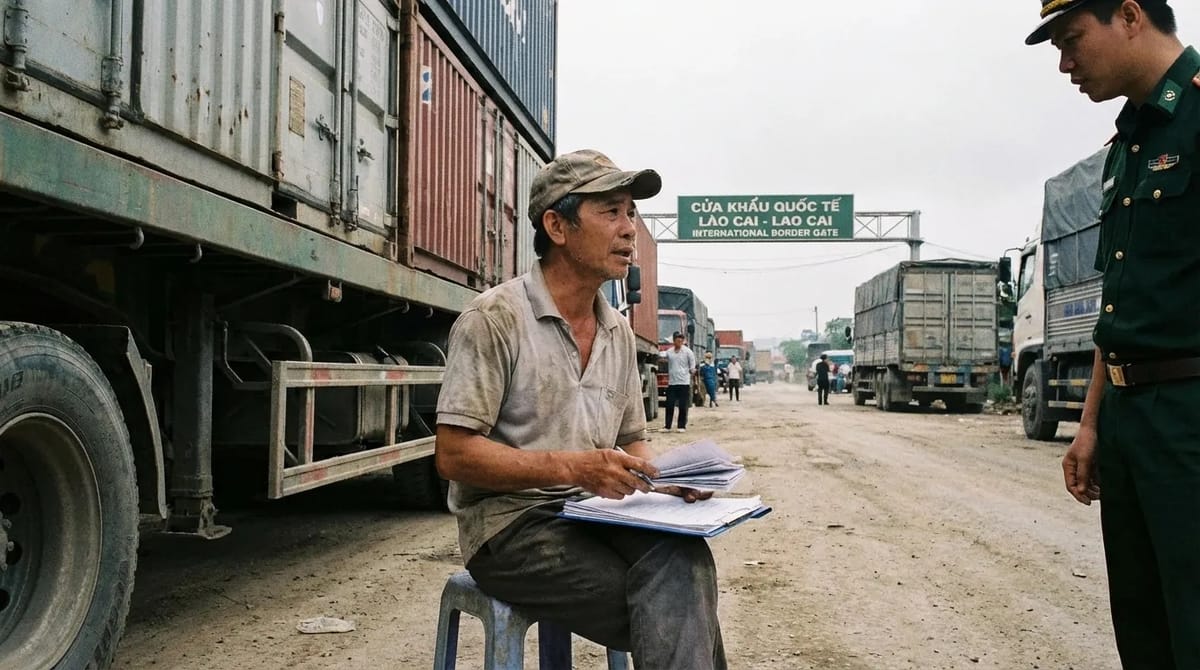
Within four days, over 700 shipments and about 300,000 tons of imported goods were stranded at land and sea border crossings nationwide.
Cat Lai port in HCMC alone had over 1,800 containers stuck.
Ten days later, the government hit the brakes
After the situation blew up, the government responded fairly quickly.
On February 3, Prime Minister Pham Minh Chinh signed an emergency directive ordering immediate clearance of border crossings and expedited implementation guidelines.
On February 5, the government officially issued Resolution 09 (Nghi quyet 09/2026/NQ-CP), suspending Decree 46 until April 15.
During the suspension, the old Decree 15 rules apply.
Once the brakes were pulled, border crossings resumed immediately.
On the afternoon of February 5, three containers belonging to a seafood importer from Lam Dong province that had been stuck at Cat Lai were released the same day.
Lao Cai border crossing was also fully cleared by 4 PM, with only 35 trucks of candy still waiting for test results — but the process was running normally again.
Pham Khanh Phong Lan, head of HCMC's Food Safety Management Authority, put it plainly: "Making the certification process more complicated does not make food safer."
The suspension is just a bandage
Decree 46 is paused, but the problems remain.
A CafeF commentary on February 7 was blunt: "This must be fundamentally revised, not just suspended."
The article highlighted several structural issues.
The current approach is "comprehensive pre-clearance inspection" — every imported food shipment must be tested before release.
Without switching to risk-based classification — fast-tracking low-risk products while intensifying checks on high-risk ones — the gridlock will repeat when the decree is reinstated on April 16.
Another issue is the disconnect with international certifications.
Many countries recognize each other's food safety certification systems. If Vietnam insists that all imports obtain local certificates from scratch, import costs will rise sharply — ultimately passed on to consumers.
The most fundamental problem is enforcement capacity.
Industry sources say there are not enough frontline inspectors, not enough accredited testing labs, and no cross-ministerial coordination mechanism in place.
No matter how well the regulation is written, if there is nobody to execute it, the result is delay and confusion.
The government has given itself until April 15 to fill these gaps.
The Ministry of Health, Ministry of Agriculture and Environment, Ministry of Industry and Trade, Ministry of Finance, and local governments have all been ordered to be ready by the deadline.
Whether two-plus months is enough to overturn eight years of institutional inertia is a big question mark.
What importers should keep in mind
If you do food-related import-export in Vietnam, a few things to watch.
Now through April 15, the old Decree 15 procedures apply — no major issues.
But after April 16, the new law is likely to return, and inspection processes, documentation requirements, and certification standards could all change.
The pre-Tet period is peak season for food imports in Vietnam, and this gridlock hit at the worst possible time.
Some businesses calculated losses in the "tens of billions of VND" — contract penalties, port storage fees, and spoiled perishables add up to real money.
Keep a close eye on the implementation details Vietnam's government issues over the next two months, and prepare any additional documents and certifications that may be required.
The worst-case scenario: the decree returns in mid-April with implementation still not ready. That means another round of gridlock.