A Tale of Two Book Streets: One Became a City Icon, One Was Built on a Mass Grave
Most visitors to Ho Chi Minh City know its book street. Fewer know Hanoi has one too — built on a former mass grave, once home to the 'Hell Market.' One turned ten as a city icon selling fewer and fewer books; the other nearly died before a revival. What should a book street sell next?
[A Tale of Two Book Streets: One Became a City Icon, One Was Built on a Mass Grave]
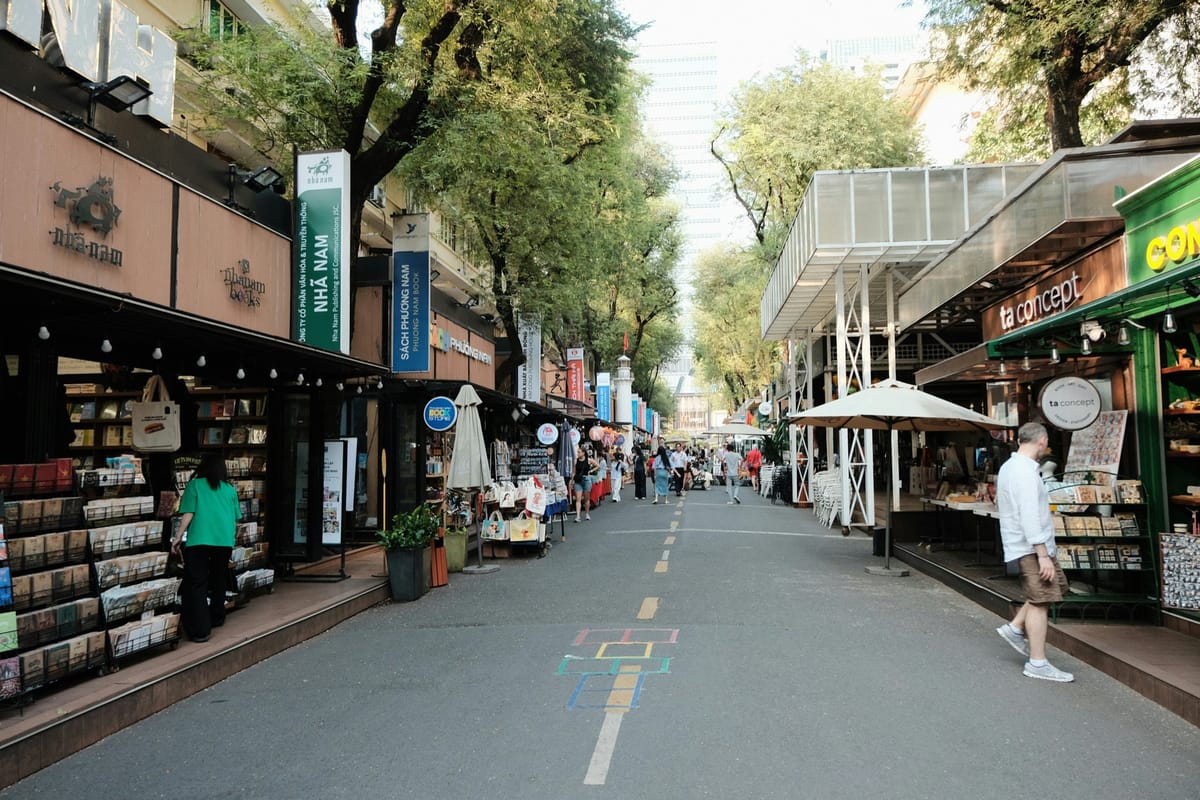
If you have been to Ho Chi Minh City, chances are you have walked Nguyen Van Binh Book Street, the deeply shaded lane beside the Notre Dame Cathedral. It runs just 144 meters, lined end to end with book stalls, bookshops, and cafés.
But did you know Hanoi has a book street too? It sits south of Hoan Kiem Lake, on a short street named "December 19." It is far less famous than Saigon's, and its past is far stranger: the land was once a mass grave, then a market locals called the "Hell Market," and it nearly became a shopping mall before it finally became a book street.
Start with Saigon. Hard to imagine now, but ten years ago this was a shabby fenced-off parking lot. The conversion barely touched the ground: the stalls were prefabricated elsewhere, trucked in, and set down on the existing sidewalk, without moving a single tree. Construction took only three months, and the street opened in early 2016. As for the name — the street was called Hongkong Street in the French colonial era, went through several renamings, and since 2000 has carried the name of Nguyen Van Binh, a prominent Catholic leader. That is the Nguyen Van Binh in "Nguyen Van Binh Book Street."
Over ten years, nearly 7 million books have passed through this street, and it has grown from a place to buy books into a destination tourists seek out. At the tenth-anniversary ceremony in January, officials declared it the most successful community cultural institution in the country — the model for anyone, anywhere in Vietnam, who wants to build a book street. The annual Tet book festival has grown year after year; this year it expanded to three venues for the first time, drawing more than a million visitors in eight days.
The street's business figures, though, are less rosy than they look.
Last year, total revenue on the book street grew nearly 10%, and it hosted more events than ever, most of them interactive or experience-based. But in the same annual report, every book-related number was falling: fewer copies sold, new titles down by nearly a third, and children's books declining for the third straight year.
More money, fewer books — where is the gap? Lê Hoàng, director of the Book Street Company, was blunt at the annual review: the business mix is shifting. Higher-priced books make up a growing share, and stalls are giving more and more space to merchandise, gifts, book cafés, and paid workshops. Revenue growth increasingly comes not from books themselves but from the experiences built around them. He also faulted vendors for passivity, saying several rounds of night book fairs went underused.
Nguyễn Ngọc Hồi, deputy director of the city's Department of Culture and Sports, went further at the same meeting: entering its second decade, the book street must be "repositioned." It should first be a space that encourages reading, and only second a tourist attraction, with children and teenagers as its priority audience. In other words, barely two months after its tenth birthday, the street held up as a national model was told to rethink what it is for.
Hanoi's street, by contrast, went through far more turmoil before it could become a book street at all.
On December 19, 1946, Hồ Chí Minh called for nationwide resistance against the French, and Hanoi fought sixty days of street battles. The dead, with no time for proper burial, were interred in a common grave along what was then Le Chan Street — and stayed there for more than three decades. In 1981 the city moved the remains to a cemetery outside the capital and renamed the street "December 19" in memory of the uprising. A few years later the city opened a market on the site. Because it stood on the old burial ground, residents gave it a blunt name: chợ Âm phủ — the Hell Market.
In 2008, the city reclaimed the land and handed it to a private company to build a shopping center and offices. The day the excavators rolled in, there was an outcry. A historian published an open letter against the project, and a Tiền Phong reporter dug up the decisive evidence: under the zoning plan approved years earlier, the plot was never meant for a mall — it was meant to be a road. The story ran on the front page on December 19, the anniversary of the resistance itself. Under public pressure, the city killed the project early the following year. Later excavation uncovered hundreds more sets of remains beneath the old street.
The book street is the child of that fight. The city replaced the mall plan with a book street, which opened in 2017.
But the opening buzz lasted only months. Once media attention faded, stall revenues fell by 60%, and publishers filed a joint petition; hosting events to draw crowds cost more than they could bear. Critics pointed to two structural flaws: the street sits off the pedestrian flow around Hoan Kiem Lake, and it is too narrow for the kind of programming that builds a reading atmosphere. Critic Phạm Xuân Nguyên put the comparison sharply: at Saigon's book street, people can relax and settle in for an afternoon; Hanoi's could not manage that.
The turnaround came in 2023. After renovations, events and crowds returned — a revival, as Hanoi media put it. This past Tet, the December 19 street ran its spring book festival as usual, with lucky-money books, calligraphy stalls, and Dong Ho painting workshops through the sixth day of the lunar new year. The organizer's name has changed with Hanoi's administrative redistricting, but the street is still here.
Put the two streets side by side and the picture sharpens.
Saigon's decade proves a book street can become a city's calling card. Hanoi's experience shows it does not happen by itself: without foot traffic, without atmosphere, without someone running events year after year, a book street can empty out within six months of opening.
Their problems differ. Saigon's question is what remains of a book street once books stop selling; Hanoi's is how to keep people coming. But both point to the same reality: on book sales alone, a book street can barely survive anymore. Ho Chi Minh City's official answer is to return to the original mission of getting people to read. Whether that works will play out over the next few years.
Next time you are in Ho Chi Minh City, walking that shaded promenade, notice whether the stalls are stacked with books or tote bags. And if your itinerary reaches Hanoi, the December 19 street is worth the detour. Knowing the story under your feet makes the walk worth it on its own.
The Viet Media Monthly
A curated monthly digest of the most important political, economic, tech, and industry developments in Vietnam.
Designed for reading on desktop or tablet — no algorithm, no noise. Just the stories that matter.
Delivered before the 10th of each month. Cancel anytime.