6 Million Viet Kieu: How Boat People's Descendants Became Vietnam's Hidden Economic Engine
Vietnam's 6 million overseas diaspora sends USD 16 billion home annually. From the boat people exodus to new dual citizenship laws, the Viet Kieu story.
Walk into a pho restaurant in Orange County, California, and you might hear the owner greet customers in Vietnamese, a South Vietnamese flag hanging on the wall. This is Little Saigon, the world's largest Vietnamese community outside Vietnam and the spiritual capital of the overseas Vietnamese.
Viet Kieu -- the Vietnamese term for overseas Vietnamese -- refers to people of Vietnamese descent scattered across the globe. This community carries a complex history, substantial economic clout, and a nuanced relationship with the homeland.
6 Million People Across 130 Countries
According to Vietnam's Ministry of Foreign Affairs, roughly 6 million Viet Kieu live in 130 countries and territories. Over 80% reside in developed nations.
The United States is the largest concentration, with about 2.4 million people, mainly in California, Texas, and Virginia. Vietnamese Americans are the fourth-largest Asian American group, behind Chinese, Indian, and Filipino Americans.
France comes next at about 350,000, followed by Australia at 330,000 and Canada at 240,000. In Asia, Japan has the highest count at nearly 500,000 -- mostly workers and students. Cambodia has close to one million, a community dating back to the 17th century.
Boat People: From the Fall of Saigon to the Refugee Wave
The mass formation of the Viet Kieu began in 1975.
On April 30 that year, the Vietnam War ended and the country was reunified. The new government launched crackdowns on dissidents, former South Vietnamese officials, and military personnel. Tens of thousands were sent to "re-education camps." Ethnic Chinese Vietnamese had their assets seized. South Vietnamese currency became worthless overnight.
Fear drove people to flee. They boarded crude fishing boats, risking pirates, storms, and starvation, drifting to Hong Kong, Malaysia, Thailand, and Indonesia. These were the "Vietnamese boat people" -- one of the largest maritime refugee crises since World War II.
Between 1975 and 1995, nearly 800,000 boat people reached other countries. The UN refugee agency estimates 200,000 to 400,000 perished at sea.
Hong Kong served as a "port of first asylum," receiving over 230,000 Vietnamese refugees over two decades. In 1988, Hong Kong introduced a screening policy, broadcasting announcements in Vietnamese on the radio. The opening phrase "Bat dau tu nay" (from now on) became seared into a generation of Hong Kongers' collective memory, locally rendered as "Bak Lau Dong La" in Cantonese.
Little Saigon: A City Built by Exiles
Many boat people eventually settled in places that became "Little Saigons."
The most famous is in Orange County, California, spanning Westminster and Garden Grove. After the war ended in 1975, refugees were drawn by Southern California's warm climate and affordable housing. They started settling and opening shops. By 1979, there were 30 Vietnamese stores. By 1981, there were hundreds.
In 1988, Westminster officially designated the Bolsa Avenue area as the "Little Saigon Tourist Commercial District." Today it houses hundreds of restaurants, supermarkets, jewelry stores, and clinics. It's the largest Vietnamese community outside Southeast Asia, often called the "Viet Kieu cultural capital."
In 1992, Tony Lam became the first Vietnamese refugee elected to public office in the United States, winning a seat on the Westminster City Council. In 2004, Van Tran became the first Vietnamese American in a state legislature.
Remittances: A USD 16 Billion Economic Lifeline
The most direct economic contribution from the Viet Kieu is remittances.
In 2024, Vietnam received about USD 16 billion in remittances, holding steady at the all-time high set in 2023. Over USD 9.5 billion flowed into HCMC alone, accounting for 60% of the national total. Since tracking began in 1993, cumulative remittances have exceeded USD 206 billion -- roughly equal to the actual disbursed amount of foreign direct investment over the same period.
Asia and the Americas are the main sources, together making up 82%. Asia accounts for nearly 54%, driven mainly by Vietnamese workers in Japan, South Korea, and Taiwan. The Americas represent the traditional Viet Kieu remittance corridor.
Where does the money go? Mostly family living expenses, children's education, and property purchases. Some goes to small business startups. Remittances are a critical income source for many Vietnamese households and a pillar of foreign exchange stability.
Viet Kieu Investment: 385 FDI Projects
Beyond remittances, Viet Kieu also invest directly in Vietnam.
As of the end of 2022, Viet Kieu from 35 countries had invested in 385 FDI projects in Vietnam with a total registered capital of USD 1.72 billion, spread across 42 provinces and cities. Manufacturing leads at 45%, followed by services and energy. Hanoi attracts the most Viet Kieu investment, followed by Long An, Binh Thuan, Hai Phong, and Dong Nai.
Many Viet Kieu entrepreneurs report that investing back home often means dealing with bureaucratic red tape and opaque regulations. They want the government to set up dedicated service windows.
Five-Year Visa Exemption and New Dual Citizenship Law
The Vietnamese government has been actively courting the Viet Kieu in recent years.
Viet Kieu who have given up Vietnamese citizenship can apply for a five-year multiple-entry visa exemption, allowing stays of up to 180 days per visit, for a fee of just USD 10 to 20. This makes it much easier to visit family and manage affairs in Vietnam.
A bigger shift came with the amended Nationality Law, effective July 2025. Vietnam had long restricted dual citizenship. The new law significantly loosens the rules, making it easier for overseas Vietnamese and second-generation Viet Kieu to acquire or restore Vietnamese citizenship while keeping their foreign passports.
Vietnam's Minister of Justice said the goal is to attract overseas talent and capital, especially Viet Kieu with expertise in AI and semiconductors. The government's calculation is clear: 80% of the 6 million Viet Kieu live in developed countries. Their money, skills, and networks are potential resources for Vietnam's industrial upgrading.
Looking Back After 50 Years
2025 marked the 50th anniversary of the end of the Vietnam War.
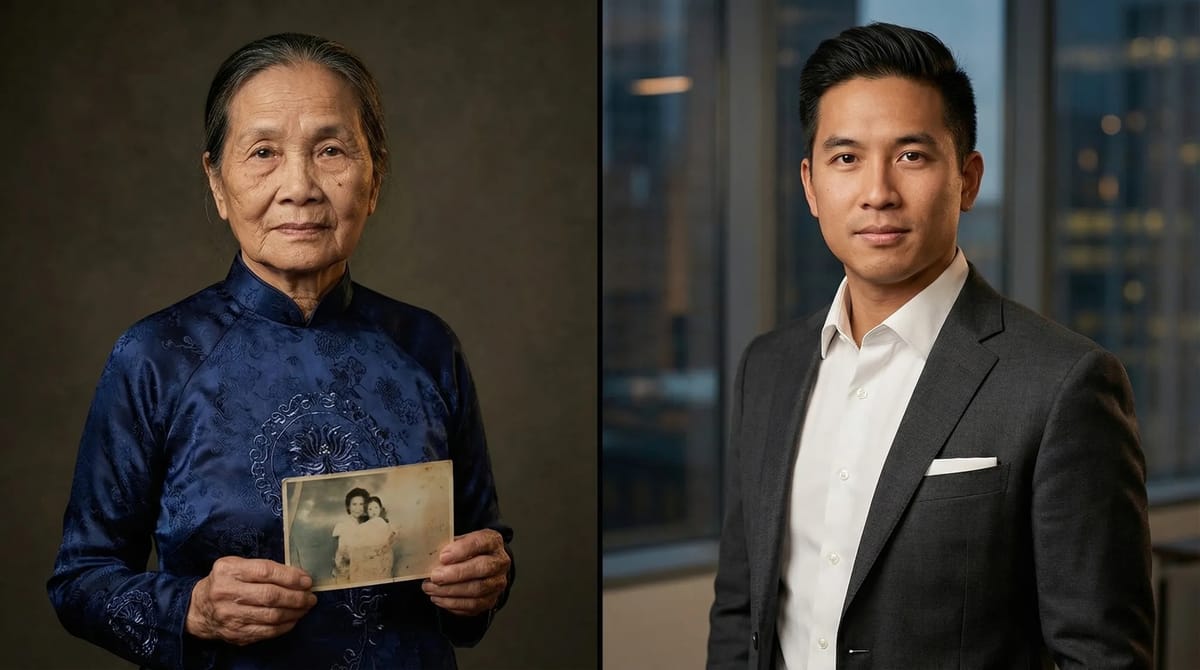
The refugees who risked death to flee five decades ago are now grandparents. Their children and grandchildren were born and raised in the United States, France, and Australia. Some speak fluent Vietnamese; others know only a few words. Every Lunar New Year, Little Saigon's flower markets are still bustling, but the young vendors are more likely to chat in English.
For the Vietnamese government, these 6 million people are resources to win over. For the Viet Kieu themselves, the relationship with the homeland is far more complicated. Some go back to invest. Some refuse to set foot on that soil. Some eagerly apply to restore citizenship. Others consider themselves citizens of another country entirely.
Regardless, this global diaspora has profoundly shaped Vietnam's economy and culture. The USD 16 billion in annual remittances, the pho shops of Little Saigon, and the achievements of a new generation of Vietnamese Americans across every industry -- these are all traces left by a history of dispersal.
Sources: Vietnam Ministry of Foreign Affairs, World Bank, General Statistics Office of Vietnam, VnExpress, VietnamPlus, Wikipedia