Is Alex Honnold Ready? Vietnam Wants to Build a 99-Story, 500-Meter Tower.
HCMC's Thu Thiem proposes a 99-story tower to surpass Landmark 81 as Vietnam's tallest building. It anchors the Vietnam International Financial Center, but Thu Thiem's history is more complicated than any planning map shows.
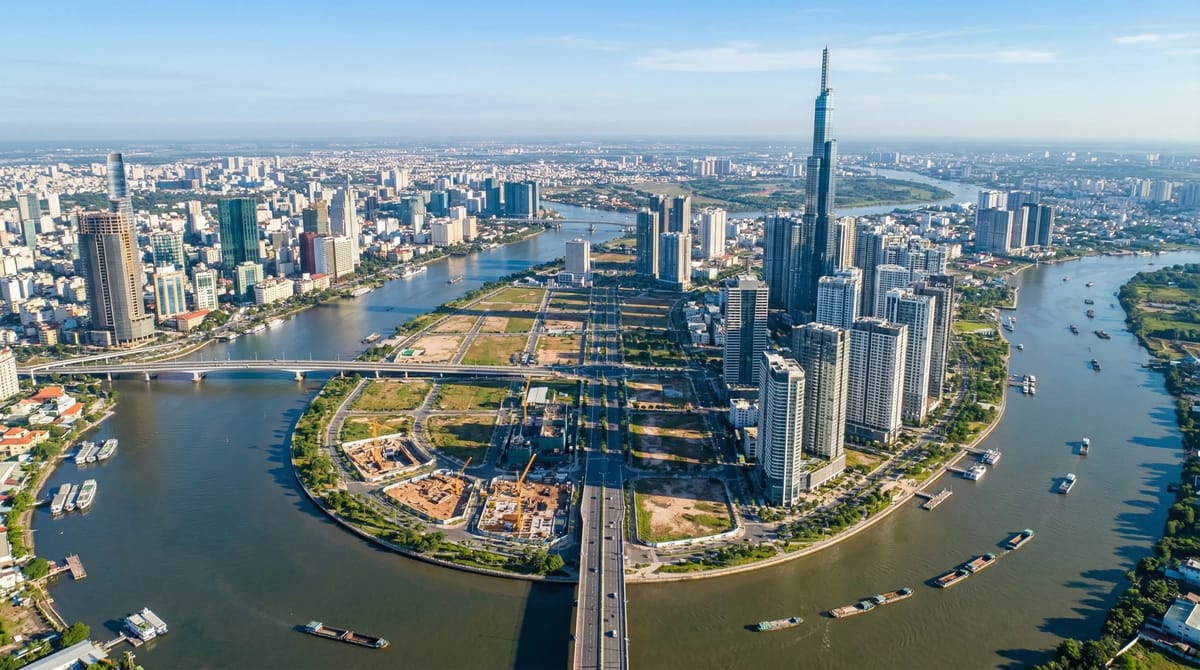
In February 2026, HCMC approved planning adjustments for the Thu Thiem New Urban Area, designating it as the site for the Vietnam International Financial Center and a new administrative center.
The most eye-catching proposal: a 99-story, 500-meter tower in Thu Thiem's core zone.
If built, it would surpass Landmark 81 as Vietnam's tallest building.
The Financial Center's Flagship Tower
The tower is the planned centerpiece of the Vietnam International Financial Center (VIFC).
In late 2025, Prime Minister Pham Minh Chinh announced the creation of VIFC. It was formally inaugurated in February 2026. Vietnam is using a "one center, two hubs" model: HCMC handles large-scale financial services, while Da Nang focuses on fintech and green finance.
Beyond the 99-story main tower, Thu Thiem's core zone also includes plans for more than a dozen skyscrapers. The financial center's footprint spans from the old city center across to Thu Thiem.
Where the Money Comes From
The initial investment estimate for the entire financial center is around USD 7 billion. Since its launch, officials say they have secured nearly USD 10 billion in investment commitments, with a goal of attracting 50 international financial institutions within three years.
Binance was one of the earlier international companies to signal participation, signing a cooperation memorandum with HCMC in late 2025.
The master plan has been approved, but the 99-story tower's detailed planning is still in process. The developer has not been announced.
Thu Thiem's Past
Anyone familiar with Vietnamese real estate will have mixed feelings when they hear "Thu Thiem."
This tract of land on the opposite bank of the Saigon River has been earmarked as HCMC's new urban core since the 1990s. Thirty years later, large swaths remain empty.
The most infamous episode came in late 2021. Four "golden plots" in Thu Thiem went to auction. A subsidiary of Tan Hoang Minh Group won one parcel for roughly USD 1 billion.
The price stunned the market. Even the Minister of Finance publicly called it "unusual."
A month later, Tan Hoang Minh walked away, forfeiting its deposit. Another winning bidder also abandoned its plot. All four auctions effectively collapsed.
The scandal exposed a loophole in Vietnam's land auction system: bidders could submit sky-high bids to inflate surrounding land prices, then forfeit their deposits and walk away. Vietnam later revised the relevant regulations.
Thu Thiem's New Neighbors
Beyond the VIFC's 99-story tower, Thu Thiem has another high-profile project underway.
Trump Organization and Vietnamese developer KBC (Kinh Bac City Development) plan to build a 60-story Trump Tower in Thu Thiem, with an investment of approximately USD 1 billion. Construction could begin as early as 2026.
HCMC has also confirmed that a new political-administrative center and an international university will break ground in Thu Thiem in Q2 2026. The city says it will launch at least 25 major projects citywide in 2026, with Thu Thiem as a priority area.
If all these projects move forward, Thu Thiem's skyline will change visibly in the coming years. But "if" is a word that has appeared too many times in Thu Thiem's history.
Between Blueprint and Reality
Vietnam wanting its own financial center makes sense.
HCMC's economy accounts for more than 20% of Vietnam's GDP, but the city's financial infrastructure has long lagged behind. Vietnam's stock market was classified as a frontier market for years. FTSE announced in late 2025 that it would upgrade Vietnam to emerging market status, effective September 2026, but the MSCI reclassification has not yet come through.
VIFC offers attractive terms: investors who encounter obstacles can use a "special process" that escalates directly to the Prime Minister's office. Pham Minh Chinh has also instructed ministries to shift from "administrative management thinking" to "service facilitation thinking."
These commitments point in the right direction. But getting international capital to actually flow in requires regulatory transparency, judicial independence, and free capital movement — not just a very tall building.
The 99-story blueprint is drawn. Thu Thiem's sky is high enough. Now we see whether the ground can keep up.