Year of the Horse Retrospective: The Rise and Fall of Saigon''s Racetrack
2026 is the Year of the Horse. Saigon's Phu Tho Racetrack, once the largest in Asia, is being torn down for a park. A look back at its century of gambling, war, and fading glory.
2026 is the Year of the Fire Horse in the lunar calendar — it comes around once every sixty years.
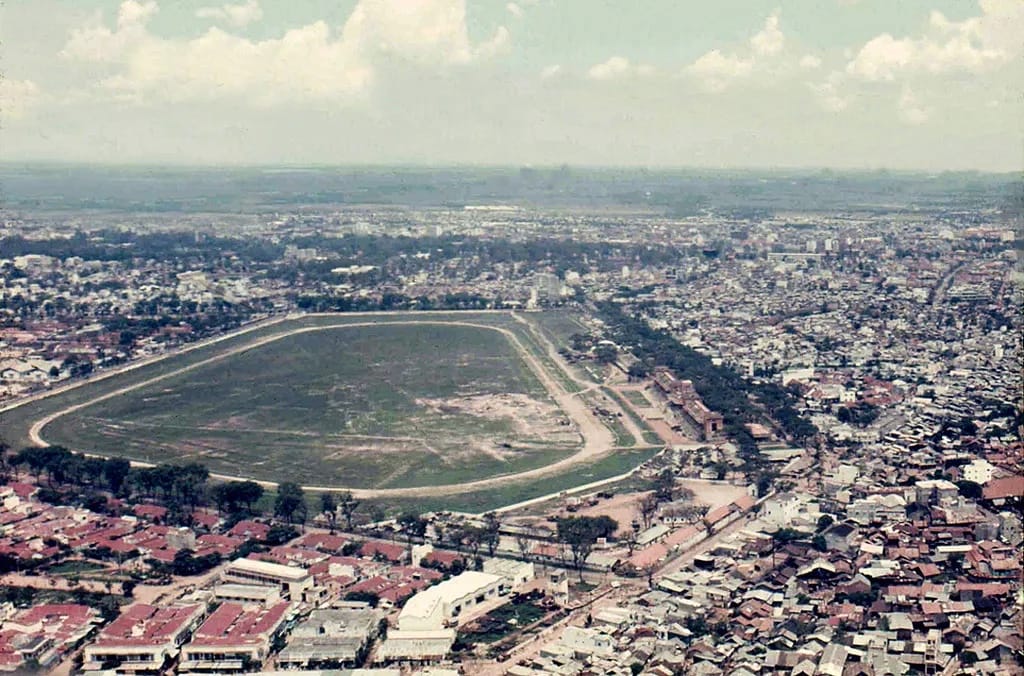
The Phu Tho Racetrack (Truong dua Phu Tho) in HCMC's District 11 broke ground last year on its conversion into a park and road network, with completion expected this year.
This nearly century-old racetrack went from a colonial-era gambling venue to a Vietnam War battlefield to a parking lot and karaoke parlor. In the spirit of the Horse Year, here is its story.
A Frenchman and eight Arabian horses
Saigon's ties to horse racing go back further than most people realize.
In 1864, French colonists organized the city's first horse race, near the intersection of what is now Cach Mang Thang Tam and Dien Bien Phu streets.
But the man who turned Saigon racing into a big business was Jean Duclos, a French merchant.
In 1906, Duclos brought eight Arabian horses from Hanoi to the Cholon area of Saigon and built the first proper racetrack.
Cholon was the Chinese merchant quarter — wealthy, and with a taste for gambling.
Duclos read the market perfectly. Within six months, he staged nearly two hundred races and made a fortune.
In 1912, the Saigon Hippique Club was officially established, and horse racing became an upper-class social event.
Asia's largest racetrack at 44 hectares
Business was booming, and the venue was too small.
In 1932, another French businessman named Monpezat spent one million Indochinese piastres to buy 44 hectares of open land in Phu Tho village (now District 11) and built a proper racetrack.
It took seven years to pay off the investment, but upon completion, Phu Tho was ranked among the largest racetracks in Asia, with course distances ranging from 800 to 3,000 meters.
Vietnamese writer Ho Bieu Chanh described the scene in a 1935 novel: cars and horse carriages jammed the entrance, both regular and VIP seats were packed, and nearly half the spectators were women.
At its peak, around 1,200 racehorses were in service around Saigon, with stallions and foals pushing the total above 4,000.
An entire underground economy grew around the track.
The French called professional gamblers "turfistes." Cantonese merchants in Cholon built their own intelligence networks. "Tuy-do" (information brokers) gathered intel on horse conditions and jockey movements, then sold tips to bettors.
Some merchants went straight to the source, paying off jockeys and owners to fix race results.
From racetrack to battlefield
The good times did not last.
During World War II, Japanese forces occupied French Indochina (1940-1945) and requisitioned the racetrack. Horses were confiscated.
Racing resumed after the war, but never regained its colonial-era grandeur.
During the 1968 Tet Offensive (Tet Mau Than), the racetrack became a literal battlefield.
Phu Tho sat at the junction of five major roads and was the only open space in central Saigon where helicopters could land.
The North Vietnamese side recognized this advantage.
At 3 AM on January 30, the 6th Binh Tan Battalion (200 soldiers and 100 porters) entered the city from the west. Guided by local contacts, they seized the racetrack.
American forces responded quickly, forming Task Force Gibler and deploying M113 armored personnel carriers to counterattack.
Fighting continued until February 11. The Cholon area was declared a free-fire zone, with air and artillery strikes unleashed.
The grandstands that once held crowds of gamblers were reduced to rubble.
After reunification in 1975, the new government banned all gambling and the racetrack went silent.
A 32-kilogram jockey and a Honda 67
In 1989, under Vietnam's Doi Moi reforms, horse racing quietly returned as a "sport."
The Phu Tho Racetrack was renamed the Phu Tho Sports Club. Races were held every weekend, drawing two to three thousand spectators.
In 2003, Vietnamese-Australian businessman Nguyen Ngoc My's company Thien Ma (Celestial Horse) took over operations and invested in facility upgrades.
At the time, about 900 horses competed at the venue, ridden by over 40 jockeys.
Most of these jockeys were teenagers.
Huynh Van Ton entered the trade in 1969 weighing just 32 kilograms.
Winning a race earned VND 60,000. In those days, a Honda 67 motorcycle cost only VND 29,000.
Win two races and you could ride a motorbike home.
Before mounting up, jockeys had a special ritual: they had to go to a temple and swear an oath not to throw races or cheat.
This tradition dated back to the colonial era and continued until the racetrack closed.
But child labor was always a lurking issue.
In 2009, HCMC's government invoked the Child Protection Law to ban underage jockeys.
Without young, lightweight riders, race quality suffered badly.
The last horse leaves in the Year of the Horse
On May 31, 2011, HCMC's People's Committee officially terminated Phu Tho Racetrack's operating contract.
The reasons: poor management and uncontrollable gambling.
The last horse left the track, ending nearly a century of horse racing in Saigon.
For the next decade-plus, this 360,000-square-meter patch of prime real estate became a parking lot, restaurant cluster, karaoke venue, and mini football field.
In 2025, District 11 formally began redevelopment, investing VND 200 billion (about USD 7.7 million) to build five roads through the site.
In November, a 6.45-hectare park also broke ground, along with a high school and sports training facilities, all expected to be completed this year.
In the Year of the Fire Horse, the last racetrack site in Saigon is about to become a park.
The old jockeys sum up those days in four words: "mot thoi lung lay" — a brief blaze of glory.