From Rubber Plantation to International Gateway: The Ambitions and Risks Behind Vietnam's Largest Infrastructure Project
Vietnam's Long Thanh International Airport, the country's largest infrastructure project at $18.7B, aims to become Southeast Asia's biggest aviation hub—but inadequate transport links could be its critical weakness.
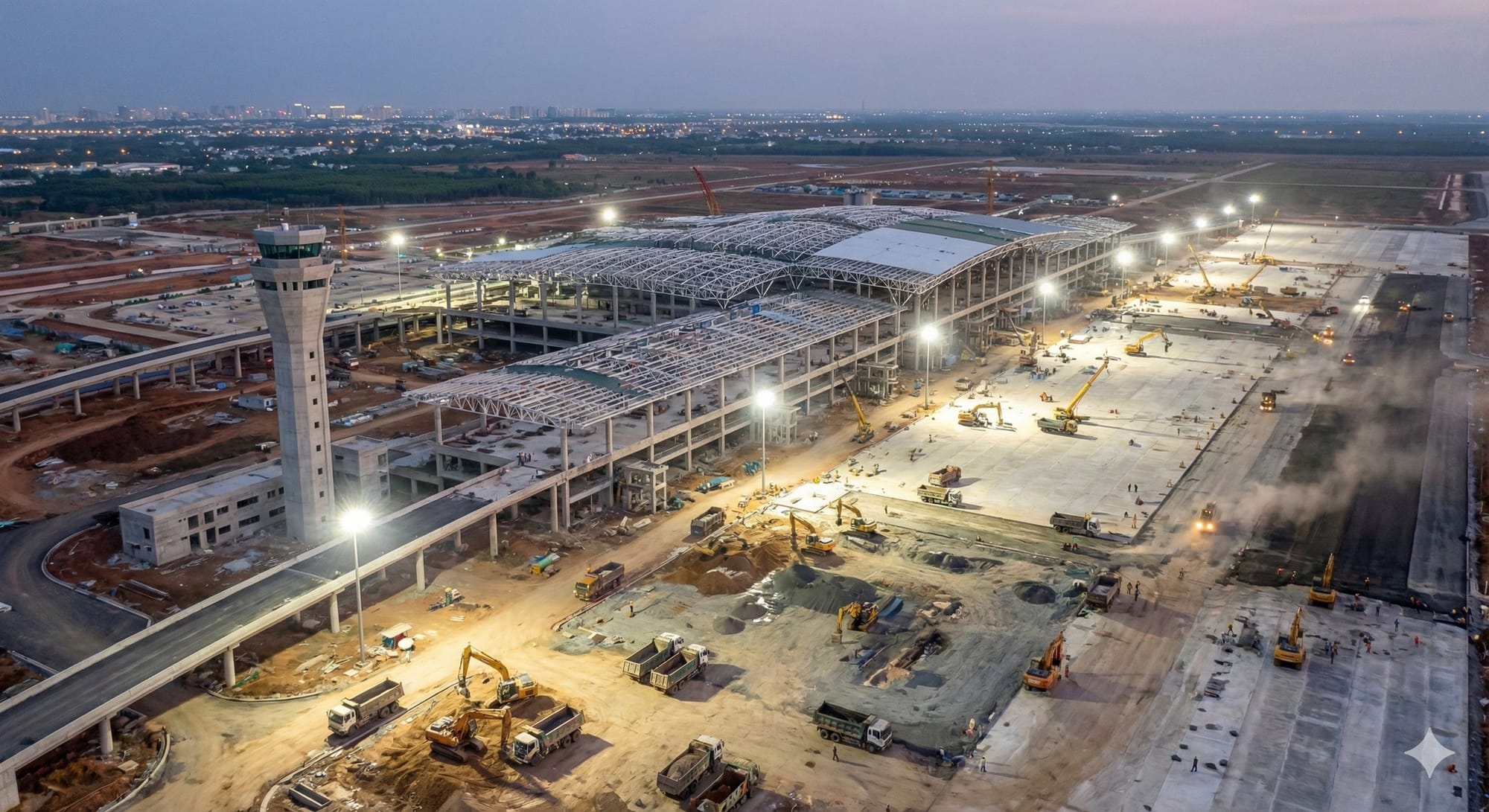
Forty kilometers east of TP. Ho Chi Minh, on land once covered with rubber trees, 14,000 workers are pulling round-the-clock shifts.
This is the construction site of Long Thanh International Airport — Vietnam's most expensive infrastructure project ever, with a total investment of USD 18.7 billion.
A national mission that cannot wait
During this year's four-day Independence Day holiday, while the rest of the country celebrated Vietnam's 80th anniversary, engineers and workers at the site kept going 24 hours a day. Prime Minister Pham Minh Chinh has visited the site eight times and issued a firm directive: the airport must receive its first flight on December 19, 2025 — a full year ahead of the schedule originally approved by the National Assembly.
The urgency is understandable.
Since receiving approval in 2015, the project has been plagued by land acquisition disputes, resettlement delays, funding shortfalls, and the disruption of COVID-19. Workers are now required to press on "rain or shine," rotating in three shifts across four teams, with no weekends off.
The ambition: Southeast Asia's new aviation hub
Long Thanh's vision goes beyond a single airport — it aims to reshape regional aviation.
Phase one will deliver capacity for 25 million passengers and 1.2 million tonnes of cargo per year.
That is just the start. Once all three phases are complete, the design capacity will reach 100 million passengers and 5 million tonnes of cargo annually, making it one of Southeast Asia's largest aviation hubs.
Airports Corporation of Vietnam (ACV) estimates that at full operation the airport will contribute 3–5% of national GDP and generate an "airport economy" with tens of thousands of jobs. Dong Nai provincial authorities are already planning a green free-trade zone spanning more than 8,200 hectares, linking the airport to four industrial parks.
The worry: what happens after it is built?
The biggest challenge may not be the airport itself but getting there.
When Long Thanh opens, TP. Ho Chi Minh will join Bangkok, Jakarta, Kuala Lumpur, and Singapore as a "dual-airport city." But unlike those cities, the transport links between Long Thanh and the urban core are still woefully inadequate.
The airport sits at the junction of the Long Thanh–Dau Giay and Bien Hoa–Vung Tau expressways, but the high-speed rail connection that could unlock the airport's logistics potential is still looking for investors.
Some analysts warn that airport rail links may be another decade away, and several feeder roads remain unfinished.
That raises a critical question: which flights should be moved from Tan Son Nhat to Long Thanh? For travelers and tourists accustomed to the convenience of a city-center airport, will an extra hour's drive to a new facility with limited ground transport really be attractive?
Whether Long Thanh International Airport opens on schedule, successfully evolves into a regional hub, or becomes a grand facility that is "useful but underused" — the answer may lie not within the airport's perimeter but along the roads and rail lines that have yet to be built.
It is a high-stakes race against time, and Vietnam has gone all in.