Fuel Price Surge Gives HCMC Metro an Unexpected Boost — Ridership Jumps Nearly 25%
As fuel prices surged, HCMC Metro Line 1 ridership jumped nearly 25% in one week, from 52,000 to nearly 60,000 daily passengers.
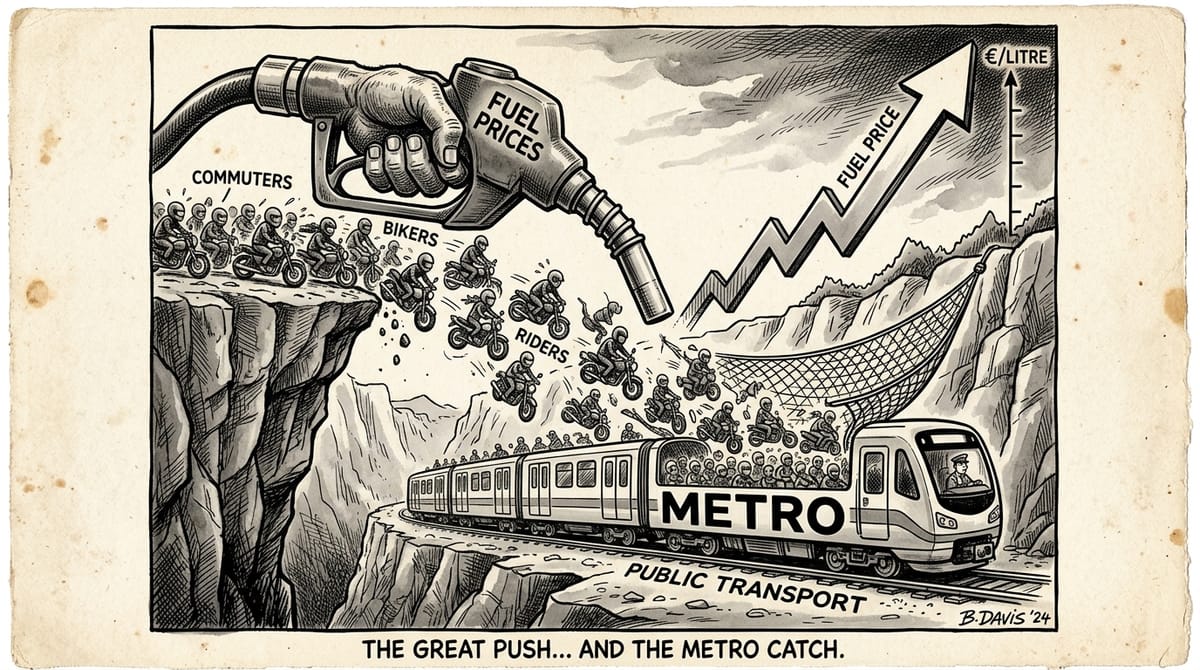
Middle East tensions sent oil prices soaring, and Vietnam's gasoline prices shot up 27% in two weeks. One of the biggest winners? Ho Chi Minh City's Metro Line 1, which only opened in late 2024.
Between March 9 and 12, daily ridership jumped 24.7% compared to the week before fuel prices started climbing (March 2–5). Average daily passengers rose from around 52,000 to nearly 60,000.
Why Vietnam Is So Sensitive to Fuel Prices
To understand why the reaction was so sharp, look at Vietnam's transport structure.
The country has over 80 million registered motorbikes — one of the highest motorcycle densities in the world. Nine out of ten personal vehicles are motorbikes. The reason is simple: before Metro Line 1 opened in late 2024, HCMC had virtually no rail transit. Hanoi had just two light rail lines. Public transport was chronically underdeveloped, and motorbikes were the only commuting option for most people.
That means every fuel price hike hits not just a small group of car owners, but nearly every commuter in the country.
According to the General Statistics Office, the average Vietnamese worker earned 8.4 million VND per month in 2025. In urban areas, the figure was about 10.1 million VND. HCMC's minimum wage stands at 5.31 million VND. A typical motorbike commuter burns through 15 to 20 liters of gasoline per month. With RON95 rising from 20,151 to 25,575 VND per liter, that adds nearly 100,000 VND to monthly fuel costs. For minimum-wage workers, fuel alone now eats up close to 10% of their paycheck — before factoring in rising food and daily goods prices driven by higher logistics costs.
How Much Did Fuel Prices Rise?
In late February, the military conflict between the US, Israel and Iran escalated sharply. Oil shipments through the Strait of Hormuz — a route carrying roughly 20% of global oil production — were disrupted. Brent crude surged to nearly $102 per barrel, while WTI hit $96.
Vietnam has adjusted fuel prices six times since March 5 (five increases, one cut). RON95-III gasoline climbed from 20,151 VND per liter all the way to 29,120 VND on March 10, a 44% peak increase. After a sharp 4,000 VND cut on March 11, prices ticked up 335 VND on March 12 and now sit at 25,575 VND — still 27% above pre-crisis levels.
Diesel rose even more, from 19,279 to 27,025 VND per liter — a 40% increase on paper. But these are subsidized prices. The government is currently tapping its fuel price stabilization fund to the tune of 4,000 VND per liter for gasoline and 5,000 VND for diesel. Without the subsidy, RON95-III would cost 29,575 VND and diesel 32,025 VND — 47% and 66% above pre-crisis levels, respectively.
For motorbike commuters, the math is straightforward. Filling up used to cost under 100,000 VND. Now it's closer to 130,000. And it's not just transport — food and daily goods prices have risen 10–15% as logistics costs climb across the board.
Not Just Metro — Bus Fares Are Rising Too
The ripple effects spread quickly across the entire transport market.
Fifteen bus operators in HCMC have raised fares on 102 routes, with increases ranging from 5% to 36%. Viet Tan Phat hiked prices on 33 routes by 21–30%. Toan Thang raised fares on 20 routes by up to 36%. About 1,700 taxis followed suit, with Vinasun increasing fares by 11–12%.
There are exceptions. Phuong Trang (FUTA Buslines), Vietnam's largest long-distance bus operator, has held prices steady. Ride-hailing platforms Grab and Be haven't moved either.
Electric Vehicles Seize the Moment
While everyone else was raising prices, Vingroup went the other way.
Starting March 11, its electric ride-hailing platform Xanh SM cut fares by 10% through the end of the month. The company also launched a "swap gas for electric" trade-in program: customers trading in old gas vehicles for VinFast EVs get an extra 3% discount on cars and 5% on motorbikes.
The timing was sharp. When running a gas vehicle suddenly costs much more, the economic case for going electric makes itself.
Same Story in Hanoi
It's not just HCMC. Hanoi's public transit also saw clear growth.
The Cat Linh – Ha Dong line saw ridership rise 4.9% between March 6 and 9. The Nhon – Hanoi Station line grew even faster, up 13.2%. Subsidized bus ticket sales jumped 15% from pre-adjustment levels, topping 104,000 rides per day.
How Residents Are Adapting
HCMC residents are adjusting fast.
Some commuters have done the math: taking the metro costs about 44,000 VND per day, cheaper than riding a motorbike. Current metro promotions make it even more attractive — the Vikki card offers fully free rides, and VPBank cardholders get e-vouchers.
Some companies have shifted roughly half their staff to remote work. Residents are consolidating errands into single trips or walking for nearby tasks.
HCMC now operates 66 eco-friendly bus routes, including 50 electric and 16 CNG-powered buses — 48% of the city's bus network. The city government has also rolled out a "Cashless Friday" program, waiving fares for up to four bus rides per day when paying with digital wallets.
An Unexpected Stress Test
For HCMC's metro, this fuel price spike amounts to an unplanned stress test.
Since opening in December 2024, Line 1 had settled into a steady rhythm of around 52,000 daily passengers. The moment fuel prices surged, that number jumped to 60,000 — proof that latent demand was always there, just waiting for a push.
But there's a catch. Metro fares are still set at promotional rates established in late 2024. If oil prices eventually retreat, some riders may drift back to their motorbikes. Whether the metro can hold onto these new passengers is the real test.