Vietnam's Đi Bão Explained: The Street Celebration That Baffles Foreigners
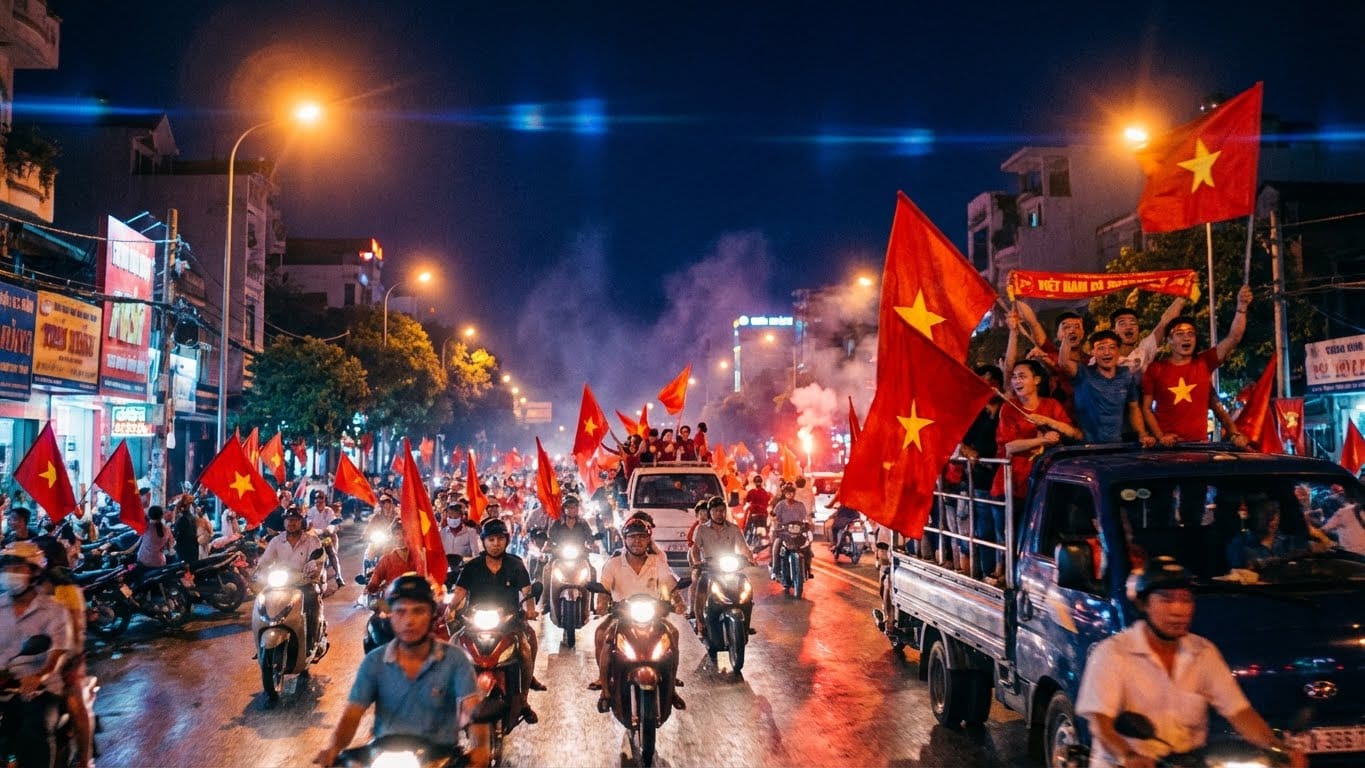
On the evening of December 18, Vietnam's U-22 squad came from behind to beat Thailand 3–2 in Bangkok, clinching the SEA Games men's football gold. Minutes later, tens of thousands poured onto the streets of Ha Noi and TP. Ho Chi Minh. Motorbikes and cars took over main roads, national flags flew, pots and pans clanged, and chants of "Viet Nam vo dich!" (Vietnam is the champion!) shook the night.
This is "di bao" — a tradition unique to Vietnam.
What is di bao?
Di bao (pronounced roughly "dee bow") literally means "riding into the storm." In practice it is a spontaneous street celebration. When the national team wins a major match, fans flood the streets on motorbikes, in cars, and even standing on truck beds, waving flags, banging pots, blasting patriotic songs through megaphones, and converging on the city center.
Nobody organizes it. Nobody calls for it. Yet within ten minutes an entire city turns into a sea of red.
Where did it start?
At the 1995 SEA Games, Vietnam beat Malaysia on home turf and fans spontaneously took to the streets. As the team advanced to the final, the crowds grew. Vietnam finished runners-up, and tens of thousands mobbed the airport to welcome the players home.
Former national team player Tran Cong Minh recalled: "We had never seen anything like it — we were shocked and moved."
Since then, di bao has been inseparable from Vietnamese football.
Why do foreigners stare in disbelief?
For a foreigner experiencing di bao for the first time, the scene is almost surreal.
Within ten minutes of the final whistle, quiet streets are swallowed by a flood of vehicles. Three or four people on a single motorbike is standard. Some stand on truck beds waving enormous flags; others haul speakers into the road at full volume. Red lights? Merely suggestions. Traffic rules? Temporarily suspended. The city flips an invisible switch and goes full party mode.
What shocks foreigners most is the age range — this is not just a young-people thing. Grandparents clap on the sidewalk, office workers charge out still in dress shirts, kids ride on their fathers' shoulders waving flags. Some wear pajamas, some bang woks, some bring the family dog along for the "parade."
More than a football match
Vietnamese love football, but they love the red flag with its gold star even more.
Apart from National Day and Reunification Day, a football victory is virtually the only event that puts the entire nation on the street. When 11 players pull on the national jersey, they carry the hopes of 100 million people.
So di bao is never just about celebrating a goal — it is a collective declaration: "We won." The noise, the flags, the shared euphoria — for one night, even foreigners get a taste of what it feels like to be Vietnamese.
If you happen to be in Vietnam next time it erupts, do not panic — this is simply how the Vietnamese celebrate victory. Find a safe spot to watch the street carnival, or join in.