Meituan Enters Vietnam. Baemin's Cautionary Tale.
Meituan brings USD 27 billion in cash to Vietnam, but two foreign giants already failed here. Baemin burned USD 160M in four and a half years. Gojek pulled out the following year.
In February 2026, China's food delivery giant Meituan began hiring business development staff in Ho Chi Minh City, offering salaries of VND 20 to 30 million per month. The company registered in Vietnam in late 2025 under the name "Cong ty TNHH Cong nghe Meituan."
Meituan sits on USD 27 billion in cash. Its brand KeeTa grabbed 32% market share in Hong Kong within 12 months of launch. It looks formidable.
But Vietnam's food delivery market has already buried more than one foreign giant. The most recent departure was Korea's Baemin.
Korea's No. 1 Food Delivery App Goes to Vietnam
Baemin's full name is Baedal Minjok, meaning "Delivery Nation." The app ranked first in South Korea, run by Seoul-based Woowa Brothers.
In May 2019, Woowa Brothers acquired Vietnamese food delivery platform Vietnammm.com, gaining an existing merchant network and user base. Vietnammm had earlier absorbed Rocket Internet's Foodpanda Vietnam business, making it a seasoned local player. In June, Baemin officially launched in HCMC.
That December, German food delivery giant Delivery Hero signed a deal to acquire Woowa Brothers for USD 4 billion. The deal closed in March 2021, with the final price ballooning to USD 6.2 billion.
Baemin entered Vietnam as a Korean startup. It left as a subsidiary of a German public company.
A Fat Cat Conquers HCMC
Baemin's biggest success in Vietnam was marketing.
They designed a local mascot called "Meo Map" (Fat Cat), a round yellow cartoon cat. The entire app, ads, and social media content revolved around it. Brand recognition was sky-high.
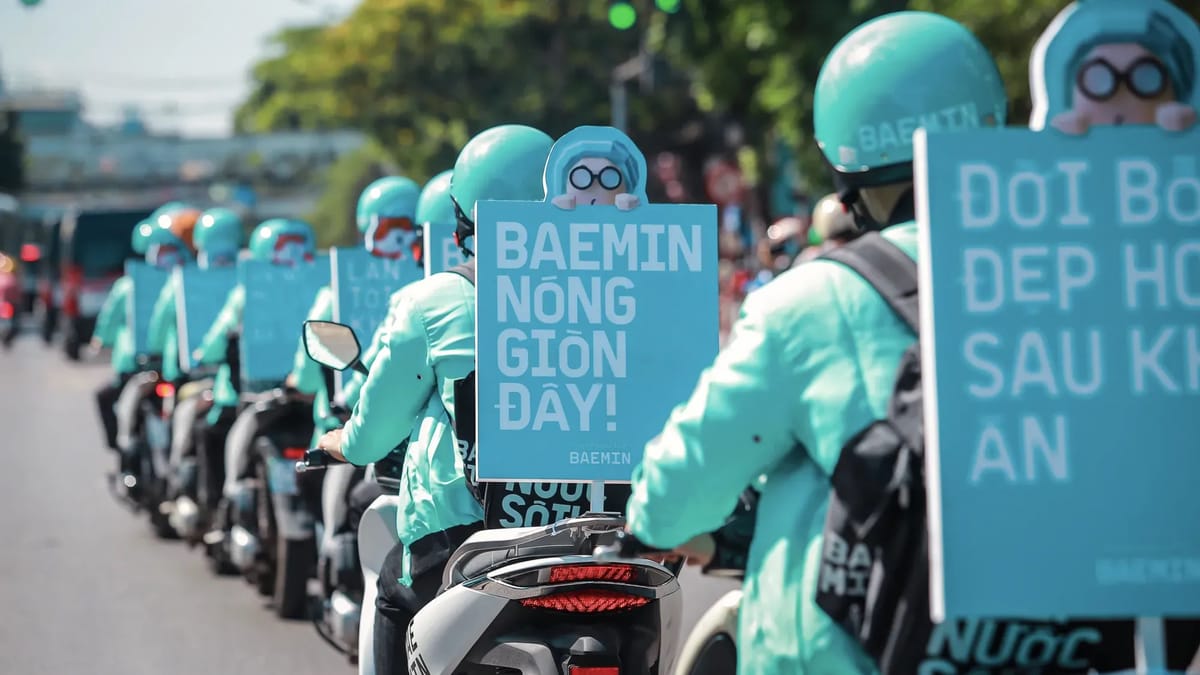
Outdoor advertising was Baemin's killer move. They placed customized billboards across HCMC districts, each featuring rhyming slogans with local district names. "Tan Binh nha anh do, dat la co anh giao" (I'm right here in Tan Binh, order and I'll deliver). "Quan 1 nay anh nam, gan lam de anh giao" (District 1 is my turf, so close I'll bring it right over). This district-by-district approach felt personal and quickly went viral.
In 2020, Baemin partnered with Vietnamese celebrity Tran Thanh for a campaign called "Quan ngon quan minh" (Best restaurants in our district), generating over 11,000 social media discussions. Buzzmetrics ranked it the seventh-best social marketing campaign in Vietnam that year.
That year, Baemin's revenue grew 484%. The app ranked second in the App Store's food delivery category, and Google Play downloads topped one million.
Won Hearts, Lost Money
The marketing numbers looked great. The financial statements told a different story.
In 2019, Baemin Vietnam lost USD 13.2 million. By 2021, losses ballooned to USD 98.3 million. Over three years, cumulative losses exceeded VND 4 trillion, roughly USD 160 million.
Where did the money go? Mostly subsidies.
Baemin threw massive discount coupons at users: first-order deals, spend-more-save-more offers, stackable promotions. Growth curves looked good. The problem was that surveys showed 90% of users chose delivery platforms based primarily on discount strength. Cut the discounts, lose the users.
A Baemin executive once admitted: "If users only use your app because of promotions, they'll leave the moment promotions stop."
There was a more fundamental issue: Vietnam's delivery unit economics. A meal costing VND 30,000 to 40,000 to eat in becomes VND 60,000 to 70,000 after platform fees and delivery charges. Prices nearly double, pushing many consumers to just eat out instead.
A Single App Can't Beat a Super App
Baemin only did food delivery and grocery runs in Vietnam, with some extension into desserts and drinks. Its competitors had already turned themselves into super apps.
Grab offered ride-hailing, motorbikes, delivery, payments, and hotel bookings. Users might open it three or four times a day. ShopeeFood was backed by Southeast Asia's e-commerce leader Shopee. Users finishing an online purchase could order food with nearly zero switching cost.
2022 data showed Grab held 45% of Vietnam's food delivery market, ShopeeFood held 41%. Together, 86%. Baemin had 12%.
The ecosystem gap meant Grab and ShopeeFood could subsidize delivery losses with profits from other business lines and fight a war of attrition. Baemin had one business line. Every order had to carry its own weight.
COVID Gave and Took
In the early days of COVID-19, delivery demand surged and Baemin briefly benefited. But as the pandemic dragged on, the backlash set in.
In July 2021, HCMC issued Directive 16, imposing strict lockdowns. All delivery platforms suspended operations for 15 days. Restaurants shuttered. Many small merchants questioned whether paying 25 to 30% platform commissions was worth it when business was this bad.
After the pandemic, consumer behavior shifted. People who had endured months of lockdown wanted to eat out again. Delivery demand growth began to slow.
Exit
By 2023, the global tech funding environment was nothing like 2019. Investors no longer tolerated the "burn cash now, figure out profits later" model. Every market needed a path to profitability.
Delivery Hero operated in over 70 markets globally. Vietnam was a small share of the portfolio, but losses kept growing with no turnaround in sight. The Grab-ShopeeFood duopoly had solidified. Baemin was stuck in third place, unable to climb and unable to break even.
In September 2023, Baemin notified employees it was scaling down. On December 8, it officially shut down its Vietnam operations.
Vietnamese social media mourned, but mostly for the Fat Cat and the clever ads. For actual food orders, everyone was already using Grab.
Not Just Baemin
Baemin was not the only foreign platform to fail in Vietnam.
Indonesia's Gojek entered Vietnam in 2018 under the "GoViet" brand, offering ride-hailing and delivery. In September 2024, Gojek also pulled out. At the time of exit, Gojek's ride-hailing market share in Vietnam was just 7%, and its delivery business accounted for less than 1% of parent company GoTo's global transaction volume.
After two foreign platforms left in succession, Vietnam's delivery market returned to a Grab-ShopeeFood duopoly. Local players beFood and Loship tried to fill the gap, but remained small.
Meituan's Playbook
Back to Meituan. It registered a company in HCMC's An Khanh ward in late 2025 and started posting jobs on TopCV in early 2026, looking for staff to develop restaurant, hotel, and entertainment merchant partnerships. Its initial strategy targets Chinese tourists (about 5.3 million per year), leveraging their familiarity with the Meituan app.
Meituan holds a few cards Baemin never had. USD 27 billion in cash reserves gives it staying power. Operating experience from holding roughly 70% of China's domestic delivery market means it has fought and won real wars. And it may not go head-to-head with Grab right away, instead carving out a niche with Chinese visitors first.
But Baemin's lesson is clear. Vietnam's delivery market reality: Grab and ShopeeFood hold about 90% combined, platforms take 25 to 30% commission, consumers are extremely price-sensitive, and super app ecosystem advantages are nearly impossible to replicate.
Baemin spent four and a half years and USD 160 million proving one thing: in Vietnam, deep pockets determine how long you survive, but not whether you get to stay.
Meituan has clearly read this story. The question is whether it can write a different ending.